Space Telescope Imaging Spectrograph Instrument Handbook for Cycle 14
 |
 |
 |
 |
 |
|
| Space Telescope Imaging Spectrograph Instrument Handbook for Cycle 14 | |||||
| ||||||
5.1 Imaging Overview
STIS can be used to obtain images in undispersed light in the optical and ultraviolet. When STIS is used in imaging mode, the appropriate clear or filtered aperture on the slit wheel is rotated into position, and a mirror on the Mode-Selection Mechanism is moved into position (see Figure 3.1).
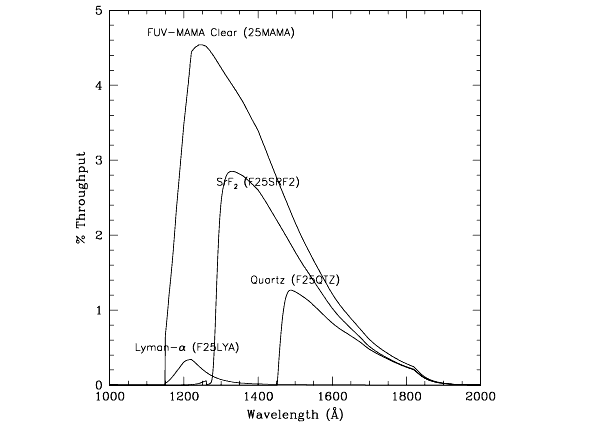
Table 5.1 provides a complete summary of the clear and filtered apertures available for imaging with each detector. In Figure 5.6 through Figure 5.9 we show the integrated system throughputs.
Table 5.1: STIS Imaging Capabilitiesc in Å)
50CCDClear STIS/CCDF28X50LPOptical longpass STIS/CCDF28X50OIII[O III] STIS/CCDF28X50OII[O II] STIS/CCD50CORONClear + coronagraphic fingers STIS/CCD25MAMAClear STIS/NUV-MAMASTIS/FUV-MAMAF25QTZUV near longpass STIS/NUV-MAMASTIS/FUV-MAMAF25SRF2UV far longpass STIS/NUV-MAMASTIS/FUV-MAMAF25MGIIMg II STIS/NUV-MAMAF25CN270Continuum near 2700 Å STIS/NUV-MAMAF25CIIIC III] STIS/NUV-MAMAF25CN182Continuum near 1800 Å STIS/NUV-MAMAF25LYALyman- STIS/FUV-MAMAF25NDQ14F25NDQ2F25NDQ3F25NDQ4ND=10-1 ND=10-2 ND=10-3 ND=10-4 STIS/NUV-MAMASTIS/FUV-MAMASTIS/CCD5F25ND3ND=10-3 STIS/NUV-MAMASTIS/FUV-MAMASTIS/CCD5F25ND5ND=10-5 STIS/NUV-MAMASTIS/FUV-MAMASTIs/CCD5
1See Section 14.2.1 for definition of pivot wavelength and FWHM.
2The CCD and MAMA plate scales differ by about 1% in the AXIS1 and AXIS2 directions, a factor that must be taken into account when trying to add together rotated images. Also, the FUV-MAMA uses a different mirror in the filtered and unfiltered modes. In the unfiltered mode, the plate scale is 0.3% larger (more arcsec/pixel). Information on geometric distortions can be found in Section 14.6.
3The dimensions are 28 arcsec onAXIS2=Yand 52 arcsec onAXIS=X. See Figure 3.2 and Figure 11.1.
4Information on theF25NDQaperture can be found on page 360.
5The neutral density filters can only be used as available-but-unsupported apertures with the CCD detector.
5.1.1 STIS versus ACS Imaging
The Advanced Camera for Surveys (ACS) was installed on HST during servicing mission SM3B in March of 2002, and has been performing very well since that time. Compared with STIS, ACS offers detectors with a much larger field of view, significantly higher throughputs at most wavelengths, a wider selection of filters, better suppression of point spread function (PSF) wings, and newer CCD detectors with far less accumulated radiation damage. Observers will therefore find that, especially at optical wavelengths, most imaging programs are better and more efficiently done with ACS than with STIS. There will, however, still be some cases where imaging with STIS is a better choice. The following points should be considered when choosing between STIS with ACS imaging:
- STIS does have a few filters that offer capabilities not duplicated by ACS. These include the narrow band STIS CCD
F28X50OIIfilter, and the STIS NUV-MAMAF25MGIIandF25CIIIfilters. The NUV-MAMA intermediate bandF25CN182andF25CN270filters may also prove useful for some programs.- For very deep optical imaging, ACS WFC imaging with
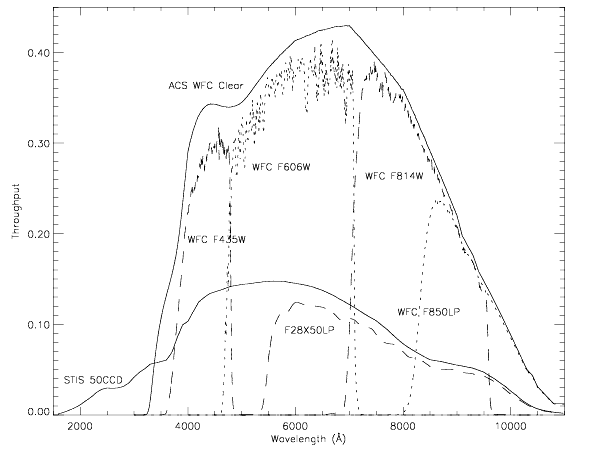
F606WorF814Wwill usually be a better choice than the STIS50CCDorF28X50LPconfigurations (seeFigure 5.1).- For many programs the ACS HRC with the
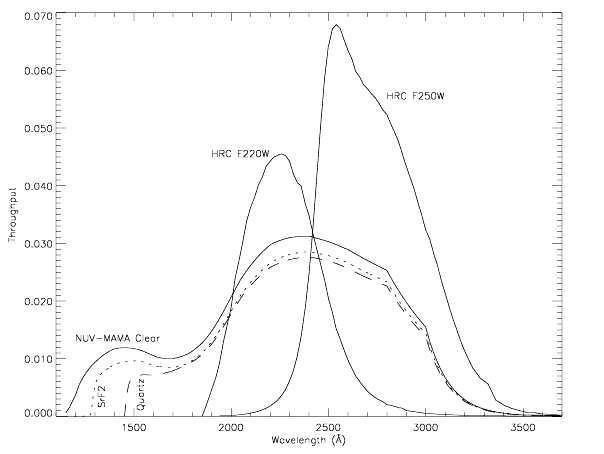
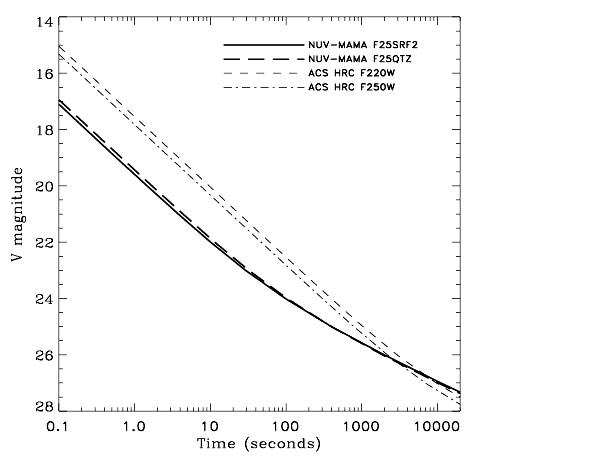
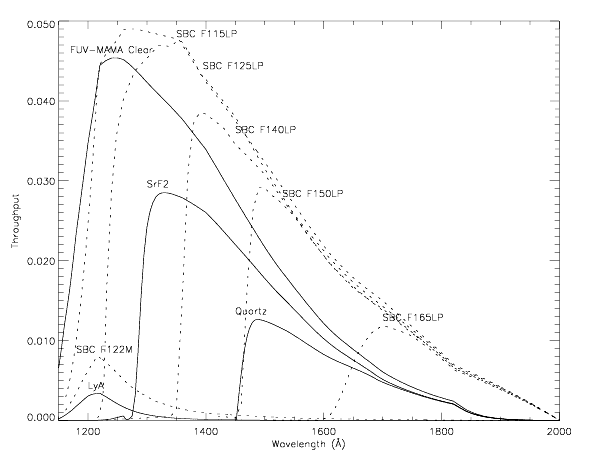
F220WorF250Wfilter should be considered as an alternative to broadband imaging with the STIS NUV-MAMA (see Figure 5.2 and Figure 5.3). The NUV MAMA has no read noise, a very low red sensitivity (so that filter redleaks have very little impact), and a lower dark current (the MAMA's dark current advantage over the HRC should increase as the HRC CCD ages), while the HRC has a higher peak sensitivity and, unlike the NUV-MAMA detector, is not subject to bright object constraints. The NUV-MAMA does have a slightly smaller pixel size than the HRC, but the much cleaner PSF of the HRC will often offset this advantage when attempting to detect faint sources near bright objects. Furthermore, there is a significant focus change with position across the STIS NUV-MAMA (see Section 5.1.3). The final choice between the NUV-MAMA and the ACS HRC will depend on the details of each program's science requirements.- The choice between the STIS FUV-MAMA and ACS SBC for far-ultraviolet imaging also largely depends on the details of the science requirements. ACS offers a larger variety of filters and better throughput at most wavelengths (see Figure 5.4 and Figure 5.5). On the other hand, the STIS FUV-MAMA has better sampling of the PSF, thus providing higher spatial resolution. The STIS FUV-MAMA generally has a lower dark current (see Section 7.4.2).
- The STIS CCD coronagraphic aperture contains two occulting wedges and an occulting bar and is especially useful for detecting faint material surrounding a bright source. The wedges provide a wider choice of occulter sizes than do the ACS coronagraphic spots, and in some cases this may provide a better match for a particular target. See Section 12.10.
- The STIS MAMA detectors enable very high time resolution (
~125 microseconds) imaging in the ultraviolet, by means of
TIME-TAGmode.The ACS Instrument Handbook for Cycle 14 provides additional comparisons between the capabilities of STIS and ACS. Ultimately, observers should use the exposure time calculators for STIS and ACS to decide which of the two instruments is better suited for their science.
Figure 5.1: The total system throughputs of the STIS50CCDandF28X50LPconfigurations are compared to the throughputs of several broad band ACS WFC filters.
Figure 5.2: The throughput of the NUV-MAMA with the25MAMA,F25QTZ, andF25SRF2apertures is compared with that of the ACS HRCF220WandF250W.
Figure 5.3: Exposure time required to reach S/N=10 versus the target V magnitude, for various STIS NUV-MAMA and ACS HRC filtered configurations, assuming a B1 V target spectrum. The relative sensitivities of the various configurations will depend strongly on the shape of the target object's spectrum
.
Figure 5.4: The throughputs of STIS FUV-MAMA configurations (solid lines) are compared with the filtered ACS SBC detector throughputs (dotted lines).
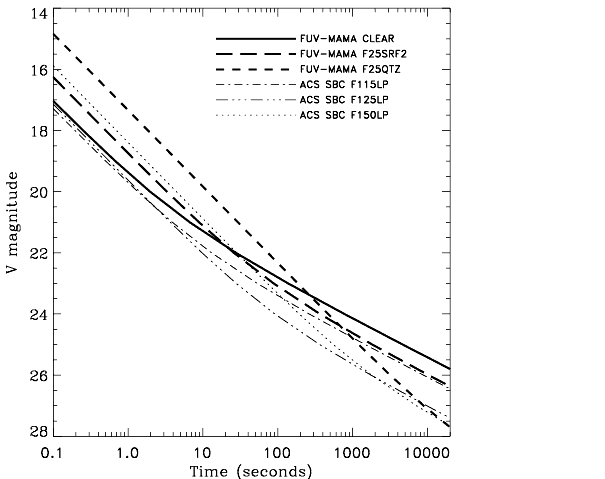
Figure 5.5: Exposure time required to reach S/N=10 versus the target's V magnitude, for various STIS FUV-MAMA and ACS SBC filtered configurations, assuming a B1 V target spectrum. The relative sensitivities of the various configurations will depend very strongly on the shape of the target object's spectrum.
5.1.2 STIS vs. WFPC2 Imaging
While ACS has clear advantages over either STIS or WFPC2 for most prime GO imaging science, the great success of ACS also means that there will be ample opportunities for parallel observing with the other HST instruments. It is therefore still useful to compare the imaging capabilities of STIS and WPFC2.
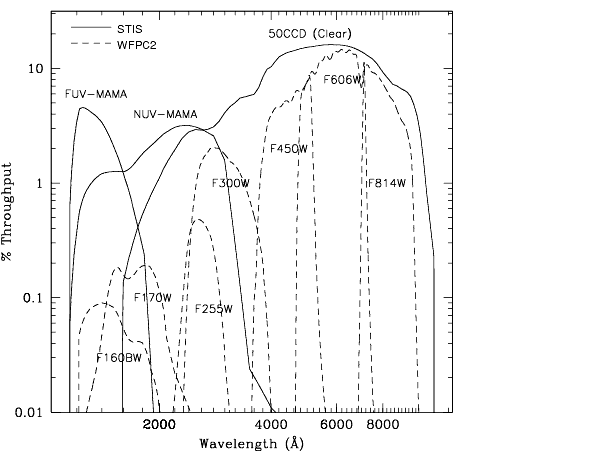
Figure 5.6: STIS's Clear Imaging Throughputs Versus WFPC2
- The STIS CCD detector, although it covers a much smaller field of view (52 x 52 arcsec) than WFPC2, has higher throughput over a much wider range of the spectrum (2000-11,000 Å). The STIS CCD also has a low read noise and dark current; thus STIS CCD observations with the clear
50CCDaperture have significantly higher sensitivity to faint sources than WFPC2 (see Figure 5.6). The CCD long-pass imaging filter,F28X50LP, has similar sensitivity longward of 5500 Å. The STIS CCD also has a low read noise and dark current; thus STIS CCD observations with the clear or long-pass apertures are extremely sensitive to faint sources (see Figure 5.6). The STIS CCD clear imaging mode is especially useful when no color information is needed, for example, for finding faint variable sources, or imaging the faintest possible sources in a given integration time.- The wings of the point-spread function in the STIS CCD imaging modes are suppressed by an internal Lyot stop. This feature provides a significant advantage for detecting faint sources near much brighter sources.
- The STIS FUV-MAMA detector enables true solar-blind imaging with high throughput from 1150 to 1700 Å with a considerably higher throughput than WFPC2. The NUV-MAMA is also relatively insensitive to red light and has also high relative throughput. Both provide near-critical sampling of the PSF (0.024 arcsecond per pixel).
- Remember that, because of the need to screen all MAMA observations for the presence of bright objects, the STIS MAMA detectors cannot be used for pure parallel observing, and can only be used for coordinated parallels when an exact orientation is specified.
- Charge Transfer Inefficiency (CTI) is larger for WFPC2 (
4%) compared to the STIS CCD (1%).
5.1.3 Caveats for STIS Imaging
There are several important points about imaging with STIS which should be kept in mind:
- The filters are housed in the slit wheel, and while they are displaced from the focal plane, they are not far out of focus. This location means that imperfections (e.g., scratches, pinholes, etc.) in the filters cause artifacts in the images. These features do not directly flat-field out because the projection of the focal plane on the detector shifts from image to image due to the nonrepeatability of the Mode Selection Mechanism's (MSM) placement of the mirror (careful post-processing may be able to account for registration errors).
- The quality of the low-order flat fields for the MAMA imaging modes limits the photometric accuracy obtained over the full field of view (see Section 16.1).
- The focus varies across the field of view for imaging modes, with the optical performance degrading by ~40% at the edges of the field of view for MAMA and by ~30% for the CCD (see Section 14.7).
- STIS CCD imaging slightly undersamples the intrinsic PSF. The use of dithering (See Section 11.3) to fully sample the intrinsic spatial resolution and to cope with flat-field variations and other detector nonuniformities may be useful for many programs.
- Two of the STIS narrow-band filters (
F28X50OIIIandF25MGII) have substantial red leaks (see Figure 5.11 and Figure 5.16, respectively).- The STIS CCD will have far more "hot" pixels and a much higher dark current than the newer ACS CCDs. Relative to WFPC2, a STIS CCD image will have a slightly larger proportion of the pixels affected by cosmic rays and "hot" dark current.
- Programs requiring high photometric precision at low count levels with the CCD should use
GAIN=1; programs at high count levels should useGAIN=4. AtGAIN=4the CCD exhibits a modest read-noise pattern that is correlated on scales of tens of pixels. (See Section 7.1.8.)- At wavelengths longward of ~9000 Å, internal scattering in the STIS CCD produces an extended PSF halo (see Section 7.3.4). Note that the ACS WFC CCDs have a front-side metallization that prevents a similar problem in that camera.
- The dark current in the MAMA detectors varies with time due to temperature fluctuations, and in the FUV- MAMA, it also varies strongly with position, although it is far lower overall than in the NUV-MAMA (see the discussion of Section 7.4.2).
- The repeller wire in the FUV-MAMA detector (see Section 7.3) leaves a 5-pixel-wide shadow that runs from approximately pixel 0,543 to 1024,563 in a slightly curved line. The exact position of the wire varies with the optical element used.
- The Charge Transfer Efficiency (CTE) of the STIS CCD is decreasing with time. The effects of the CTE decline are most serious for the lower rows of the detector and for faint sources with low background levels. For further details see Section 7.2.6.
These caveats are not intended to discourage observers from using STIS for imaging; indeed, for many imaging projects, particularly those not requiring a large field of view or the range of filters provided by WFPC2 and ACS, STIS may be the best choice.
5.1.4 Throughputs and Limiting Magnitudes
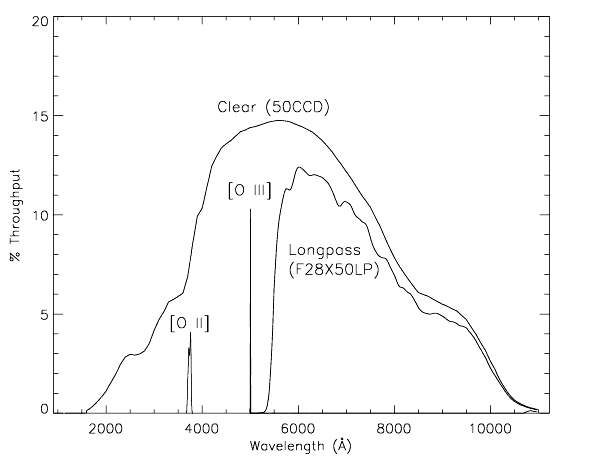
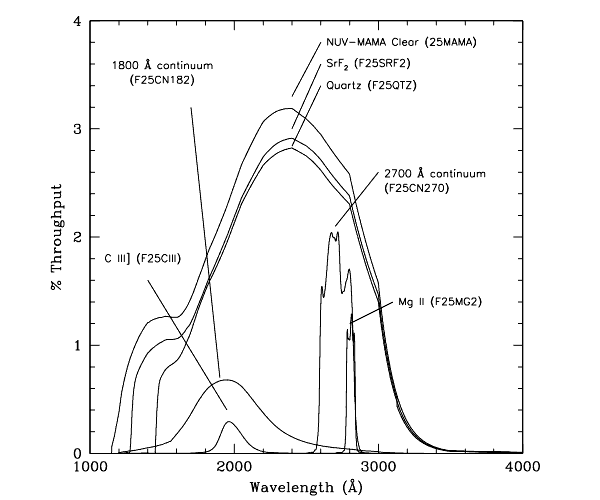
In Figure 5.6 above, we show the throughput (where the throughput is defined as the end-to-end effective area divided by the geometric area of a filled, unobstructed, 2.4 meter aperture) of the three STIS clear imaging modes, with the CCD, the NUV-MAMA, and the FUV-MAMA. Superposed on this plot, we show the broadband WFPC2 throughputs. In Figure 5.7, Figure 5.8, and Figure 5.9, we show the throughputs of the full set of available filters for the CCD, the NUV-MAMA, and the FUV-MAMA, respectively.
Figure 5.7: STIS CCD Clear and Filtered Imaging Mode Throughputs
Figure 5.8: STIS NUV-MAMA Clear and Filtered Imaging Mode Throughputs
Figure 5.9: STIS FUV-MAMA Clear and Filtered Imaging Mode Throughputs
Limiting Magnitudes
In Table 5.2 below, we give the A0 V star V magnitude reached during a one-hour integration which produces a signal-to-noise ratio of 10 integrated over the number of pixels needed to encircle 80% of the PSF flux. The observations are assumed to take place under average zodiacal background and low earth shine conditions. These examples are for illustrative purposes only and the reader should be aware that for dim objects, the exposure times can be highly dependent on the specific background conditions. For instance, if a 26.9 magnitude A star were observed under high zodiacal light and high earth shine, the exposure time required to reach signal-to-noise of 10 with CCD clear would be twice as long as the one stated in Table 5.2.
Table 5.2: Limiting A Star V Magnitudes*Detector Filter Filter CCD Clear [O II] CCD Longpass [O III]1 NUV-MAMA Clear NUV-MAMA Longpass quartz Longpass SrF2 NUV-MAMA C III] 1800 Å continuum NUV-MAMA Mg II1 2700 Å continuum1 FUV-MAMA Clear Lyman- 
FUV-MAMA Longpass quartz Longpass SrF2
1These filters have substantial red leaks (see [O III]-F28X50OIII, Mg II-F25MGII, and 2700 Å Continuum-F25CN270).
5.1.5 Signal-To-Noise Ratios
In Chapter 14 we present, for each imaging mode, plots of exposure time versus magnitude to achieve a desired signal-to-noise ratio. These plots, which are referenced in the individual imaging-mode sections below, are useful for getting an idea of the exposure time you need to accomplish your scientific objectives. More detailed estimates can be made either by using the sensitivities given in Chapter 14 or by using the
STIS Imaging Exposure Time Calculator. The exposure time calculator is also available as part of theAPTpackage.5.1.6 Saturation
Both CCD and MAMA imaging observations are subject to saturation at high total accumulated counts per pixel: the CCD due to the depth of the full well and the saturation limit of the gain amplifier for
CCDGAIN = 1; and the MAMA due to the 16-bit format of the buffer memory (see Section 7.2.1 and Section 7.4.1). In Chapter 14, saturation levels as functions of source magnitude and exposure time are presented in the S/N plots for each imaging mode.
|
|||||
|
Space Telescope Science Institute http://www.stsci.edu Voice: (410) 338-1082 help@stsci.edu |