Space Telescope Imaging Spectrograph Instrument Handbook for Cycle 14
 |
 |
 |
 |
 |
|
| Space Telescope Imaging Spectrograph Instrument Handbook for Cycle 14 | |||||
| ||||||
F25NDQ Aperture
Description
Supported neutral-density-filtered aperture for slitless 1st order MAMA spectroscopy of targets too bright to be observed with a clear aperture. The
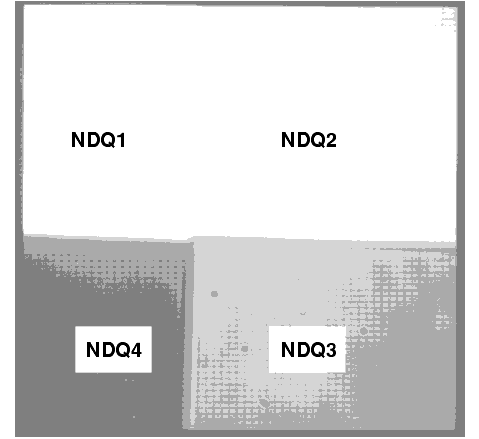
F25NDQfilter is unique in that it is divided into four quadrants, each having a different neutral density factor. In clockwise order starting from the upper left these areF25NDQ1,F25NDQ2,F25NDQ3, andF25NDQ4, where the number appended to each name is the approximate dex ND factor. Approximate dimensions of each quadrant and the default location of an external target in each quadrant are given in Table 13.33.Special Considerations
The default aperture locations where the target is placed in each quadrant are significantly offset from the center of the detector in both the spatial and the dispersion directions. For observations at these nominal aperture locations this will cause a significant shift in the wavelength coverage for any given grating setting. For example, when observing with
G140LinF25NDQ1, wavelengths shorter than about 1330 Å will fall off the detector. Users may wish to use aPOS-TARGto bring the target back closer to the center line of the detector. However, if the target would violate BOP restrictions in any quadrant of the aperture, the restrictions regarding pointing close to objects violating safety limits discussed in Chapter 7 andSTIS ISR 2000-01will apply. This latter rule renders theF25NDQ4quadrant mostly useless, and theF25NDQ3quadrant is redundant with the full fieldF25ND3aperture, so in practice only theF25NDQ1andF25NDQ2quadrants are commonly used. Also the dividing lines between the quadrants are somewhat displaced from the center of the detector and are not quite parallel to the detector edges (see Figure 13.82), so observers for whom the exact locations of the quadrant boundaries are important should consulthelp@stsci.edu.
Table 13.33: NDQ quadrant dimensions and the default locations at which a target is placed in each quadrant.
(arc-sec)
Width(arc-sec)
location
(pixels)
location
(pixels)
Figure 13.82: A CCD lamp image taken through the NDQ filter. Note the unequal sizes of the four quadrants.
Table 13.34: F25NDQ Throughputs (%)
Note: Aperture throughputs values for NDQ1 and NDQ4 at
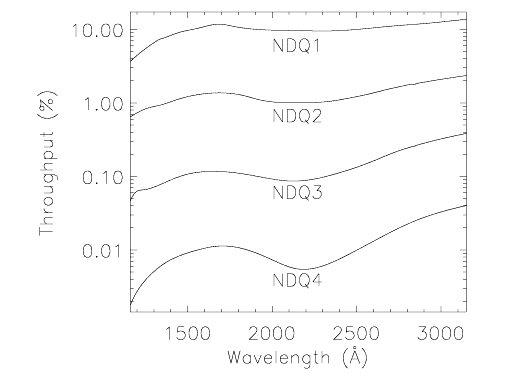
Figure 13.83: F25NDQ Aperture Throughputs vs. Wavelength.<1330 Angstroms and for NDQ2 and NDQ3 at
|
|||||
|
Space Telescope Science Institute http://www.stsci.edu Voice: (410) 338-1082 help@stsci.edu |