Space Telescope Imaging Spectrograph Instrument Handbook for Cycle 14
 |
 |
 |
 |
 |
|
| Space Telescope Imaging Spectrograph Instrument Handbook for Cycle 14 | |||||
| ||||||
7.1 The CCD
7.1.1 Detector Properties
The
STIS/CCDis a low-noise device capable of high sensitivity in the visible and the near-UV. It is a thinned, backside-illuminated device manufactured by Scientific Imaging Technologies (SITe). In order to provide near-UV imaging performance, the CCD was backside-treated and coated with a wide-band anti-reflectance coating. The process produces acceptable near-UV quantum efficiency (QE) without compromising the high QE of the visible bandpass. The CCD camera design incorporates a warm dewar window, designed to prevent buildup of contaminants on the window, which were found to cause a loss of UV throughput for the WFPC2 CCDs. A summary of theSTISCCD performance is given in Table 7.1. The performance values on read noise and dark current are those valid as of February 2002.
7.1.2 Effects of the Change to STIS Side-2 Electronics on CCD Performance
In May 2001, the primary Side-1 electronics on STIS failed. Operations were subsequently resumed using the backup Side-2 electronics. CCD observations have been affected in two ways.
First, the Side-2 electronics do not have a working CCD temperature controller, and the detector can no longer be held at a fixed temperature. As a result, the CCD dark current now fluctuates with the detector temperature. Fortunately, the dark current variation correlates well with the CCD housing temperature, with the dark current varying by ~ 7%/°C. Further details are given in
STIS ISR 2001-03. All reference file dark images prepared for use with STIS/CCD data taken during Side-2 operations are now scaled to a standard housing temperature of 18°C before being delivered. Before subtraction of the appropriate dark file from Side-2 CCD data, the calstis package rescales the dark using the CCD housing temperature value in theOCCDHTAVkeyword which is found in the extension header of each sub-exposure.The second change is an increase in the read noise by about 1e-/s when
CCDGAIN=1and by 0.2 e-/s whenCCDGAIN=4. This extra read noise appears in the form of coherent pattern noise, and under some circumstances it may be possible to ameliorate this noise by using Fourier filtering techniques. SeeSTIS ISR 2001-05for additional discussion.7.1.3 CCD Spectral Response
The spectral response of the unfiltered CCD is shown in Figure 5.6 (labeled as
50CCD). This figure illustrates the extremely wide bandpass over which this CCD can operate. The wide wavelength coverage is an advantage for deep optical imaging (although the new Advanced Camera for Surveys is better suited to most optical imaging programs). The near-UV sensitivity of the CCD makes it a good alternative to theNUV-MAMAfor low- and intermediate-resolution spectroscopy from ~2500 to 3100 Å using theG230LBandG230MBgrating modes (Table 4.1).Based on data to date, the STIS CCD does not suffer from Quantum Efficiency Hysteresis (QEH)-that is, the CCD responds in the same way to light levels over its whole dynamic range, irrespective of the previous illumination level.
7.1.4 CCD Sensitivity
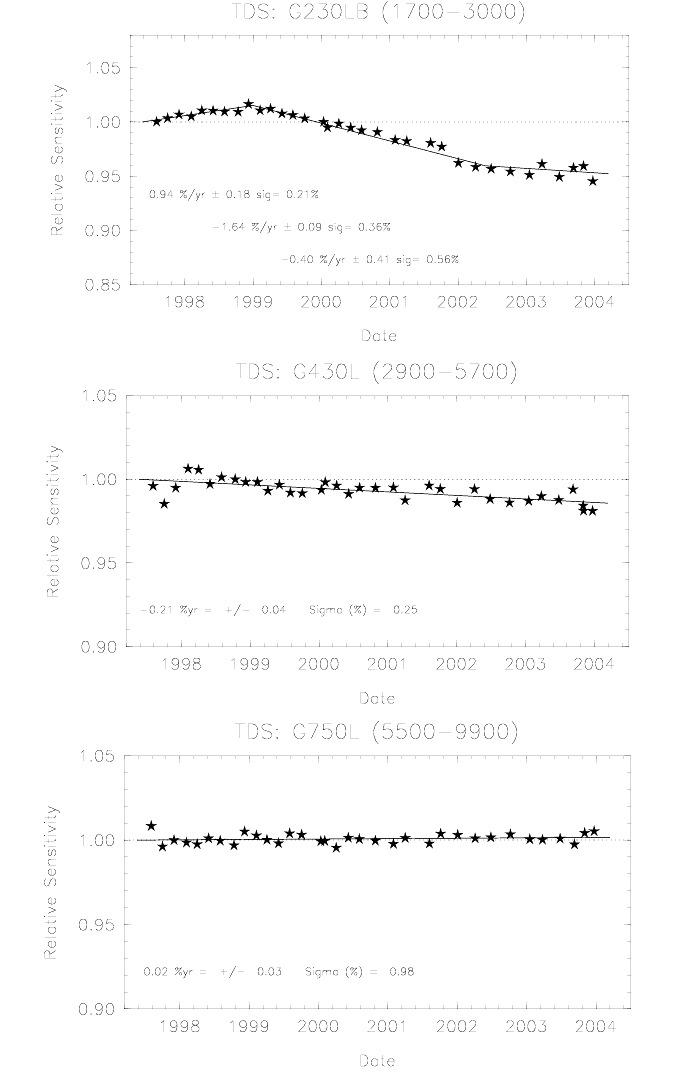
Sensitivity variations in CCD spectroscopic configurations have been determined to be due primarily to increasing charge transfer efficiency (CTE) losses (see Section 7.2.6), temperature fluctuations since the switch to the Side-2 electronics (see Section 7.1.2), and actual time-dependent changes in sensitivity. For a more detailed analysis of the STIS Sensitivity Monitor observations from 1997 through March 2004 please refer to STIS ISR 2004-?.
Since the switch to Side-2 operations, a linear trend of the sensitivity with temperature has been found for the first-order modes
G230LBandG430L, and is of the order of +0.42 and +0.20 %/°C, respectively. In contrast, theG750Lsensitivity does not show any significant dependence on temperature.After temperature and CTE effects are taken into account, the sensitivity of the
G230LBandG430Lmodes is seen to vary with time at a rate that has significantly slowed down in the most recent epoch of observations (beginning in early 2002), and ranges, on average, from 0.40%/yr (G230LB) to 0.21%/yr (G430L). TheG750Lmode does not show significant time-dependence. Trends for time-dependent sensitivity (TDS) for the CCD low-resolution (L) modes are shown in Figure 7.1. Selected wavelength settings of the medium-resolution (M) gratingsG230MB,G430M, andG750Mhave also been monitored. Sensitivity trends measured for the limited M-mode wavelength coverage are similar to those observed in the L-modes at corresponding wavelengths. TheG230LBandG230MBCCD configurations exhibit the same behavior found for the NUV MAMAG230Lmode (see Section 7.3.3), featuring an increase in sensitivity during the first 1.5 years of STIS operations, followed by decreasing sensitivity, and a slow-down in the decline in the last two years (see Figure 7.13).TDS corrections for all first-order CCD modes have been implemented into the STIS pipeline as new TDSTAB reference files (see Section 15.1) and will correct fluxes of extracted spectra for sensitivity changes to a typical accuracy of 1% or better. CTE corrections have also been implemented (see Section 7.2.6), however no correction for temperature dependence of the sensitivity is yet performed in the STIS pipeline. These new TDS trends have also been incorporated into reference files used by SYNPHOT and the STIS ETCs. This enables count rate predictions to take the sensitivity changes into account. The default TDS throughputs for SYNPHOT and STIS ETC calculations will assume a date of 2004-Jul-01 (beginning of Cycle 13).
TDS corrections for CCD imaging modes are currently being tested and will be implemented in the pipeline in the near future. On the other hand, the CTE effects for imaging modes will be addressed by means of tailored post-pipeline IRAF tasks, in view of the inability of the pipeline to identify all targets on the image for which CTE effects are to be corrected. These IRAF tasks are planned to become available during Cycle 13.
Figure 7.1: Relative sensitivity vs. time for first-order CCD L-modes G230LB, G430L, and G750L.
7.1.5 CCD Long-Wavelength Fringing
Like most CCDs, the STIS CCD exhibits fringing in the red, longward of ~7500 Å. This fringing limits the signal-to-noise routinely achievable in the red and near-IR unless contemporaneous fringe flats are obtained (see below). In principle, fringing can also affect imaging observations if the source's emission over the
50CCDorF28X50LPbandpass is dominated by emission lines redward of 7500 Å. However, if the bulk of the emission comes from blueward of 7500 Å, then emission from multiple wavelengths will smooth over the fringe pattern so that imaging will not be affected by fringing.The amplitude of the fringes is a strong function of wavelength and spectral resolution. Table 7.2 lists the observed percentile peak-to-peak and rms amplitudes of the fringes as a function of central wavelength for the
G750MandG750Lgratings. The listed "peak-to-peak" amplitudes are the best measure of the impact of the fringing on your data. The rms values at wavelengths < 7000 Å give a good indication of the counting statistics in the flat-field images used for this analysis.
Table 7.2: Fringing Amplitude in Percent as a Function of Wavelength
rms
rms
The fringe pattern can be corrected by rectification with an appropriate flat field. The fringe pattern is a convolution of the contours of constant distance between the front and back surfaces of the CCD and the wavelength of the light on a particular part of the CCD. The fringe pattern has been shown to be very stable, as long as the wavelength of light on a particular part of the CCD stays constant. However, due to the grating wheel positioning uncertainty (Slit and Grating Wheels) and the effect of temperature drifts in orbit, the wavelength on a particular part of the CCD will vary from observation to observation. Thus, the best de-fringing results are obtained by using a contemporaneous flat ("fringe flat"), i.e., a tungsten lamp flat taken at the same grating wheel setting and during the same orbit as your scientific exposures.
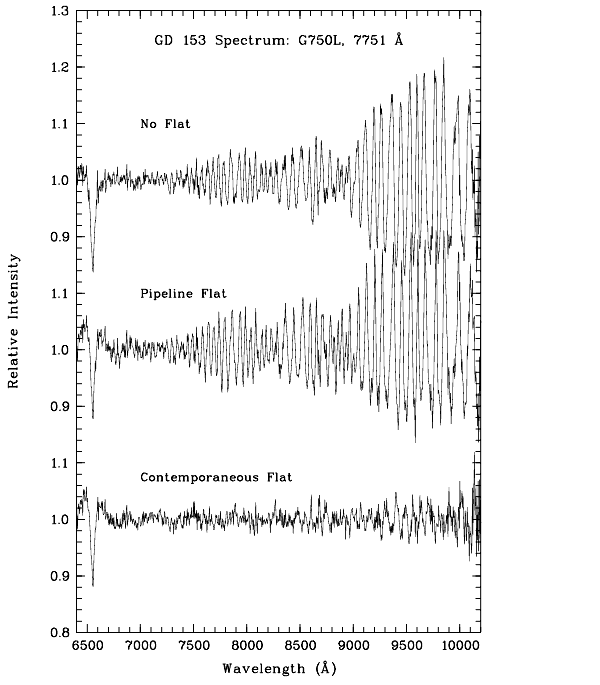
Table 7.3 compares the estimated peak-to-peak fringe amplitudes after flat-fielding by the library flat and by those after flat fielding with an appropriately processed contemporaneous flat. These estimates are based upon actual measurements of spectra of both point sources and extended sources made during Cycle 7 (the results for point sources and extended sources were essentially the same). Figure 7.2 shows such a comparison for a
Figure 7.2: Comparison of De-fringing Capabilities of Pipeline Flats and Those of Contemporaneous FlatsG750Lspectrum of a white dwarf; in this figure, the top panel shows white dwarf GD153 (central wavelength 7751 Å) with no flat field correction, the second spectrum shows the result of de-fringing with the standard pipeline flat field, and the third spectrum shows the result of de-fringing with a contemporaneous flat (all spectra were divided by a smooth spline fit to the stellar continuum). It is clear that a contemporaneous flat provides a great improvement over the use of a library flat. Therefore, if you are observing in the far red (> 7500 Å) and using gratingG750LorG750M, you should take a contemporaneous flat field along with your scientific observations. More detailed information and analysis on fringe correction for STIS long-wavelength spectra can be found in STIS ISRs1998-19,1998-29, and the references therein.
Table 7.3: Residual fringe amplitude (rms, in percent) after flat-fielding with library pipeline flat and a contemporaneous flat
1Measurements of the fringe amplitude have not been made yet for G750Mwavelength settings redward of 8561 Å. However, from our experience with fringe corrections we expect the residual fringe amplitudes to be of order 1% when contemporaneous fringe flats are used.
7.1.6 Fringing due to the Order Sorter Filters
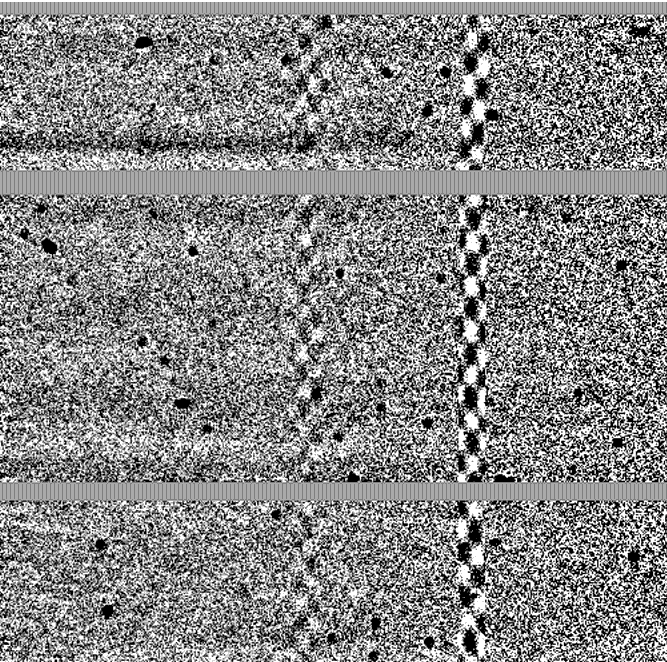
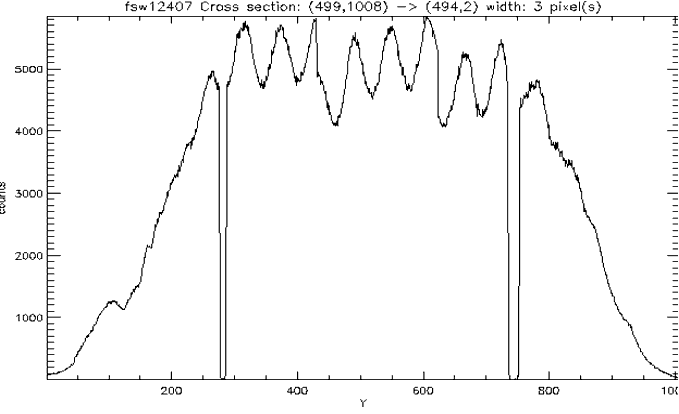
Examination of long slit observations in the CCD spectroscopic modes has revealed periodic variations of intensity along the slit when highly monochromatic, calibration lamp sources are used. An example of such `chevron-pattern' variations is shown in Figure 7.3 and Figure 7.4. These variations are thought to be the result of transmission variations through the highly parallel faces of the order sorting filters that are situated next to the gratings in the optical path. In the cross dispersion direction, the modulation amplitude depends on the line width with a maximum of 13% for a monochromatic source in
Figure 7.3: CCD image of a calibration lamp exposure which shows the chevron-pattern variations. The image is taken with G430L grating and a 2 arcsec slit. The chevron patterns are seen at the position of the emission lines.G430LandG430Mmodes, and 4.5% inG750LandG750Mmodes. Periods range from 40 - 80 pixels/cycle. In the dispersion direction, there is a small, residual, high frequency modulation with a peak amplitude of about 1.5% inG430Mat the 5471Å setting and with smaller amplitudes in all other modes and settings. No such modulation has been observed in any of the MAMA modes. Some modulation is also apparent in the CCDG230LBandG230MBmodes, however the amplitudes of these modulations are much smaller and analysis of these modes is ongoing.
It should be noted that this effect is pronounced only for monochromatic sources; the modulation is negligible for continuum sources. So far, such modulation has not been observed in any astronomical observations. A calibration program would be necessary to investigate this effect further.
Figure 7.4: A plot of the 52x0.2 slit illumination near 4269Å in mode G430L obtained with the Pt-Cr/Ne calibration lamp
7.1.7 Optical Performance
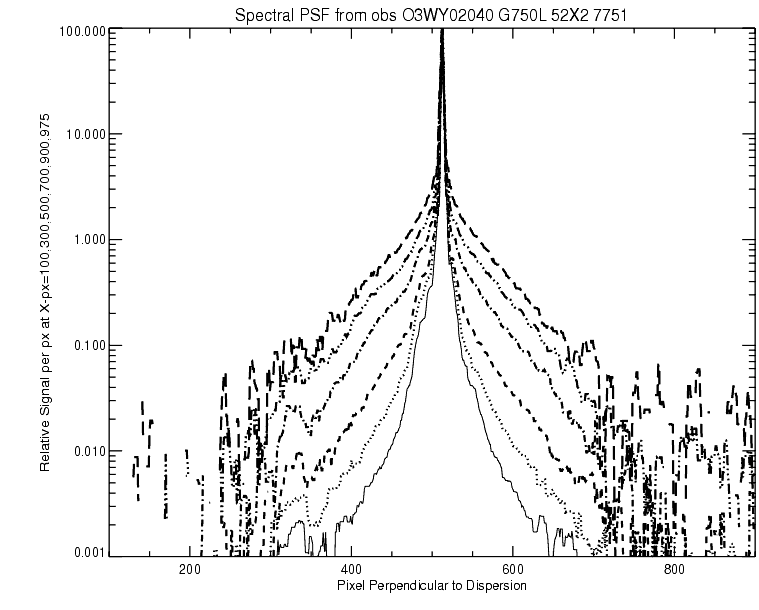
Verification testing has shown that STIS meets its image-quality specifications. While the optics provide fine images at the focal plane, the detected point-spread functions (PSFs) are degraded somewhat more than expected by the CCD at wavelengths longward of about 7500 Å, where a broad halo appears, surrounding the PSF core. This halo is believed to be due to scatter within the CCD mounting substrate, which becomes more pronounced as the silicon transparency increases at long wavelengths. The effects of the red halo (see Figure 7.5), which extend to radii greater than 100 pixels (5 arcsec), are not included in the encircled energies as a function of observing wavelength that are described for the CCD spectroscopic and imaging modes in Chapter 13 and 14, respectively. However, estimates of the encircled energy vs. radius that include the halo are shown in Table 7.4. The integrated energy in the halo amounts to approximately 20% of the total at 8050 Å and 30% at 9050 Å (see also
STIS ISR 1997-13for the implication for long-slit spectroscopic observations at long wavelengths). Note that the ACS WFC CCDs have a front-side metallization that eliminates the large angle long wavelength halo problem in those detectors.The CCD plate scale is 0.0507 arcseconds per pixel for imaging observations (see
Figure 7.5: Cross-sections of the signal distribution perpendicular to the dispersion direction for G750L, at six wavelengths from 5752 Å to 10020 Å. Each PSF is normalized to a peak value of 100. The strong wavelength dependence of the PSF provides a clean separation of the curves.STIS ISR 2001-02), and in the spatial (across the dispersion) direction for spectroscopic observations. Due to the effect of anamorphic magnification, for spectroscopic observations the plate scale in the dispersion direction is slightly different and it depends on the grating used and its tilt. The plate scale in the dispersion direction ranges from 0.0512 to 0.0581 arcseconds per pixel (seeSTIS ISR 1998-23).
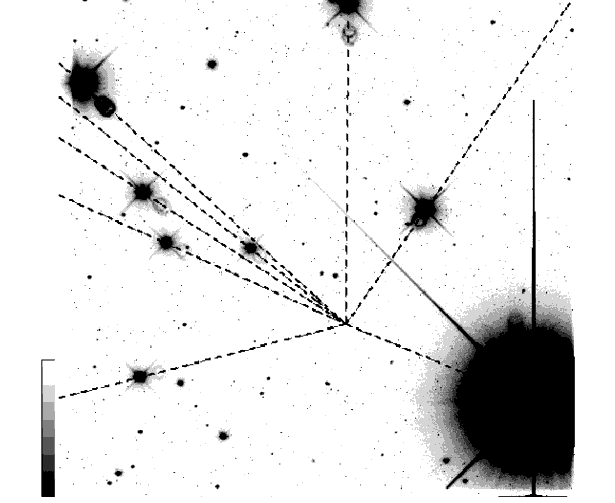
The CCD detector produces a relatively faint, out-of-focus, ring-shaped "ghost" image, due to specular reflection from the CCD surface and window. The ring contains about 1% of the total energy in the image and is very stable. Additional rings of similar size can be seen at other locations in the field in grossly saturated images, but these contain only of order 10-5 of the total energy and are thus not likely to be detected in normal scientific images. Lines drawn from stars in images through their respective ghosts are found to converge at a "radiant point" located to the lower right of the image center. This effect is illustrated in Figure 7.6 where the line segments are drawn from pixel coordinates 528,342 (in 1024 x 1024 user coordinates) through the centroids of the brightest stars in the image. Note that these line segments intercept the centers of the ring-like ghosts very well. Observers who wish to avoid placing very faint objects within the range of the ghosts may want to take this geometry into account when writing Phase II submissions.
Figure 7.6: Ring-Shaped Ghost Images Near Bright Point Sources (50CCD Image)
7.1.8 Readout Format
A full detector readout is 1062 x 1044 pixels including physical and virtual overscans. Scientific data are obtained on 1024 x 1024 pixels, each projecting to ~0.05 x 0.05 arcseconds on the sky. For spectroscopic observations, the dispersion axis runs along
axis1(image X or along a row of the CCD), and the spatial axis of the slits runs alongaxis2(image Y or along a column of the CCD). The CCD supports the use of subarrays to read out only a portion of the detector, and on-chip binning. For more details see Section 11.1.1.7.1.9 Analog-to-Digital Conversion: Selecting the CCDGAIN
Electrons that accumulate in the CCD wells are read out and converted to data numbers (DN, the format of the output image) by the analog-to-digital converter at a default
CCDGAINof 1 e-/DN (i.e., every electron registers 1 DN). The CCD is also capable of operating at a gain of 4 e-/DN. The analog-to-digital converter operates at 16 bits, producing a maximum of 65,536 DN pixel-1. This is not a limitation at either gain setting, because other factors set the maximum observable DN to lower levels in each case (Section 7.2 below).The CCDGAIN=1 setting has the lower read noise (Table 7.1) and digitization noise. Although the read noise has increased since the switch to the Side 2 electronics in July 2001 (see Section 7.1.2),
CCDGAIN=1is still the most appropriate setting for observations of faint sources. However, saturation occurs at about 33,000 e- at the CCDGAIN=1 setting (as described in Section 7.2 below).The
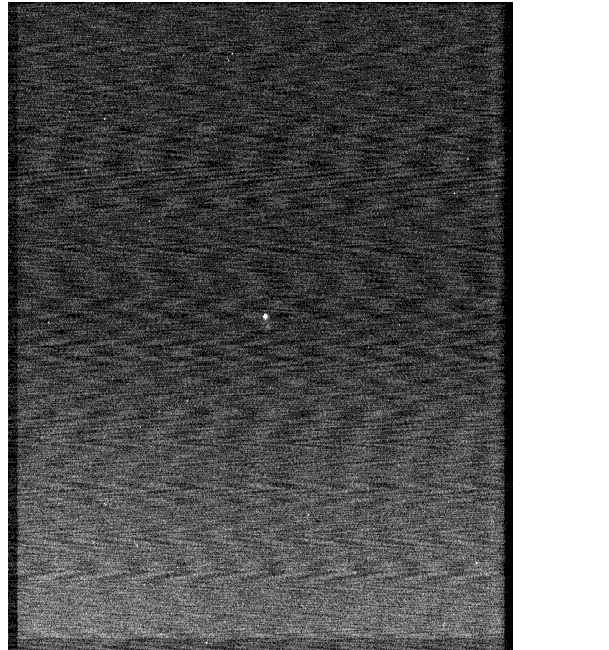
CCDGAIN=4setting allows use of the entire CCD full well of 144,000 e-, and use of theCCDGAIN=4 setting is therefore recommended for imaging photometry of objects whenever more than 33,000 e- might be obtained in a single pixel of an individual sub-exposure. However, short exposures taken inCCDGAIN=4show a large-scale pattern noise ("ripple") that is not removed by the standard bias images. This pattern noise is in addition to the usual coherent noise visible since STIS switched to using the backup Side-2 electronics. Figure 7.7 (a 0.2 second exposure of a lamp-illuminated small slit) shows an example of theCCDGAIN=4ripple. The peak-to-peak intensities of these ripples vary from near zero to about 1 DN, and there is a large amount of coherence in the noise pattern. This coherence makes background determination difficult and limits the precision of photometry of faint objects in shallow exposures taken usingCCDGAIN=4.The CCD response when using
Figure 7.7: Ripple Effect in Short Exposures with CCDGAIN=4CCDGAIN=4remains linear even beyond the 144,000 e- full well limit if one integrates over the pixels bled into (Section 7.2.1), and for specialized observations needing extremely high S/N, this property may be useful.
|
|||||
|
Space Telescope Science Institute http://www.stsci.edu Voice: (410) 338-1082 help@stsci.edu |