Space Telescope Imaging Spectrograph Instrument Handbook for Cycle 14
 |
 |
 |
 |
 |
|
| Space Telescope Imaging Spectrograph Instrument Handbook for Cycle 14 | |||||
| ||||||
7.3 The MAMA Detectors
7.3.1 MAMA Properties
There are two MAMA detectors: the
STIS/FUV-MAMAprovides coverage from 1150 to 1700 Å and theSTIS/NUV-MAMAprovides coverage from 1600 to 3100 Å (with lower response below 1600 Å). The STIS MAMA detectors are photon-counting devices that process events serially. They can be used to take data in either an accumulate (ACCUM) mode in which a time-integrated image is produced, or in a time series (TIME-TAG)mode in which the detector location and time of arrival of each photon are recorded as an event stream (see Section 11.1.2 and Section 11.1.3, respectively). The primary benefits afforded by the STIS MAMAs, in comparison with previous HST UV spectroscopic detectors such as those of the GHRS and FOS, are high spatial resolution, two-dimensional imaging over a relatively large field of view, and low background for point sources. The MAMA detector was developed by J. Timothy and R. Bybee for X-ray and UV imaging applications. The properties of the STIS MAMA detectors are summarized in Table 7.7.
Table 7.7: STIS MAMA Detector Performance Characteristics
Characteristic FUV-MAMA Performance NUV-MAMA Performance Photocathode CsI Cs2Te Wavelength range 1150-1700 Å 1600-3100 Å Pixel format 1024 x 1024 1024 x 1024 Pixel size 25 x 25 µm2 25 x 25 µm2 Image mode pixel plate scale 0.0245 x 0.0247 arcseconds (clear)
0.0246 x 0.0247 arcseconds (filtered)0.0245 x 0.0248 arcseconds Field of view 25.1 x 25.3 arcseconds (clear) 25.2 x 25.3 arcseconds (filtered) 25.1 x 25.4 arcseconds Quantum efficiency 25% @ 1216 Å 10% @ 2537 Å Dark count 5 x 10⁻⁶ to 1 x 10⁻⁴ counts sec-1 pix-1 8 x 10⁻⁴ to 1.7 x 10⁻³ counts sec-1 pix-1 Global count-rate linearity limit1 285,000 counts sec-1 285,000 counts sec-1 Local count-rate linearity limit1 ~220 counts sec-1 pix-1 ~340 counts sec-1 pix-1
1Rate at which counting shows 10% deviation from linearity. These count rates are well above the bright-object screening limits.
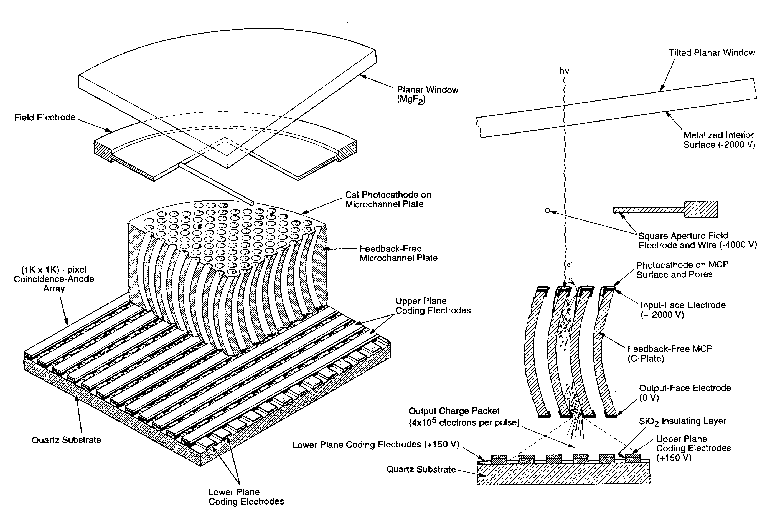
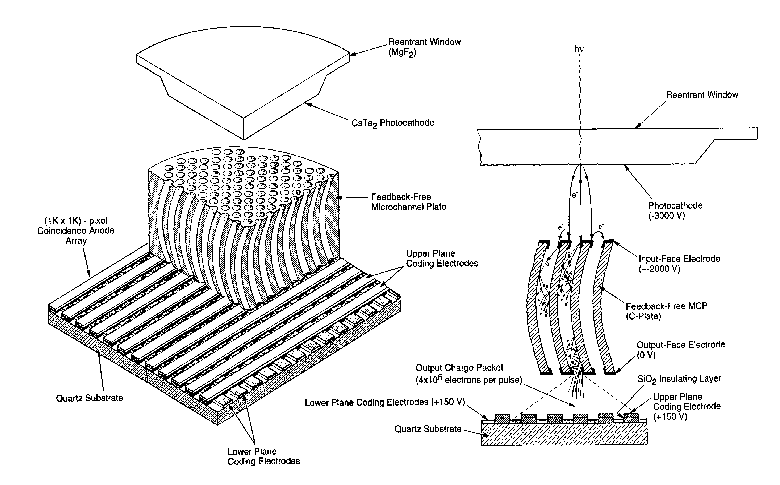
Figure 7.11 and Figure 7.12 illustrate the design of the FUV- and NUV-MAMA, respectively. A photocathode material is deposited on the front surface. The FUV-MAMA has an opaque CsI photocathode deposited directly on the face of the curved microchannel plate (MCP); the NUV-MAMA has a semi-transparent Cs2Te photocathode deposited on the back side of the detector's entrance window.
Target photons strike the photocathode, liberating single photoelectrons which pass into the microchannel plate (MCP). There they are multiplied to a pulse of ~4 x 10⁵ electrons. The pulse is recorded by an anode array behind the photocathode and detected by the MAMA electronics which process it, rejecting false pulses and determining the origin of the photon event on the detector.
The FUV-MAMA has a field electrode (repeller wire) which is used to repel electrons emitted away from the microchannel plate back into the channels. This provides an increase in quantum efficiency of the detector at the price of a small increase in the detector PSF halo. The repeller wire is normally on for FUV-MAMA observations (but see Section 7.3.4).
Figure 7.11: Design of the FUV-MAMA
Figure 7.12: Design of the NUV-MAMA
7.3.2 MAMA Spectral Response
The spectral responses of the unfiltered FUV- and NUV-MAMAs are illustrated in Figure 5.14. The peak photocathode response of the
FUV-MAMAoccurs at Lyman-. Its spectral response is defined by the cutoff of the MgF2 window at 1150 Å at short wavelengths, and by the relatively steep decline of the CsI photocathode at long wavelengths. Out-of-band QE at longer wavelengths (>2000 Å) is <10-6 yielding excellent solar-blind performance. The
NUV-MAMAspectral response has a relatively flat maximum (~10%) that encompasses 1800-2600 Å. The photocathode QE declines to ~4% at 3150 Å, while at longer wavelengths the out-of-band QE is ~10-4. (See also Section 5.3.3.)7.3.3 MAMA Sensitivity
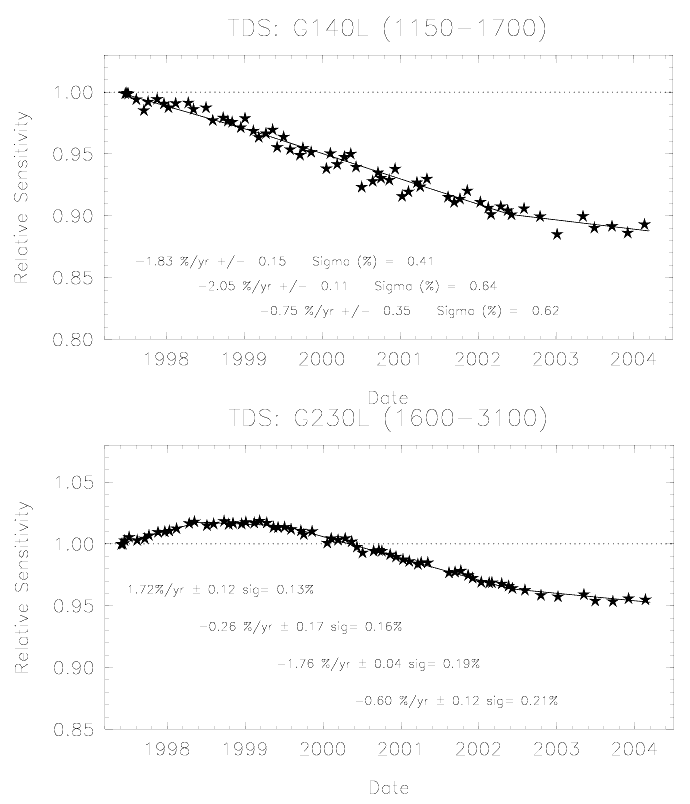
The MAMA detectors, similarly to the CCD, suffer from changes in sensitivity which depend on both temperature and time. A similar STIS Sensitivity Monitoring program aimed at characterizing the CCD behavior has been used to characterize the MAMAs (see Section 7.1). The well-known sensitivity of the FUV MAMA to temperature for the first-order mode
Figure 7.13: Relative sensitivity of STIS MAMA first-order low-resolution modes G140L and G230L as a function of time..G140Lhas been confirmed to be -0.30%/ºC. No significant change with temperature for the NUV-MAMA first-orderG230Lmode has been registered. Following a correction for the temperature dependence, the sensitivities of the FUV first-order modes decrease linearly with time (see Figure 7.13) by wavelength-dependent amounts ranging up to a few percent per year. For the NUV first-order configurations, the sensitivities increased during the 1.5 years of STIS operations and then began to drop, by wavelength-dependent amounts comparable to those in the FUV (see Figure 7.13). There has been a significant slow-down in the decline of the time-dependent sensitivity (TDS) of all STIS observational modes in the last two years. Currently, MAMA sensitivity losses range on average from -0.75%/yr (G140L) to -0.60%/yr (G230L). Full details of the changes in the sensitivity over time for all STIS first-order L and M spectroscopic configurations can be found in STIS ISR 2004-?. TDS corrections for all first-order MAMA spectra have already been implemented in the data-reduction pipeline (see Section 15.1). All OTFR retrievals of such data will have corrected fluxes regardless of their acquisition epoch with an accuracy of 1% or better. SYNPHOT and the ETC have also been updated to apply TDS corrections to MAMAs. Sensitivity-monitor data for the echelle and MAMA imaging configurations are currently under investigation; they appear to show analogous effects, but no pipeline corrections are yet available. TDS corrections for these modes will be added during Cycle 13.
7.3.4 Optical Performance
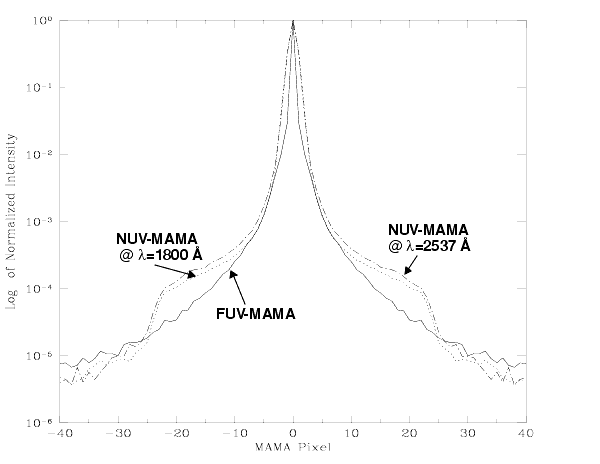
Both MAMAs exhibit low-level extended wings in their detector point-spread functions (PSFs), with the
NUV-MAMAPSF being considerably worse. Sample MAMA detector PSFs are shown in Figure 7.14. For those wishing to model their effect on absorption- or emission-line equivalent-width measurements or coronagraphic observations, the LSFs and detector PSFs are maintained on the STScISTIS World Wide Web site.Data for spectral modes can be found at:
http://www.stsci.edu/hst/stis/performance/spectral_resolution/
http://www.stsci.edu/hst/stis/performance/image_quality/.The FUV-MAMA includes a repeller wire that establishes a field above the microchannel plate and reflects forward-ejected photoelectrons back into the microchannel pores. The repeller wire is normally on for FUV-MAMA observations, but an improvement to the FUV-MAMA PSF (at the expense of a 35% decrease in sensitivity) can be made by disabling the high voltage to this wire. This procedure is only recommended for observations that use the
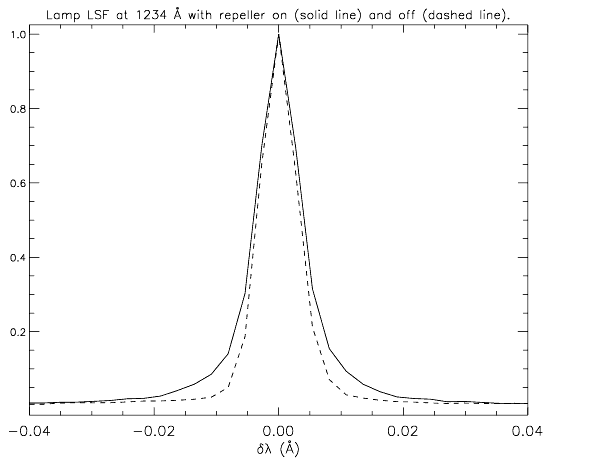
E140H, and perhaps also theE140M, gratings when used with the0.1X0.03aperture (sometimes called the "Jenkins slit") for observations shortward of 1400 Å. In pre-launch testing, resolutions as high as R ~ 220,000 were obtained in observations of a mono-isotopic emission line lamp in highres mode (see Highres), and R ~ 200,000 has been achieved on-orbit (Jenkins 2000, BAAS 32, 731). Figure 7.15 shows the effect of disabling the repeller voltage for the case of an observation of a linelamp with theE140Hcenwave =1234 Å setting. Note that the main difference is not the FWHM of the central core, but a decrease in the intensity of the line wings.Only a small number of proposals per cycle (of the order of one to two) requesting the repeller off mode will be accepted. Note that repeller off observations will require special treatment, so a scientific case will need to be made for why these observations are necessary.
Also note that, due to the large PSF of HST in imaging mode (currently 3.5 low-resolution pixels), there is no advantage in performing FUV-MAMA imaging observations with the repeller wire voltage turned off.
Figure 7.14: MAMA Detector PSFs
Figure 7.15: Average Profile of Calibration Lamp Line at 1234 Å with the Repeller Wire On and Off
|
|||||
|
Space Telescope Science Institute http://www.stsci.edu Voice: (410) 338-1082 help@stsci.edu |