5.2 Important Considerations for ACS Imaging
There are a few characteristics of ACS that should be taken into account when imaging with ACS:
- The HRC and WFC filters are housed in two filter wheels shared by both cameras. As a consequence, when a filter is chosen for the primary camera, the filter used in the parallel camera is not independently selectable.
- The ACS cameras are designed to be used with a single filter, and for this reason unfiltered imaging or imaging through two filters leads to significantly degraded imaging quality (particularly in the WFC) and is not normally used except for polarization observations, or bright target acquisitions with the HRC. The polarizer filters were designed with a zero optical thickness so that they can and should be used with another filter.
- The geometric distortion of the WFC is significant and causes the projected pixel area to vary by ±9% over the field of view. This distortion affects both the photometric accuracy and the astrometric precision, and must be accounted for when the required accuracy is better than 10%.
- The ratio of in-band vs. out-of-band transmission for the ACS CCD UV filters is similar to that of WFPC2, once the two detector QE curves are taken into account (the red leak on ACS F330W is very small). This implies that the effect of filter red leaks needs to be calibrated for UV imaging of intrinsically red objects.
- The cosmic ray fluxes for HRC and WFC are comparable, respectively, to those of the STIS CCD and WFPC2. As with these instruments, typical imaging observations will need to be split or dithered for cosmic ray rejection.
- Section 4.3.5 provides further details and a recommendation that separate exposures with small dithers be used as a means of helping to remove residual hot pixels.
- The large format of the WFC requires significantly more shifts to read out data compared to STIS or WFPC2. Therefore, the impact of decreasing charge transfer efficiency will be encountered earlier. Section 4.3.7 details current expectations.
- The default GAIN setting for WFC primary observations is GAIN=2. This allows for good sampling of the readout noise and allows one to reach the full well counts of WFC. For the HRC primary observations, the default gain is GAIN=2. To sample the detector full well depth, GAIN=4 is needed, but this results in modest undersampling of the readout noise. For HRC ACQ data, the default setting is GAIN=4. Users may select the GAIN they wish to use for their ACS observations by using the GAIN optional parameter in their Phase II proposal. However, not all GAIN settings are supported (see Section 7.6).
- At wavelengths longward of ~8000 Å, internal scattering in the HRC CCD produces an extended PSF halo. This should affect only a small number of observations since the WFC camera is normally preferred at these wavelengths. The WFC CCDs include a front-side metallization that eliminates the large angle, long wavelength halo problem for l < 9000 Å. (For observations of red targets with the F850LP refer to Section 9.3.2).
- The ACS filter complement is not as rich as that in WFPC2. In particular, the Strömgren filter set and several narrow band filters available in WFPC2 (F375N, F390N, F437N, F469N, F487N, F588N, F631N, F656N, F673N, F953N) are not available on ACS. In general, these filters were not heavily used by the GO community. For most applications they can be replaced with the ACS medium and narrow ramps.
5.2.1 Optical Performance
Testing of the WFC and HRC cameras, following fine alignment activities on-orbit, has shown that the optical quality objectives of the cameras are met. The encircled energy values obtained from observations made in SMOV are given in Table 5.4.
Table 5.4: Encircled energy measurements for the ACS channels.5.2.2 CCD Throughput Comparison
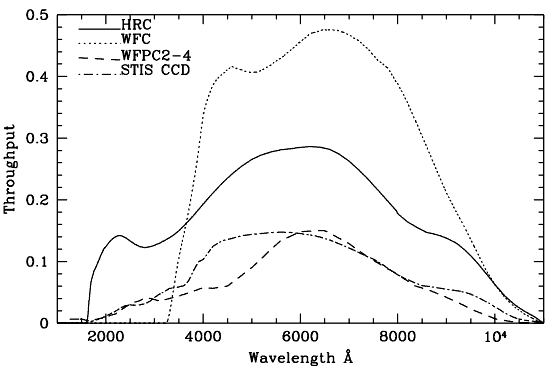
Figure 5.7 shows the throughput of the two unfiltered ACS CCD cameras: WFC and HRC. Superposed on this plot are unfiltered WFPC2 (WF4) and the clear STIS throughputs.
5.2.3 Limiting Magnitudes
Table 5.5 contains Johnson-Cousins V magnitudes for unreddened O5 V, A0 V, and G2 V stars, generated using the Exposure Time Calculator. WFC and HRC values used the parameters CR-SPLIT=2, GAIN=2, and a 0.2 arcsecond circular aperture. For the SBC, a 0.5 arcsecond circular aperture was used. An average sky background was used in these examples. However, limiting magnitudes are sensitive to the background levels; for instance, the magnitude of an A0 V in the WFC using the F606W filter changes by ±0.4 magnitudes at the background extremes.
Figure 5.7: ACS CCD system throughputs + OTA versus those of STIS and WFPC2.Table 5.5: V detection limits for ACS, HRC, and SBC direct imaging.5.2.4 Signal-To-Noise Ratios
In Chapter 10, we present, for each imaging mode, plots of exposure time versus magnitude to achieve a desired signal-to-noise ratio. These plots, which are referenced in the individual imaging-mode sections below, are useful for getting an idea of the exposure time you need to accomplish your scientific objectives. More accurate estimates require the use of the ACS Exposure Time Calculator (http://www.stsci.edu/hst/acs/software).
5.2.5 Saturation
Both CCD and SBC imaging observations are subject to saturation at high total accumulated counts per pixel. For the CCDs, this is due either to the depth of the full well or to the 16 bit data format. For the SBC, this is due to the 16 bit format of the buffer memory (see Section 4.3.1 and Section 4.5.2).
|
Space telescope Science Institute http://www.stsci.edu |