4.5 SBC Operations and Limitations
4.5.1 SBC Scheduling Policies
The STIS MAMA control electronics are subject to resets due to cosmic-ray upsets. Therefore, STIS MAMAs were operated only during the contiguous orbits of each day that are free of the South Atlantic Anomaly (SAA). Even though the design of the ACS MAMA control electronics in the SBC was modified so that they would not be susceptible to cosmic-ray hits, the background count rate still exceeds the bright object limits for the SBC during SAA passage. Consequently, the SBC will in general only be scheduled for use during SAA-free orbits.
4.5.2 MAMA Overflow of the 16 Bit Buffer
The MAMA is a photon-counting detector: as each event is recorded, the buffer memory for the corresponding pixel is incremented by one integer. The buffer memory stores values as 16 bit integers; hence the maximum number it can accommodate is 65,535 counts per pixel in a given
ACCUMmode observation. The 2-Byte (16-bit) memory can hold 216 values, including 0. When accumulated counts per pixel exceed this number, the values will wrap, i.e. the memory resets to 0. As an example, if you are counting at 25 counts/second/pixel, you will reach the MAMA “accumulation” limit in ~44 minutes.One can keep accumulated counts per pixel below this value by breaking individual exposures into multiple identical exposures, each of which is short enough that fewer than 65,535 counts are accumulated per pixel. There is no readnoise for MAMA observations, so no penalty is paid in lost signal-to-noise ratio when exposures are split. There is only a small overhead for each MAMA exposure (see Section 8.2).
4.5.3 MAMA Darks
MAMA detectors have intrinsically low dark currents. Ground test measurements of the ACS MAMA showed count rates in the range of 10-5 to 10-4 counts per pixel per second as the temperature varied from 28 ×C to 35 ×C degrees. The count rate increased by about 30% for one degree increase in temperature. In-flight measurements, taken weekly throughout June and July 2002, show count rates between 8x10⁻⁶ and 10-5. These measurements were taken as soon as the MAMA was turned on and were therefore at the lower end of the temperature range. A 10 hour observation in SMOV, long enough for nominal temperatures to be reached, yielded a dark current of 1.2 x 10⁻⁵ counts per second per pixel. Monthly monitoring shows the in-flight dark current to be about 9x10⁻⁶ counts per second per pixel. For typical SBC operations in which the detector is turned on for less than two hours, a dark image collected at lower temperatures is more suitable and replaces the current calibration image. This has a mean dark rate of 10-5 counts per second per pixel.
Recent measurements of SBC darks have shown a significant increase in the rate when the detector is on for several hours. The rate for the first two years remains close to 10-5 counts per second per pixel but after 5 hours the rate is 5 x 10⁻⁵ counts per second per pixel. When last measured in 2002 this time dependant effect was almost negligible.
The ACS MAMA has a broken anode which disables rows 599 to 605. There are three dark spots smaller than 50 microns at positions (334,977), (578,964), and (960,851), as well as two bright spots at (55,281) and (645,102) with fluctuating rates that are always less than 3 counts per second. The reference pixel has been moved to (512,400) to avoid these areas (see Table 7.10)
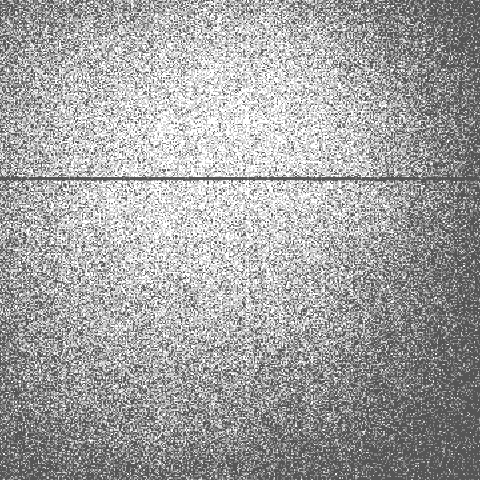
An example of the dark current variation across the detector can be seen in Figure 4.19 below.
Figure 4.19: MAMA dark image. Full frame MAMA dark image. The average dark rate in this image is 5 x 10⁻⁵ counts per second per pixel.4.5.4 SBC Signal-To-Noise Ratio Limitations
MAMA detectors are capable of delivering signal-to-noise ratios of order 100:1 per resolution element (2 ¥ 2 pixels) or even higher. Tests in orbit have demonstrated that such high S/N is possible with STIS (Kaiser et al., PASP, 110, 978; Gilliland, STIS ISR 1998-16). For targets observed at a fixed position on the detector, the signal-to-noise ratio is limited by systematic uncertainties in the small-scale spatial and spectral response of the detector. The MAMA flats show a fixed pattern that is a combination of several effects including beating between the MCP array and the anode pixel array, variations in the charge-cloud structure at the anode, and low-level capacitive cross-coupling between the fine anode elements. Intrinsic pixel-to-pixel variations are of order 6% but are stable to < 1%. Photometric accuracy can be improved by averaging over flat field errors by dithering the observation (see Section 7.4).
4.5.5 SBC Flatfield
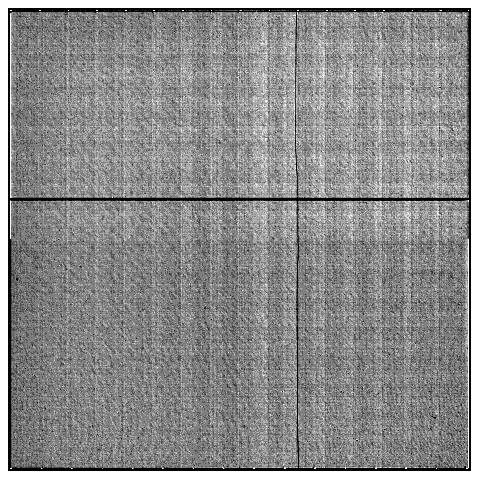
Figure 4.20: MAMA flat field. Wavelength independent P-Flat for the SBC MAMA (full frame shown).The SBC requires two types of flat fields: the "pixel-to-pixel flats" (or P-flats), which take care of the high-frequency structures in the detector sensitivity, and the "low-order flats" (or L-flats), which handle the low-frequency components. Current P-flats were derived by Bohlin & Mack (ACS ISR 2005-04) using the on-board deuterium lamp and were found to be independent of wavelength. The P-flat in Figure 4.20 shows the effect of the disabled broken anode for rows 601 to 605 and of the shadow of the repeller wire around column 577.
Low-frequency flatfield corrections for the SBC imaging modes have been derived using multiple exposures of the globular cluster NGC6681 (Mack, et. al., ACS ISR 2005-013). Variations of ±6% (full range) were found for the F115LP and F125LP filters, ±8% for the F140LP and F150LP filters, and ±14% for the F165LP filter. The F122M filter was not included in this analysis due to lack of sufficient data. The L-flat shows a similar general pattern in all filters, with the required correction increasing with wavelength. The L-flat analysis detected a decline in the UV sensitivity with time at a level of 2 to 4%/yr over the first 1.6 years of operation. The sensitivity appears to have leveled off after this time. A slight sensitivity loss as a function of temperature (~0.1%/degree) was also discovered. These effects were detected for the STIS FUV-MAMA detector (see STIS ISRs 2003-01 and 2004-04).
4.5.6 SBC Nonlinearity
Global
The MAMA detector begins to experience nonlinearity (photon impact rate not equal to photon count rate) at global (across the entire detector) count rates of 200,000 counts/second. The nonlinearity reaches 10% at 360,000 counts/second and can be corrected for in post-observation data processing at the price of a loss of photometric reliability. Additionally, the MAMA detector plus processing software are not able to count reliably at rates exceeding 285,000 counts/second. For this reason, and to protect the detectors, observations beyond this rate are not allowed (see Section 4.6).
Local
The MAMA detector remains linear to better than 1% up to ~22 counts/second/pixel. At higher rates, it experiences local (at a given pixel) nonlinearity. The nonlinearity effect is image dependent—that is, the nonlinearity observed at a given pixel depends on the photon rate affecting neighboring pixels. This property makes it impossible to correct reliably for the local nonlinearity in post-observation data processing. In addition, MAMA detectors are subject to damage at high local count rates (see Section 4.6).
|
Space telescope Science Institute http://www.stsci.edu |