4.3 CCD Operations and Limitations
4.3.1 CCD Saturation: the CCD Full Well
The full well capacity for the ACS CCDs is given in Table 3.1 as 84,700 e- for the WFC and 155,000 e- for the HRC. This is somewhat dependent on the position on the chip, with variations of the order 10% and 18% across the field of view for the WFC and the HRC, respectively. If the CCD is over-exposed, blooming will occur. This happens when a pixel becomes full, so excess charge flows into the next pixels along the column. However, extreme overexposure is not believed to cause any long-term damage to the CCDs, so there are no bright object limits for the ACS CCDs. When using GAIN=2 on the WFC and GAIN=4 on the HRC, it has been shown that the detector response remains linear to well under 1% up to the point when the central pixel reaches the full well depth. On-orbit tests have demonstrated that when using aperture photometry and summing over the surrounding pixels affected by bleeding, linearity to £ 1% holds even for cases in which the central pixel has received up to 10 times the full well depth (see ACS ISR 2004-01 for details). After the ACS repair, on-orbit tests will be devoted to characterize the linearity of both CCDs.
4.3.2 CCD Shutter Effects on Exposure Times
The ACS camera has a very high-speed shutter; even the shortest exposure times are not significantly affected by the finite traversal time of the shutter blades. On-orbit testing reported in ACS ISR 2003-03 has verified that shutter shading corrections are not necessary to support 1% photometry for either the HRC or WFC.
A total of 4 exposure times are known to be in error by up to 4.1%; the nominal 0.1 seconds HRC exposure is really 0.1041 seconds (updates for reference files have been made to use the correct values in pipeline processing). No significant differences exist between exposure times controlled by the two shutters (A and B), with the possible exception of non-repeatability up to ~1% on the WFC for exposures in the 0.7 to 2.0 second range. The HRC provides excellent shutter time repeatability.
4.3.3 Readnoise
WFC
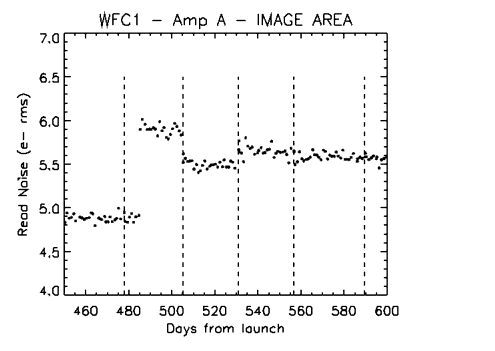
We measured the readnoise level in the active area and overscan regions for all the amplifiers at the default gain settings. In general the readnoise has been constant with time. On June 29, 2003, just after a transit through the South Atlantic Anomaly (SAA) the readnoise in Amp A changed from ~4.9 to ~5.9 electrons rms. Although the telemetry did not show any anomaly in any component of the camera, it is likely that the readnoise jump was due to some sort of radiation damage. Amp A is the only amplifier that showed this anomaly. The amplitude of the variation (~1 e-) was the same for GAIN 1 and 2. After the following anneal date the readnoise dropped to ~5.5 e- and it remained constant for 27 days. After the following two anneal cycles the readnoise reached stability at ~5.6 e- rms, approximately 0.7 e- higher than before the change, and has remained constant since then. Figure 4.4 shows the readnoise in the image area for amplifier A during the “instability” period. The readnoise of all the other amplifiers have been very stable since launch with post-launch figures almost unchanged from the pre-launch measurements made during ground testing.
Even with a slightly higher readnoise in Amp A most of the WFC broadband science observations are sky limited, while narrowband observations are primarily readnoise limited. Table 4.1 and Table 4.2 list the CCD gain measured under side-1 and side-2 operations. The ACS repair is expected to produce read noise levels comparable to or better than listed for Side-1.
Figure 4.4: Readnoise jump in WFC Amp A (occurred on June 29, 2003).The vertical dashed lines indicate the annealing dates. See Table 4.1 for CCD gain and readout noise values.
HRC
The readnoise is monitored only for the default readout amplifier C at the default gain setting (2 e-/DN). No variations have been observed with time. The readnoise measured in the image area (Tables 4.1 and 4.2) is in agreement with the readnoise measured in the two overscan regions, and it is comparable to the pre-flight value of 4.74 e-.
4.3.4 Dark Current
All ACS CCDs are buried channel devices which have a shallow n-type layer implanted below the surface to store and transfer the collected signal charge away from the traps associated with the Si-SiO2 interface. Moreover, ACS CCDs are operated in Multi Pinned Phases (MPP) mode so that the silicon surface is inverted and the surface dark current is suppressed. ACS CCDs therefore have very low dark current. The WFC CCDs are operated in MPP mode only during integration, so the total dark current figure for WFC includes a small component of surface dark current accumulated during the readout time.
Like all CCDs operated in a low earth orbit radiation environment, the ACS CCDs are subject to radiation damage by energetic particles trapped in the radiation belts. Ionization damage and displacement damage are two types of damage caused by protons in silicon. The MPP mode is very effective in mitigating the damage due to ionization such as the generation of surface dark current due to the creation of trapping states in the Si-SiO2 interface. Although only a minor fraction of the total energy is lost by a proton via nonionizing energy loss, the displacement damage can cause significant performance degradation in CCDs by decreasing the charge transfer efficiency (CTE), increasing the average dark current, and introducing pixels with very high dark current (hot pixels). Displacement damage to the silicon lattice occurs mostly due to the interaction between low energy protons and silicon atoms. The generation of phosphorous-vacancy centers introduces an extra level of energy between the conduction band and the valence band of the silicon. New energetic levels in the silicon bandgap have the direct effect of increasing the dark current as a result of carrier generation in the bulk depletion region of the pixel. As a consequence, the dark current of CCDs operated in a radiative environment is predicted to increase with time.
Ground testing of the WFC CCDs, radiated with a cumulative fluence equivalent to 2.5 and 5 years of on-orbit exposure, predicted a linear growth of ~1.5 e-/pixel/hour/year.
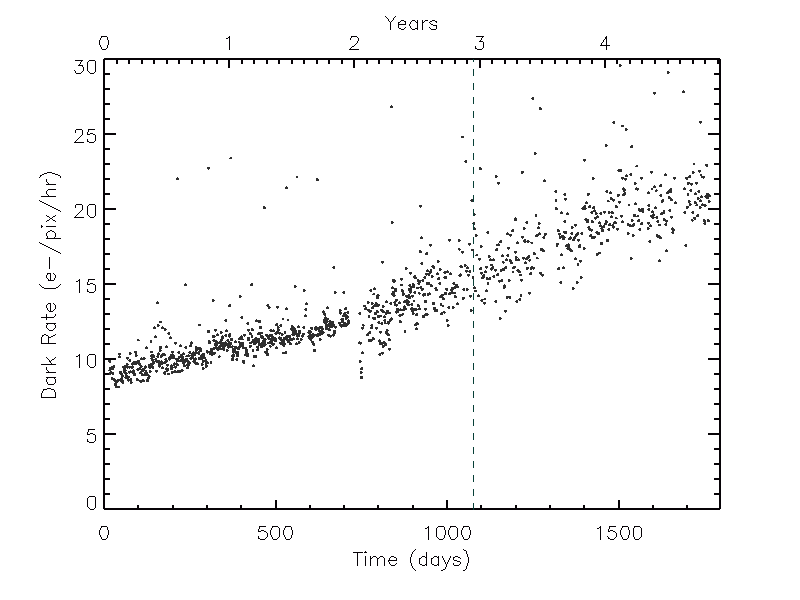
The dark current in ACS CCDs is monitored four days per week with the acquisition of four 1000 seconds dark frames (totaling 16 images per week). Dark frames are used to create reference files for the calibration of scientific images, and to track and catalog hot pixels as they evolve. The four daily frames are combined together to remove cosmic rays and to extract hot pixel information for any specific day. The dark reference files are generated by combining two weeks of daily darks in order to reduce the statistical noise. The hot pixel information for a specific day is then added to the combined bi-weekly dark. In order to study the evolution of the dark current with time, the modal dark current value in the cosmic-ray free daily darks is calculated. As expected, the dark current increases with time (Figure 4.5). The observed linear growth rates of dark current are 2.1 and 1.6 e-/pixel/hour/year for WFC1 and WFC2 respectively, and 2.1 e-/pixel/hour/year for the HRC CCD. These rates are in general agreement with the ground test predictions.
Simultaneously with the beginning of the side-2 operation in July 2006 the temperature set point of the WFC was lowered from -77 C to -80 C (see ACS TIR 2006-02).
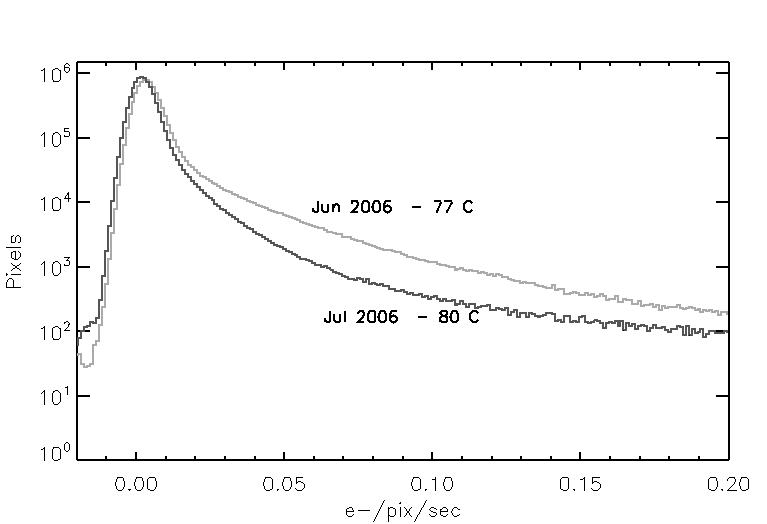
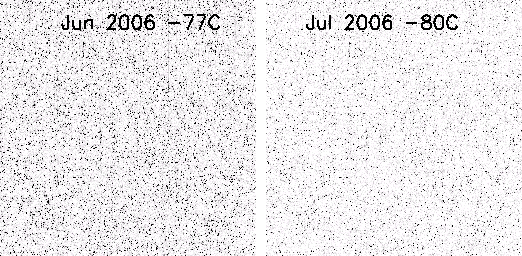
Dark current and hot pixels depended strongly on the operating temperature. The reduction of the operating temperature of the WFC CCDs reduced the number of hot pixels by almost 50%. The dark rate shows a clear drop on July 4, 2006, when the temperature was changed, and Figures 4.7 and 4.8 illustrate the before-and-after effect directly. The new operating temperature brought the dark current of the WFC CCDs back to the level eighteen months after the launch.
Figure 4.5: Dark rate trend with time for the WFC CCDs.Dark current as a function of time for one of the WFC CCDs. The first dashed line indicates the change in the anneal procedure from twelve to six hours for the duration of the warm-up period. The shorter anneal slightly increased the rate of growth of the dark current. The second dashed line indicates the change in temperature set point for the CCDs. As expected the dark current dropped drastically at the new temperature.
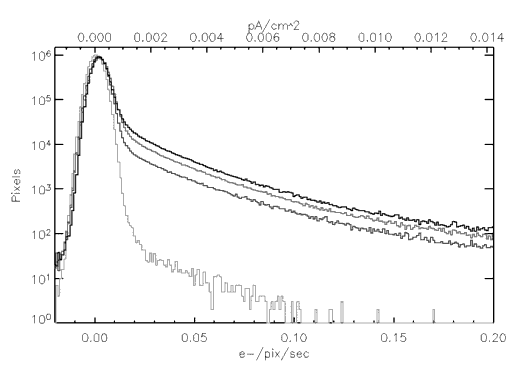
Figure 4.6: Dark current as a function of time for the HRCFigure 4.7: Histogram of WFC dark frames taken before and after the change in temperature.Figure 4.8: Sub-section of WFC dark frames showing hot pixel contamination before and after the change in temperature on July 4, 20064.3.5 Warm and hot pixels
In the presence of a high electric field, the dark current of a single pixel can be greatly enhanced. Such pixels are called dark spikes or hot pixels. Although the increase in the mean dark current with proton irradiation is important, of greater consequence is the large increase in dark current nonuniformity.
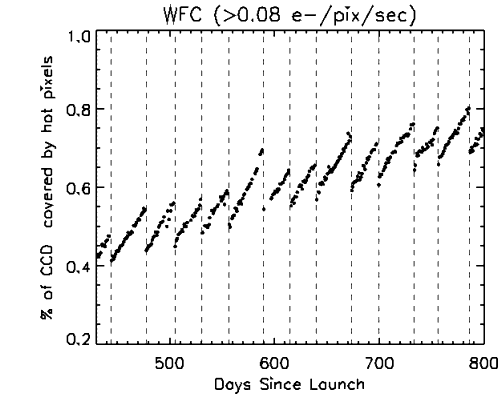
We have chosen to classify the field-enhanced dark spikes into two categories: warm and hot pixels. The definition of “warm” and “hot” pixel is somewhat arbitrary. We have chosen a limit of 0.08 e–/pixel/seconds as a threshold above which we consider a pixel to be “hot”. We identify “warm” pixels as those which exceed by about 5 s (~0.02 e–/pixel/second) the normal distribution of the pixels in a dark frame up to the threshold of the hot pixels (See Figure 4.11) for a typical dark rate pixel distribution)
Warm and hot pixels accumulate as a function of time on orbit. Defects responsible for elevated dark rate are created continuously as a result of the ongoing displacement damage on orbit. The number of new pixels with a dark current higher than the mean dark date increases every day by few to several hundreds depending on the threshold. The reduction of the operating temperature of the WFC CCDs has dramatically reduced the dark current of the hot pixels and therefore many pixels previously classified as hot are now warm or normal pixels.
Table 4.3: Creation rate of new hot pixels (pixel/day).Table 4.4: Annual permanent hot pixel growth (%).
Most of these new hot pixels are transient. Like others CCDs on HST, the ACS devices undergo a monthly annealing process. The CCDs and the thermal electric coolers (TECs) are turned off and the heaters are turned on to warm the chips to ~19 ×C. Although the annealing mechanism at such low temperatures is not yet understood, after this “thermal cycle” the population of hot pixels is greatly reduced (see Figure 4.9). The anneal rate depends on the dark current rate with very hot pixels being annealed easier than warmer pixels. For pixels classified as “hot” (those with dark rate > 0.08 e–/pix/sec) the anneal rate is ~82% for WFC and ~86% for HRC.
Annealing has no effect on the normal pixels that are responsible for the increase in the mean dark current rate. Such behavior is similar to what is seen with STIS SITe CCD and WFC3 CCDs during ground radiation testing.
Figure 4.9: Hot pixel growth in the WFC CCDs.The vertical dashed lines indicate the annealing dates.
During early annealing episodes the ACS CCDs were warmed up for 24 hours. But the annealing time was reduced to 6 hours in spring of 2004 to allow better scheduling of HST time. Even with a shorter cycle the effectiveness of the anneal in ACS CCDs has remained the same. It is interesting to note that since ACS launch, four HST safing events have occurred; after each event the population of hot pixels was reduced as if a normal anneal cycle has occurred. During the safing events the CCDs and the TECs were turned off. Since the heaters were not turned on, the CCDs warmed-up to only about -10 ×C. After a period of time ranging from 24 to 48 hours, HST resumed normal operation. The dark frames taken after the safing events showed a reduction in hot pixel population similar to those observed during normal annealing cycles.
Since the anneals cycle do not repair 100% of the hot pixels, there is a growing population of permanent hot pixels (see Figure 4.10 and Figure 4.11).
Figure 4.10: A subsection of WFC1 dark frames taken at different epochs showing the increasing population of hot pixels.From left to right: before launch, and after 1, 2 and 3 years on orbit.
Figure 4.11: Histogram of WFC dark frames taken at different epochs.Epochs pre-launch, and after 1,2, and 3 years on orbit. Both the mean dark rate increase and the growing population of permanent hot pixels are visible.
According to the current trend, about 0.3% of WFC (0.22% of HRC) pixels became permanently hot every year (see Table 4.4). In a typical 1000 second exposure the percentage of pixels contaminated by cosmic rays ranges between 1.5% and 3% of the total. By spring of 2007 the contamination from hot pixels will impact about 2% of the pixels (See Figure 4.12).
In principle, warm and hot pixels could be eliminated by the superdark subtraction. However, some pixels show a dark current that is not stable with time but switches between well defined levels. These fluctuations may have timescales of a few minutes and have the characteristics of random telegraph signal (RTS) noise. The dark current in field-enhanced hot pixels can be dependent on the signal level, so the noise is much higher than the normal shot noise. As a consequence, since the locations of warm and hot pixels are known from dark frames, they are flagged in the data quality. The hot pixels can be discarded during image combination if multiple exposures have been dithered.
While the standard CR-SPLIT approach allows for cosmic ray subtraction, without additional dithering, it will not eliminate hot pixels in post-observation processing.
For example, a simple ACS-WFC-DITHER-LINE pattern has been developed, based on integer pixel offsets, which shifts the image by 2 pixels in X and 2 pixels in Y along the direction that minimizes the effects of scale variation across the detector. The specific parameter values for this pattern are given on the ACS dithering Web page at:
Additional information can be found in the Phase II Proposal Instructions.
Given the transient nature of hot pixels, users are reminded that a few hot pixels may not be properly flagged in the data quality array (because they spontaneously “healed” or because their status changed in the period spanning the reference file and science frame acquisition), and therefore could create false positive detections in some science programs.
Figure 4.12: Growth of permanent warm and hot pixel population as a function of time (WFC top, HRC bottom).The contamination level due to cosmic rays accumulated in a 1000 second exposure is shown with a dashed line.
4.3.6 Cosmic Rays
Initial studies have been made of the characteristics of cosmic ray impacts on the HRC and WFC. The fraction of pixels affected by cosmic rays varies from 1.5% to 3% during a 1000 second exposure for both cameras, similar to what was seen on WFPC2 and STIS. This number provides the basis for assessing the risk that the target(s) in any set of exposures will be compromised. The affected fraction is the same for the WFC and HRC despite their factor of two difference in pixel areas because the census of affected pixels is dominated by charge diffusion, not direct impacts. Observers seeking rare or serendipitous objects, as well as transients, may require that every single WFC pixel in at least one exposure among a set of exposures is free from cosmic ray impacts. For the cosmic ray fractions of 1.5% to 3% in 1000 seconds, a single ~2400 second orbit must be broken into 4 exposures of 500 to 600 seconds each to reduce the number of uncleanable pixels to 1 or less. Users seeking higher S/N (lower readnoise) may prefer the trade-off of doing 3 exposures of ~800 seconds, where CR-rejection should still be very good for most purposes. But we do NOT recommend 2 long exposures (i.e. 1200 seconds), where residual CR contamination would be unacceptably high in most cases. We recommend that users dither these exposures to remove hot pixels as well as cosmic rays (see Section 7.4).
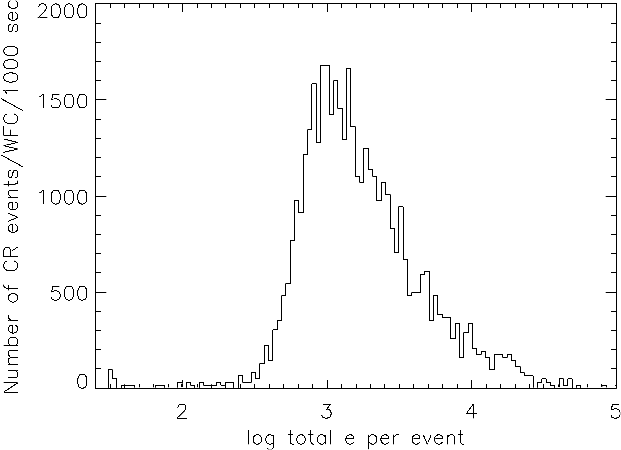
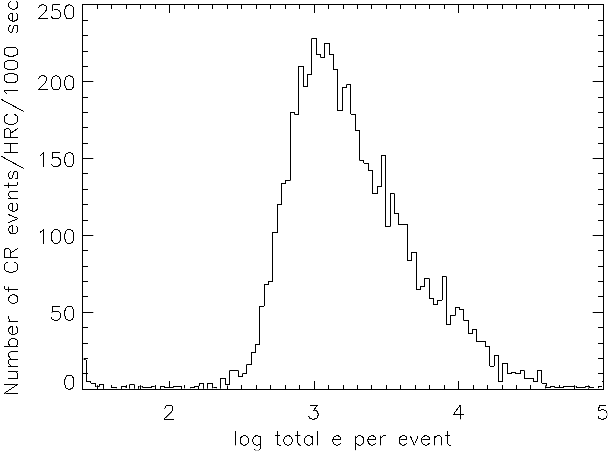
The flux deposited on the CCD from an individual cosmic ray does not depend on the energy of the cosmic ray but rather the length it travels in the silicon substrate. The electron deposition due to individual cosmic rays has a well defined cut-off with negligible events of less than 500 e– and a median of ~1000 e– (see Figure 4.13 and Figure 4.14).
Figure 4.13: Electron deposition by cosmic rays on WFC.Figure 4.14: Electron deposition of cosmic rays on HRC.The distribution of the number of pixels affected by a single cosmic ray is strongly peaked at 4 to 5 pixels. Although a few events are seen which encompass only one pixel, examination of these events indicate that at least some, and maybe all of these sources are actually transient hot pixels or unstable pixels which can appear hot in one exposure (with no charge diffusion) and normal in the next. Such pixels are very rare but do exist. There is a long tail in the direction towards increasing numbers of attached pixels.
Distributions of sizes and anisotropies can be useful for distinguishing cosmic rays from astrophysical sources in a single image. The size distribution for both chips peaks near 0.4 pixels as a standard deviation (or 0.9 pixels as a FWHM). This is much narrower than for a PSF and is thus a useful discriminant between unresolved sources and cosmic rays.
4.3.7 Charge Transfer Efficiency
Charge transfer efficiency (CTE) is a measure of how effective the CCD is at moving charge from one pixel location to the next when reading out the chip. A perfect CCD would be able to transfer 100% of the charge as the charge is shunted across the chip and out through the serial register. In practice, small traps in the silicon lattice compromise this process by holding on to electrons, releasing them at a later time. (Depending on the trap type, the release time ranges from a few microseconds to several seconds). For large charge packets (several thousands of electrons), losing a few electrons along the way is not a serious problem, but for smaller (~100 e– or less) signals, it can have a substantial effect.
CTE is typically measured as a pixel transfer efficiency, and would be unity for a perfect CCD. The CTE numbers for the ACS CCDs at the time of installation are given in Table 4.5. While the numbers look impressive, remember that reading out the WFC CCD requires 2048 parallel and 2048 serial transfers, so that almost 2% of the charge from a pixel in the corner opposite the readout amplifier is lost.
Table 4.5: Charge transfer efficiency measurements for the ACS CCDs at installation time (Fe55 test at 1620 e–).Also, the CTE numbers are significantly different for images where the pixels have a low intensity compared to those where the intensity is high.
Both the WFPC2 and STIS CCDs have been found to suffer from a significant degradation in CTE since their installation in 1993 and 1997, respectively. At the end of Cycle 11 we performed the first on-orbit calibration of the photometric losses due to imperfect CTE on ACS HRC and WFC and monitored CTE effects on photometry during the following cycles (11-14). We used images of 47 Tucanae to measure the dependence of stellar photometry on the number of parallel and serial transfers. The results are described by Riess et al. (ACS ISR 2003-09) and are summarized here. For WFC, significant photometric losses are apparent for stars undergoing numerous parallel transfers (y-direction). Extrapolated to 2008, the losses should be 3% for typical observing parameters, rising to ~15% in worst cases (faint stars, low background). The size of the photometric loss appears to have a strong power-law dependence on the stellar flux, as seen for other CCDs flown on HST.
The dependence on background is significant but for faint targets there is little advantage to increasing the background intentionally (e.g., by post-flashing) due to the added shot noise. However, in some specific cases, it may instead be useful to choose the filter in order to obtain a higher background (e.g. F606W). CTE degradation has also an impact on astrometry (see ACS ISR 2007-04). Therefore, for astrometric programs of relatively bright objects, the use of post-flash may be considered. No losses are apparent for WFC due to serial transfers (x-direction). For HRC, significant photometric losses also arise from parallel transfer (extrapolating to 2008, ~3% for typical observations, ~20% for worst case) but are not seen for serial transfer. Correction formulae are presented in ACS ISR 2004-06 to correct photometric losses as a function of a source’s position, flux, background, time, and aperture size. Updated formulae are in course of development and will substitute the previous ones. Users are encouraged to check the ACS Web page for updates.
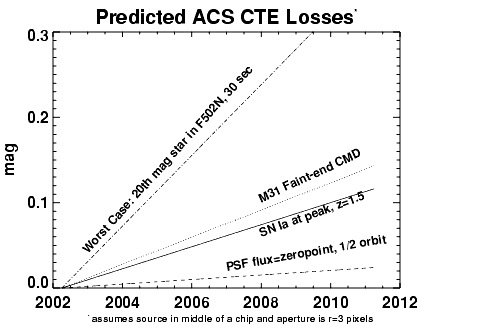
Figure 4.15 shows the predicted photometric losses for the WFC due to imperfect parallel CTE as a function of time. These curves are based on the formulae published in ACS ISR 2004-06 and require extreme extrapolation, therefore they should be used for planning purposes only. Four specific science applications are shown as examples: the measurement of the faint end of M31’s CMD (GO 9453), the measurement of high-redshift supernovae (GO 9528), the measurement of any PSF whose brightness is the zeropoint (i.e., 1 e–/second), and photometry of a 20th magnitude star in a narrow band.
Figure 4.15: Projected CTE losses in WFC (and equivalently, the size of corrections).Projected CTE losses in WFC for sample science applications described in Table 4.6. The precision of measurements is not limited by the size of the loss but rather its uncertainty. As a rule of thumb we suggest that the ultimate limit of precision will be ~25% of the loss after correction.
Table 4.6: Example of science applications and their assumed parameters.
When observing a single target significantly smaller than a single detector, it is possible to place it near an amplifier to reduce the impact of imperfect CTE. This is easy to accomplish by judicious choice of aperture and target position, or by utilizing POS TARG commands. However, be aware that large POS TARGs are not advisable because they change the fractional pixel shifts of dither patterns due to the geometric distortion of ACS. An alternative means to achieve the placement of a target near the amplifier is by using some of the subarray apertures. For example, WFC1-512 (target will have 256 transfers in X and Y), WFC1-1K, and WFC1-2K place the target near the B amplifier (or WFC2-2K for the C amplifier).
4.3.8 UV Light and the HRC CCD
In the optical, each photon generates a single electron. However, in the near-UV, shortward of ~3200 Å there is a finite probability of creating more than one electron per UV photon (see Christensen, O., J. App. Phys. 47,689, 1976). At room temperature the theoretical quantum yield (i.e., the number of electrons generated for a photon of energy E > 3.5eV (l~3500 Å)), is Ne = E(eV)/3.65. The HRC CCDs quantum efficiency curve has not been corrected for this effect. The interested reader may wish to see the STIS Instrument Handbook for details on the signal-to-noise treatment for the STIS CCDs.
|
Space telescope Science Institute http://www.stsci.edu |