4.2 The CCDs
4.2.1 Detector Properties
WFC Properties
The WFC/CCD consists of two 4096 x 2048 charge-coupled devices that are sensitive from the near-UV to the near-IR. These CCDs are thinned, backside-illuminated devices manufactured by Scientific Imaging Technologies (SITe) and are butted together along their long dimension to create an effective 4096 ¥ 4096 array with a gap corresponding to approximately 50 pixels between the chips. The CCD camera design incorporates a warm dewar window, designed to prevent buildup of contaminants on the window that cause a loss of UV throughput.
A summary of the
ACS CCDperformance is given in Table 3.1.HRC
The HRC CCD is a flight-spare STIS 1024 ¥ 1024 CCD and is a thinned, backside-illuminated device, manufactured at SITe. The coating uses a process developed by SITe to provide good quantum efficiency in the near-ultraviolet. The performance characteristics and specifications are given in Table 3.1
4.2.2 CCD Spectral Response
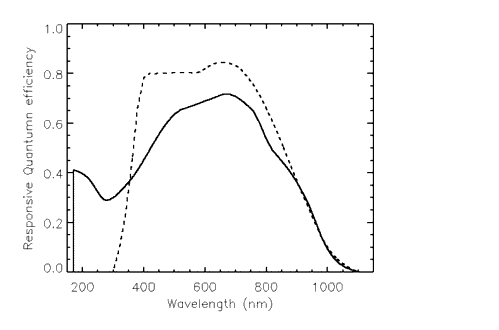
The responsive quantum efficiency (RQE) of the WFC and HRC CCDs is shown in Figure 4.1; the RQE includes corrections needed to reproduce the instrument sensitivity measured on orbit (ACS ISR 2007-06). The total spectral response of the camera (see Figure 5.7) is given by the convolution of the RQEs shown here and the throughput of optical elements of the camera. For example, the WFC silver coated mirrors enhance the reflectivity in the near-IR but impose a violet cutoff below 370nm.
Figure 4.1: Responsive quantum efficiency of the HRC CCD (solid line) and WFC CCDs (dashed line).4.2.3 Quantum Efficiency Hysteresis
Based on current data, the ACS CCDs do not suffer from quantum efficiency hysteresis (QEH). The CCDs respond in the same way to light levels over their whole dynamic range, irrespective of the previous illumination level.
4.2.4 CCD Long-Wavelength Fringing
Like most thinned CCDs, the ACS CCDs exhibit fringing in the red, longward of ~7500 Å. The amplitude of the fringes is a strong function of wavelength and spectral resolution. The fringe pattern can be corrected by rectification with an appropriate flat field. The fringe pattern is a convolution of the contours of constant distance between the front and back surfaces of the CCD, and the wavelength of light on a particular part of the CCD. The fringe pattern has been shown to be very stable in similar devices, as long as the wavelength of light on a particular part of the CCD stays constant. In practice, this means that the fringe pattern is dependent on the spectrum of the light incident on the detector, with the sensitivity to the source spectrum a function of the bandwidth of the filter.
4.2.5 Readout Format
WFC
Each CCD chip is read out as a 4144 ¥ 2068 array, including physical and virtual overscans. Two different amplifiers are used to read out each half of the chip. The final images consist of 24 columns of physical overscan, 4096 columns of pixel data, and another 24 columns of physical overscan. Each column consists of 2048 rows of pixel data followed by 20 rows of virtual overscan. The orientation of the chip is such that for the grism spectra, the dispersed images have wavelength increasing from left to right in the positive x-direction.
HRC
The HRC CCD is read out as a 1062 ¥ 1044 array, including physical and virtual overscans. There are 19 columns of physical overscan, followed by 1024 columns of pixel data, and then 19 more columns of physical overscan. Each column consists of 1024 rows of pixel data followed by 20 rows of virtual overscan. As with the WFC, the orientation of the chip was chosen so that grism images have wavelength increasing from left to right.
4.2.6 Analog-To-Digital Conversion
Electrons which accumulate in the CCD wells are read out and converted to data numbers (DN) by the analog-to-digital converter (ADC). The ADC output is a 16 bit number, producing a maximum of 65,535 DN in one pixel.
Up to Cycle 15 the CCDs were capable of operating at gains of 1, 2, 4 or 8 electrons/DN. While for the HRC operation no changes are expected for Cycle 17, the possible gain settings for the WFC are still to be defined. In principle, use of a lower gain value can increase the dynamic range of faint source observations by reducing the quantization noise; however, in practice this improvement is not significant. Table 4.1 and Table 4.2 show the actual gain levels and readout noise in electrons for the four WFC amps, and the default C amp used for the HRC for SIDE 1 and SIDE 2 respectively.
Table 4.1: CCD gain and readout noise (e- rms) under SIDE-1 operation (03/2002->06/2006).Table 4.2: CCD gain and readout noise (e- rms) under SIDE-2 operation (07/2006-01/2007)As in previous cycles the number of fully supported gain factors will be likely limited to two per each camera. The remaining gain factors will be available but unsupported so users of those modes will need to plan their own calibration. The supported gain factors will provide the lowest readnoise and/or the better sampling of the detector full well. Further information about gain values for cycle 17 will be made available in the ACS Web page as soon as is available.
4.2.7 Flat Fields
WFC
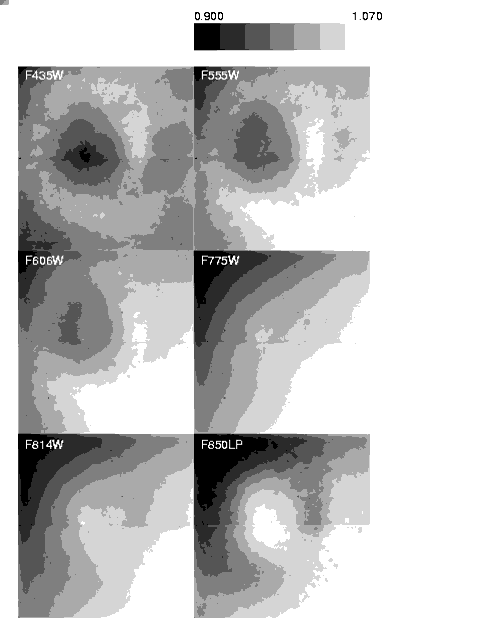
The flat fields for the WFC combine information from two sources. Ground-based flats were obtained for all filters at a signal-to-noise of ~300 per pixel. To refine the low-frequency domain of the ground flats, inflight observations of a rich stellar field with large scale dithers have been analyzed (see ACS ISR 2002-08 and 2003-10). The required L-flat correction is a corner-to-corner gradient of 10 to 18%, dependent on wavelength. The resulting flat field supports photometry to ~1% over the full WFC field of view.
Figure 4.2 shows the corrected WFC ground flats for several broadband filters. Note: the 50 pixel gap seen in external images, between the top and bottom chips, is not shown here. Since the two CCDs were cut from the same Si wafer, and have undergone similar treatments, there is a significant continuity in the response across the gap.The central donut-like structure is wavelength dependent, where pixels in the central region are less sensitive than surrounding pixels in the blue F435W filter, for example, and more sensitive in the red F850LP filter. For further discussion of WFC flat fields, see ACS ISRs 2001-11, 2002-04, 2003-10, 2003-11, 2005-02, and 2005-09.
HRC
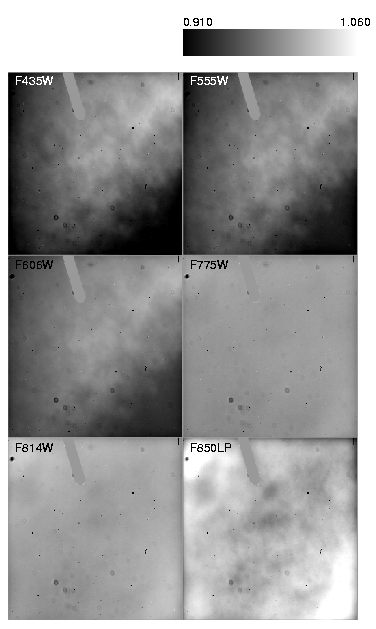
As for the WFC, the HRC ground flats were refined using in-flight observations of a rich stellar field with large scale dithers to determine the low-frequency domain of the flat fields. The correction required for the visible filters is a corner-to-corner gradient of 6% to 12%, dependent on wavelength. For the NUV filters, flats were taken in-flight using observations of the bright earth (see ACS ISR 2003-02) and include both the pixel-to-pixel and low-frequency structure of the detector response.
Currently, HRC flat fields have a signal-to-noise of ~300 per pixel and support photometry to ~1% over the full HRC field of view. Figure 4.3 shows the corrected HRC ground flats, derived for 6 broadband optical filters. The donut-like structure seen in the WFC response is not found in the HRC flats. For further discussion of HRC flat fields, see ACS ISRs 2001-11 and 2002-04.
Figure 4.2: WFC flat field.Figure 4.3: HRC flat field.
|
Space telescope Science Institute http://www.stsci.edu |