9.3 Computing Exposure Times
To derive the exposure time to achieve a given signal-to-noise ratio, or to derive the signal to noise ratio in a given exposure time, there are four principal ingredients:
- Expected counts C from your source over some area.
- The area (in pixels) over which those counts are received (Npix).
- Sky background (Bsky) in counts/pixel/second.
- The detector background, or dark, (Bdet) in counts/second/pixel and the readnoise (R) in counts of the CCD.
- Section 9.4 provides the information for determining the sky-plus-detector background.
9.3.1 Calculating Exposure Times for a Given signal-to-noise
The signal-to-noise ratio,
is given by
:
Where:
- C = the signal from the astronomical source in counts/second, or electrons/second from the CCD. The actual output signal from a CCD is C/G where G is the gain. You must remember to multiply by G to compute photon events in the raw CCD images.
- G = the gain is always 1 for the SBC, and ~1, 2, 4, or 8 for the CCDs, depending on GAIN.
- Npix = the total number of detector pixels integrated over to achieve C.
- Bsky = the sky background in counts/second/pixel.
- Bdet = the detector dark current in counts/second/pixel.
- R = the readnoise in electrons; = 0 for SBC observations, 5.0 and 4.7 for WFC and HRC respectively
- Nread = the number of CCD readouts.
- t = the integration time in seconds.
This equation assumes the optimistic (and often realistic) condition that the background zero point level under the object is sufficiently well known (and subtracted) to not significantly contribute; in crowded fields this may not be true.
Observers using the CCD normally take sufficiently long integrations that the CCD readnoise is not important. This condition is met when:
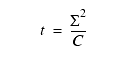
For the CCD in the regime where readnoise is not important and for all SBC observations, the integration time to reach a signal-to-noise ratio
, is given by:
If your source count rate is much brighter than the sky plus detector backgrounds, then this expression reduces further to:
i.e., the usual result for Poisson statistics of
.
More generally, the required integration time to reach a signal-to-noise ratio
is given by:
9.3.2 Exposure Time Estimates for Red Targets in F850LP
At wavelengths greater than 7500 Å (HRC) and about 9000 Å (WFC) ACS CCD observations are affected by a red halo due to light scattered off the CCD substrate. An increasing fraction of the light as a function of wavelength is scattered from the center of the PSF into the wings. This problem affects particularly the very broad z-band F850LP filter, for which the encircled energy depends on the underlying spectral energy distribution the most. In the currently available ETC, the treatment of such an effect has been ameliorated but not solved. The encircled energy fraction is calculated at the effective wavelength which takes into account the source spectral distribution. This fraction is then multiplied by the source counts. (The effective wavelength is the weighted average of the system throughput AND source flux distribution integrated over wavelength). However, this does not account for the variation in enclosed energy with wavelength.
As a consequence, in order to obtain correct estimated count rates for red targets, observers are advised to use the synphot package in IRAF/STSDAS for which the proper integration of encircled energy over wavelength has now been incorporated. To quantify this new synphot capability, we compare the ETC results with synphot for a set of different spectral energy distributions and the observation mode WFC/F850LP. In Table 9.4, the spectral type is listed in the first column. The fraction of light with respect to the total integrated to infinity is listed in the other two columns, for the ETC and synphot calculations respectively. These values are derived for a 0.2 arcseconds aperture for the ETC calculations and synphot.
Table 9.4: Encircled energy comparison for WFC/F850LP.The ETC results are off by 3% (O star), 2% (M star), 2% (L star), and 1% (T star). If this small effect is relevant to particular observations, then the synphot software package can be used. To learn how to use the synphot tool, we refer to the instructions provided in the April 2003 STAN, http://www.stsci.edu/hst/acs/documents/newsletters/stan0302.html, and in ACS ISR 2003-08.
|
Space telescope Science Institute http://www.stsci.edu |