
9.2 Determining Count Rates from Sensitivities
In this Chapter, specific formulae appropriate for imaging and spectroscopic modes are provided to calculate the expected count rates and the signal-to-noise ratio from the flux distribution of a source. The formulae are given in terms of sensitivities, but we also provide transformation equations between the throughput (QT) and sensitivity (S) for imaging and spectroscopic modes.
Throughputs are presented in graphical form as a function of wavelength for the prisms and for the imaging modes in Chapter 10. Given your source characteristics and the sensitivity of the ACS configuration, calculating the expected count rate over a given number of pixels is straightforward, since the ACS PSF is well characterized. The additional required information is the encircled energy fraction (ef) in the peak pixel, the plate scale, and the dispersions of the grisms and prisms. This information is summarized in Table 9.1, Table 9.2, and Table 9.3 for Side 1. For updates please see the ACS Web page.
Table 9.1: Useful quantities for the ACS WFC.Table 9.2: Useful quantities for the ACS HRC.Table 9.3: Useful quantities for the ACS SBC.In each Table, the following quantities are listed:
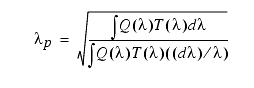
- The pivot wavelength, a source-independent measure of the characteristic wavelength of the bandpass, defined such that it is the same if the input spectrum is in units of Fl or Fn:
- The integral ÚQlTl dl/l, used to determine the count rate when given the astronomical magnitude of the source.
- The ABmag zero point, defined as the AB magnitude of a source with a constant Fn that gives 1 count/second with the specified configuration.
- The sensitivity integral, defined as the count rate that would be observed from a constant Fl source with flux 1 erg/cm2/second/Å.
- The encircled energy, defined as the fraction of PSF flux enclosed in the default photometry aperture 0.2 arcseconds for the WFC and HRC, and 0.5 arcseconds for the SBC. These correspond approximately to 5 ¥ 5, 9 ¥ 9, and 15 ¥ 15 box-sizes respectively.
- The fraction of PSF flux in the central pixel, useful for determining the peak count rate to check for overflow or bright object protection possibilities.
- The sky background count rate, which is the count rate that would be measured with average zodiacal background, and average earthshine. It does not include the contribution from the detectors, tabulated separately in Table 3.1
Here, we describe how to determine two quantities:
- The counts/second (C) from your source over some selected area of Npix pixels, where a signal of an electron on a CCD is equivalent to one count.
- The peak counts/second/pixel (Pcr) from your source, which is useful for avoiding saturated CCD exposures, and for assuring that SBC observations do not exceed the bright-object limits.
We consider the cases of point sources and diffuse sources separately in each of the imaging and spectroscopy sections following.
9.2.1 Imaging
Point Source
For a point source, the count rate, C, can be expressed as the integral over the bandpass of the filter:
- A is the area of the unobstructed 2.4 meter telescope (i.e., 45,239 cm2)
- Fl is the flux from the astronomical source in erg/second/cm2/Å
- h is Planck’s constant
- c is the speed of light
- The factor l/hc converts ergs to photons.
- QlTl is the system fractional throughput, i.e., the probability of detecting a count per incident photon, including losses due to obstructions of the full 2.4 meter OTA aperture. It is specified this way to separate out the instrument sensitivity Ql and the filter transmission Tl.
- ef = the fraction of the point source energy encircled within Npix
pixels.- Sl is the total imaging point source sensitivity with units of
counts/second/Å per incident erg/second/cm2/Å.The peak counts/second/pixel from the point source, is given by:
Where:
Again, the integral is over the bandpass.
If the flux from your source can be approximated by a flat continuum (Fl = constant) and ef is roughly constant over the bandpass, then:
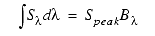
We can now define an equivalent bandpass of the filter (Bl) such that:
Where:
The count rate from the source can now be written as:
In Tables 9.1 to 9.3, we give the value of
for each of the filters.
Alternatively, we can write the equation in terms of V magnitudes:
where V is the visual magnitude of the source, the quantity under the integral sign is the mean sensitivity of the detector+filter combination, and is tabulated in Tables 9.1 to 9.3, and ABn is the filter-dependent correction for the deviation of the source spectrum from a constant Fn spectrum. This latter quantity is tabulated for several different astronomical spectra in Tables 10.1 to 10.3 in Chapter 10.
Diffuse Source
For a diffuse source, the count rate, C, per pixel, due to the astronomical source can be expressed as
:
Where:
Emission Line Source
For a source where the flux is dominated by a single emission line, the count rate can be calculated from the equation
where C is the observed count rate in counts/second, (QT) is the system throughput at the wavelength of the emission line, F(l) is the emission line flux in units of erg/cm2/second, and l is the wavelength of the emission line in Angstroms. (QT)l can be determined by inspection of the plots in Chapter 10. See Section 9.6.4 for an example of emission-line imaging using ACS.
9.2.2 Spectroscopy
Point Source
For a point source spectrum with a continuum flux distribution, the count rate, C, is per pixel in the dispersion direction, and is integrated over a fixed extraction height
in the spatial direction perpendicular to the dispersion:
Where:
For an unresolved emission line at
with a flux of
in
erg/second/cm2 the total counts recorded over the Nspix extraction height is:
These counts will be distributed over pixels in the wavelength direction according to the instrumental line spread function.
In contrast to the case of imaging sensitivity
, the spectroscopic point source sensitivity calibration (
) for a default extraction height of Nspix is measured directly from observations of stellar flux standards after insertion of ACS into HST. Therefore, the accuracy in laboratory determinations of
for the ACS prisms and grisms is NOT crucial to the final accuracy of their sensitivity calibrations.
The peak counts/second/pixel from the point source, is given by:
Where:
|
Space telescope Science Institute http://www.stsci.edu |








 is the total point source sensitivity in units of counts/second per incident erg/second/cm
 is the fraction of the point source energy within

 is the fraction of energy contained within the peak pixel.