5.1 Imaging Overview
ACS can be used to obtain images through a variety of optical and ultraviolet filters. When the selected ACS camera is the WFC or the HRC, the appropriate filter in one of the two filter wheels is rotated into position, and a clear aperture is automatically selected on the other filter wheel. For SBC imaging the single filter wheel is rotated to the required position. A number of apertures are defined for each ACS camera. In general, these refer to different target positions on the detector.
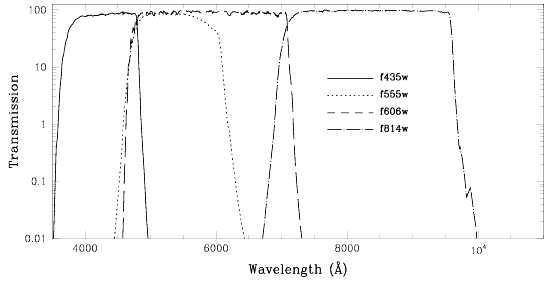
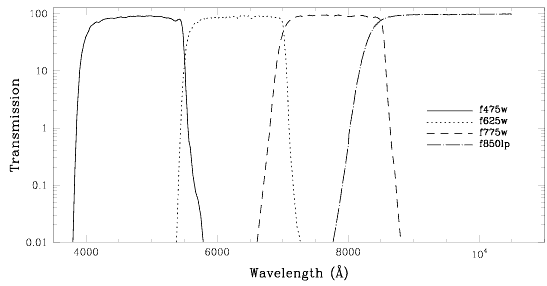
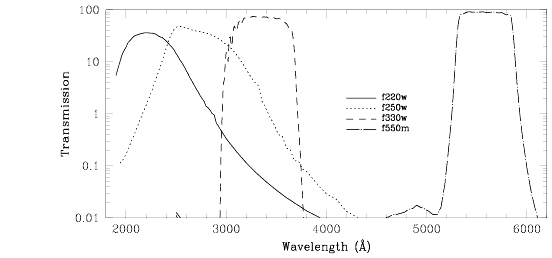
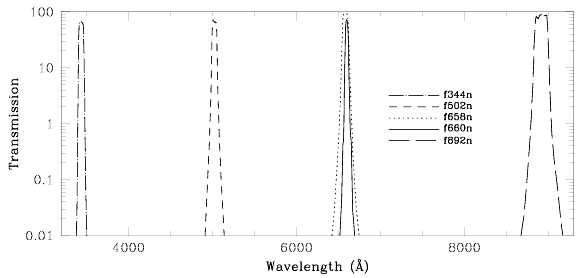
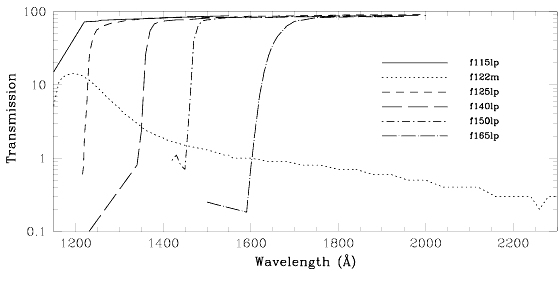
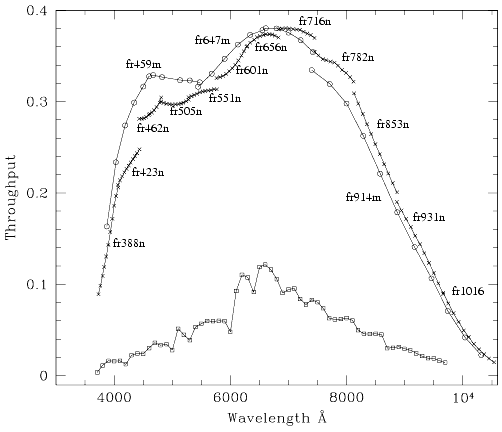
Table 5.1, Table 5.2, and Table 5.3 provide a complete summary of the filters available for imaging with each detector. Figures 5.1 through 5.6 show the filter transmission curves, and Figure 5.7 shows the integrated system throughputs.
The CCD filter wheels contain filters of two different sizes. Some filters (F435W, F475W, F502N, F550M, F555W, F606W, F625W, F658N, F660N, F775W, F814W, F850LP, and, G800L) are full-sized filters that can be used with both WFC and HRC. Others (F220W, F250W, F330W, F344N, F892N, POL0UV, POL60UV, POL120UV, POL0V, POL60V, POL120V, and PR200L) are smaller, giving a full unvignetted field of view when used with the HRC, but a vignetted field of view of only 72 ¥ 72 arcseconds when used with the WFC. Use of the small UV filters is not supported with the WFC due to the unpredictable behavior of the silver coatings shortward of 4000 Å.
The ramp filters are designed to allow narrow or medium band imaging centered at an arbitrary wavelength. Each ramp filter is divided into three segments, of which only the middle segment may be used with the HRC. More information is available at Section 7.7.2.
Note that although the CLEAR filters are specified in the filter wheel tables, users do not need to specify these filters in their HST proposals; they are added automatically in conjunction with the desired filter in the complementary wheel. In the SBC filter wheel, every third slot (#1, 4, 7, 10) is blocked off, so that in the case of a bright object limit violation, it is only necessary to rotate the filter wheel to an adjacent slot to block the incoming light.
With either the WFC or HRC, it is possible to select a filterless observation by specifying CLEAR (this is an “available-but-unsupported” filter) as the filter name, although the image will be of degraded quality. Rough wavelengths and widths, when used with the WFC or HRC, are listed in Table 5.1 under CLEAR entries. Use of CLEAR will provide slightly degraded PSFs with the HRC and seriously degraded PSFs for the WFC. More details on PSFs with use of CLEAR are provided in ACS ISR 2003-03. Applications are expected to be rare, but a valid use could be astrometry of extremely faint targets with the HRC when color information is not required.
Table 5.1: ACS WFC/HRC filters in Filter Wheel #1.[/WFC] indicates that polarizer filters, designed for the HRC field of view, induces vignetting when used with the WFC, producing a 72 by 72 arcsecond field of view.Table 5.2: ACS WFC/HRC filters in Filter Wheel #2.[/WFC] indicates that polarizer filters, designed for the HRC field of view, induces vignetting when used with the WFC, producing a 72 by 72 arcsecond field of view.Table 5.3: ACS SBC filter complement.Figure 5.1: ACS broad-band filters.Figure 5.2: ACS SDSS filters.Figure 5.3: ACS UV and medium-band filters.Figure 5.4: ACS narrow-band filters.Figure 5.5: ACS SBC filters.Figure 5.6: Comparison between the ACS and WFPC2 ramp filters.The crosses and open circles are for the ACS narrow and medium band ramps. The open squares are for the 4 WFPC2 ramps. For each of the ACS ramps the peak throughput that was calculated for eleven central wavelength values is plotted. For the WFPC2 ramps, the peak throughput calculated every 100 Å within the field of view of any of the 4 chips, and a 0 filter rotation angle (as mapped in Figures 3.4 and 3.5 of the WFPC2 Instrument Handbook, version 3.0), are plotted.
|
Space telescope Science Institute http://www.stsci.edu |