3.3 Instrument Design
3.3.1 Detectors
ACS uses the following detectors in each channel:
- The WFC employs a mosaic of two 4096 x 2048 Scientific Imaging Technologies (SITe) CCDs. The 15 x 15 µm pixels provide ~0.05 arcseconds/pixel spatial resolution, with critical sampling at 11,600 Å, resulting in a nominal 202 x 202 arcsecond field of view (FOV). The spectral sensitivity of the WFC ranges from ~3500 Å to ~11,000 Å, with a peak efficiency of 48% at ~7000 Å (including OTA).
- The HRC detector is a 1024 x 1024 SITe CCD, with 21 x 21 µm pixels that provide ~0.028 x 0.025 arcsecond/pixel spatial resolution with critical sampling at 6300 Å. This gives the HRC a nominal 29 x 26 arcsecond field of view. The spectral response of the HRC ranges from ~1700 Å to ~11,000 Å, and it has a peak efficiency of 29% at ~6500 Å (including OTA).
- The SBC detector is a solar-blind CsI microchannel plate (MCP) with Multi-Anode Microchannel Array (MAMA) readout. It has 1024 x 1024 pixels, each 25 x 25 µm in size. This provides a spatial resolution of ~0.034 x 0.030 arcseconds/pixels, producing a nominal FOV of 34.6 x 30.1 arcseconds. The SBC UV spectral response ranges from ~1150 Å to ~1700 Å with a peak efficiency of 7.5% at 1250 Å.
The WFC & HRC CCDs
The ACS CCDs are thinned, backside-illuminated full-frame devices cooled by thermo-electric cooler (TEC) stacks housed in sealed, evacuated dewars with fused silica windows. The spectral response of the WFC CCDs is optimized for imaging at visible to near-IR wavelengths, while the HRC CCD spectral response is optimized specifically for near-UV wavelengths. Both CCD cameras produce a time-integrated image in the
ACCUMdata-taking mode. As with all CCD detectors, there is noise (readout noise) and time (read time) associated with reading out the detector following an exposure.The minimum exposure time is 0.1 seconds for the HRC and 0.5 seconds for the WFC. Between successive identical exposures, the minimum time is 45 seconds for the HRC, and 135 seconds for the WFC, for full-frame readouts. However, this can be reduced to as little as ~35 seconds for WFC subarray readouts. The dynamic range for a single exposure is ultimately limited by the depth of the CCD full well (~85,000 e– for the WFC and 155,000 e– for the HRC), which determines the total amount of charge that can accumulate in any one pixel during an exposure without saturation. Cosmic rays will affect all CCD exposures. CCD observations should be broken into multiple exposures whenever possible to allow removal of cosmic rays in post-observation data processing, see Section 4.3.6.
The SBC MAMA
The SBC MAMA is a photon-counting detector which provides a two-dimensional ultraviolet capability. It can only be operated in ACCUM mode. In order to preserve its functionality, the SBC MAMA detector is subject to both scientific and absolute brightness limits. At high local ( 50 counts/second/pixel) and global (> 200,000 counts/second) illumination rates, counting becomes nonlinear in a way that is not correctable. At only slightly higher illumination rates, the MAMA detectors are subject to damage. We have therefore defined absolute local and global count rate limits, which translate to a set of configuration-dependent bright-object screening limits. Sources which violate the screening limits in a given configuration cannot be observed in those configurations, as discussed in Section 4.6 and Section 7.2.
3.3.2 ACS Optical Design
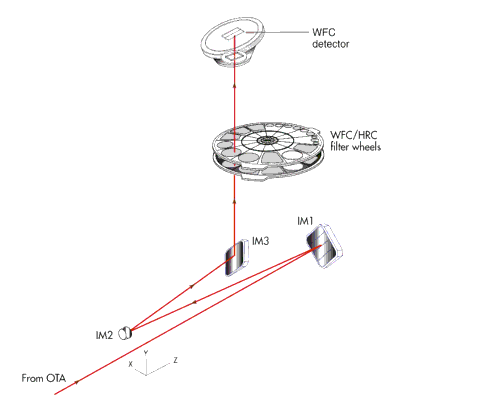
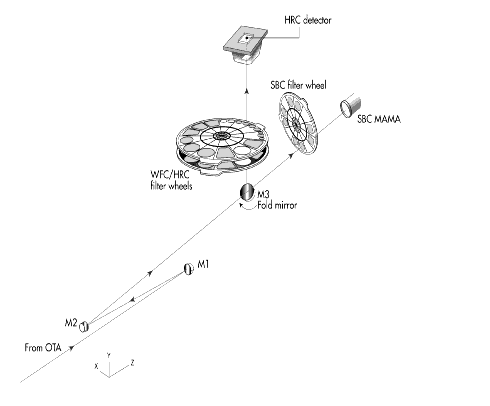
The ACS design incorporates two main optical channels: one for the WFC, and one which is shared by the HRC and SBC. Each channel has independent corrective optics to compensate for spherical aberration in the HST primary mirror. The WFC has three silver-coated optics to optimize instrument throughput in the visible and near-IR. The silver coatings cut off at wavelengths shortward of 3500 Å. The WFC has two filter wheels which it shares with the HRC, offering the possibility of internal WFC/HRC parallel observing for some filter combinations (Section 7.9). The optical design of the WFC is shown schematically in Figure 3.2. The HRC/SBC optical chain comprises three aluminized mirrors overcoated with MgF2, shown schematically in Figure 3.3. The HRC or SBC channels are selected by means of a plane fold mirror (M3 in Figure 3.3). The HRC is selected by inserting the fold mirror into the optical chain so that the beam is imaged onto the HRC detector through the WFC/HRC filter wheels. The SBC channel is selected by moving the fold mirror out of the beam to yield a two mirror optical chain that focuses light through the SBC filter wheel onto the SBC detector. The aberrated beam coronagraph is accessed by inserting a mechanism into the HRC optical chain. This mechanism positions a substrate with two occulting spots at the aberrated telescope focal plane and an apodizer at the re-imaged exit pupil.
While there is no mechanical reason why the coronagraph could not be used with the SBC, for health and safety reasons, use of the coronagraph is forbidden with the SBC.
Figure 3.2: ACS optical design: wide field channel.Figure 3.3: ACS optical design: high resolution/solar blind channelsFilter Wheels
ACS has three filter wheels: two shared by the WFC and HRC, and a separate wheel dedicated to the SBC. The WFC/HRC filter wheels contain the major filter sets. Each wheel also contains one clear WFC aperture and one clear HRC aperture (see Chapter 5 for more on filters). Parallel WFC and HRC observations are possible for some filter combinations (auto-parallels) and these are automatically added by the Astronomer's Proposal Tool (APT) (http://apt.stsci.edu/) in Phase II, unless the user disables this option via the PAREXP optional parameter, or if adding the parallel observations disallowed due to timing considerations. Because the filter wheels are shared, it is not possible to independently select the filter for WFC and HRC parallel observations.
Calibration-Lamp Systems
ACS has a calibration subsystem consisting of tungsten lamps and a deuterium lamp for internally flat fielding each of the optical chains. The calibration subsystem illuminates a diffuser on the rear surface of the ACS aperture door, which must be closed for calibration exposures. Under normal circumstances, users are not allowed to use the internal calibration lamps.
In addition, a post-flash capability was added to the instrument to provide the means of mitigating the effects of Charge Transfer Efficiency (CTE) degradation. We do not expect to use this facility at present (except for calibration and characterization) but in later years, as radiation damage of the CCDs causes the CTE to degrade, it is possible that some users will want to avail themselves of this facility. Astrometry programs may particularly benefit from the use of this capability, as is discussed briefly in Section 4.3.7. Since we are not yet at a stage where use of post-flash is expected to be useful for any science observations, we do not provide an extensive discussion related to it.
|
Space telescope Science Institute http://www.stsci.edu |