Space Telescope Imaging Spectrograph Instrument Handbook for Cycle 14
 |
 |
 |
 |
 |
|
| Space Telescope Imaging Spectrograph Instrument Handbook for Cycle 14 | |||||
| ||||||
12.1 Slitless First-Order Spectroscopy
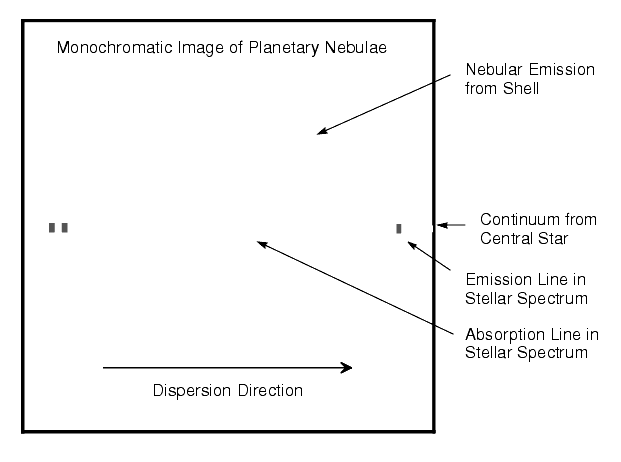
The vast majority of STIS first-order grating mode observations use a long slit. The use of a long slit ensures a clean separation of emission lines arising from different spatial features. However, all of STIS's first-order gratings as well as the NUV-PRISM (see Table 4.1) can also be used slitless or with a wide slit to obtain emission-line images. Figure 12.1 below shows a schematic example of a slitless spectrogram. Figure 4.9 shows an image of SN1987A observed using the
52X2aperture, and as the source is smaller than the slit, this is effectively a slitless image.The Advanced Camera for Surveys (ACS) also can be used for slitless spectroscopy. A comparison of STIS and ACS spectroscopy can be found in Section 4.1.2.
Figure 12.1: Schematic Slitless Spectrogram of Planetary Nebula
When STIS is used slitless (or with a wide slit), the image obtained will be the sum of a series of shifted monochromatic images of the field of view. The range of wavelengths covered in the series of monochromatic images is dictated by the spectral range of the grating. The result is that there is not a one-to-one mapping of pixel location to wavelength in your image or of pixel location to spatial location on the sky. Depending on the structure of your source and the grating you use, it may be easy to deconvolve the spatial and spectral information, or it may be very difficult.
Slitless spectroscopy can be employed either for prime or parallel STIS observing, (although MAMA pure parallels are not allowed). If you are designing a slitless spectroscopic observation there are a few important points to keep in mind:
- The more complex the emission-line, velocity, and spatial structure of your target field, the more difficult it will be to deconvolve the spatial and spectral information. It is important to match the grating you choose to the structure of your source. Gratings which produce images of multiple, kinematically resolved emission lines will be the most challenging to deconvolve. At the other extreme, a grating which covers only a single strong emission line at a resolution where the lines are kinematically unresolved will produce a clean image of the source in the single emission line (see Figure 12.1, above). You may also wish to specify the orientation for slitless spectroscopic observations to ensure that the most complex source structure is oriented perpendicular to the dispersion axis (see Section 11.4).
- Since each point in the sky emits geocoronal light, the background due to the geocoronal emission lines (Lyman-

1216, [O I]
- Slitless spectroscopic data will not be fully calibrated by the STScI STIS pipeline. Slitless spectroscopic data will be passed through the first phase of calibration and a flat-fielded calibrated image will be produced; however, the pipeline will not attempt to spectroscopically calibrate the data. This process must be interactively done by the observer since, as described above, ambiguous overlap of spatial and spectral information will occur. The slitless task in the stsdas.contrib package (originally contributed by ST-ECF) is available to aid in performing this post-pipeline processing. The Spectrographs Branch at STScI is currently working on a self-extraction tool for objective-prism data.
In order to properly calibrate slitless data it is necessary to know the position of each source along the dispersion direction. To do this it is usually necessary to take in the same visit a STIS image of the field for which you are obtaining slitless spectroscopy. Variations in the positioning of the Mode Select Mechanism (MSM), which contains the mirrors and gratings, can result in an uncertainty of the position of an image or spectrum on the detector by as much as five pixels, and an additional special calibration may be needed in order to fix the absolute offset between the images and the spectrograms. The standard STIS
ACQprocedure automatically measures the offset between the location of a star and a reference aperture on the CCD detector and uses this to place the target accurately in the desired slit. So if theACQtarget appears in the field of view, there is no need for an additional image to calibrate the MSM offset, although a separate full field image may still be needed to measure the relative positions of other sources with respect to theACQtarget. In cases where no STISACQexposure is done, an image of the field should be taken either immediately following or immediately proceeding a lamp image taken through a narrow slit. For the CCD, a 1 second tungsten lamp exposure with the52X0.1slit will do nicely. This will allow the MSM offset for that image to be determined. It is important that no MSM motion (mirror or grating change) occur between the sky image and the lamp image of the slit. The MSM offset for the spectrographic exposure itself can usually be measured from the standard wavecal exposure. If extremely precise alignment between the spectrum and the field image in the cross dispersion direction is also required for source identification, this procedure may require some modifications, and observers should consult their contact scientist or the STScI help desk athelp@stsci.edu.Finally, we note that to achieve an accurate wavelength calibration for targets observed in slitless mode, when those targets are well displaced from the nominal
AXIS1center, the dispersion coefficients at the off-nominal centerings must be well known. Currently, the incidence-angle offset corrections are based on ground calibration data and are somewhat less accurate than the on-axis dispersion solutions. We recommend that observers consulthelp@stsci.eduif they are concerned about the calibration of observations taken of targets which are expected to be off-center by more than 1 arcsecond in the dispersion direction.
|
|||||
|
Space Telescope Science Institute http://www.stsci.edu Voice: (410) 338-1082 help@stsci.edu |