Space Telescope Imaging Spectrograph Instrument Handbook for Cycle 14
 |
 |
 |
 |
 |
|
| Space Telescope Imaging Spectrograph Instrument Handbook for Cycle 14 | |||||
| ||||||
4.2 First-Order Long-Slit Spectroscopy
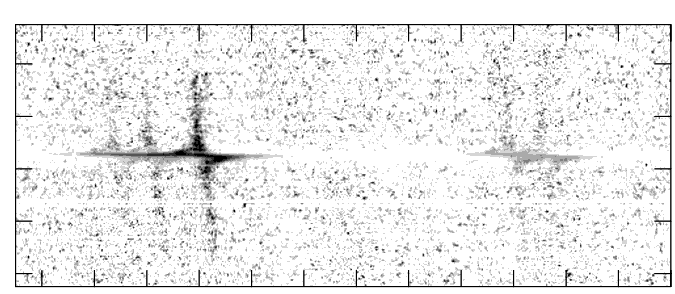
STIS first-order mode long-slit spectroscopy has a wide observing range from the near IR through the optical and into the ultraviolet. Figure 4.7 shows an early STIS result measuring the black hole mass in the nucleus of a nearby galaxy.
Figure 4.7: Greyscale Representation of STIS G750M 52X0.2 Long-Slit Spectrum of the nuclear region of M84, showing the velocity structure of the H, [NII], and [SII] emission lines in the inner gaseous disk. The continuum has been subtracted from the data and they have been renormalized. (Figure courtesy of Gary Bower and Richard Green, see also Bower et al. 1998, ApJ, 492, L111).
4.2.1 Gratings for First-Order Spectroscopy
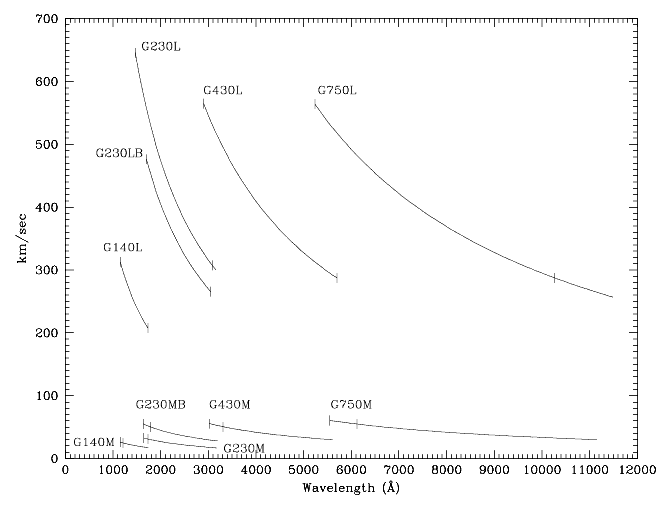
There are 10 first-order gratings available for long-slit spectroscopy, providing resolving powers of ~500-17,000 from the UV at 1150 Å through the near IR at ~ 10,000 Å. The wavelength coverage and kinematic resolution of the first-order gratings are summarized in Figure 4.8. Briefly:
Figure 4.8: Wavelength Coverage Versus Kinematic Resolution of First-Order Modes. The hatches indicate the wavelength coverage at a single scan setting.
4.2.2 Slits for First-Order Spectroscopy
Supported for use with the first-order gratings are long slits of widths 0.05, 0.1, 0.2, 0.5 and 2.0 arcseconds (in the dispersion direction), and lengths of 52 arcseconds (as projected on the CCD detector) or 25 arcseconds (as projected on the MAMA detectors) for the MAMA low-resolution, first-order gratings (
G230LandG140L) and 28 arcseconds for the MAMA intermediate-resolution, first-order gratings (G230MandG140M).1 Note that the 0.1 arcsecond width matches the 2 pixel resolution of the CCD, while the 0.05 arcsecond width does so for the MAMAs, providing maximum spectral resolution. The 0.2 arcsecond-wide slit is the general utility slit used most often; it provides a good compromise between resolution and throughput. Programs requiring accurate absorption-line measurements in continuum sources should always use slits of widths0.2 arcsecond, since for larger apertures the spectral purity is significantly degraded by the telescope plus instrumental Point-Spread Function (PSF); see Section 13.7. Finally, we expect the wider 0.5 and 2.0 arcsecond slits to be used predominantly in photon-starved ultraviolet observations of extended sources, but provide them for use in the optical as well to assure that line-ratio studies with coverage from the ultraviolet to the optical can sample the same physical region on the sky. Additionally, they are the most photometric slits as their throughput is least affected by centering and telescope breathing. Of course, observations of extended sources with wide slits will have correspondingly degraded spectral resolutions.
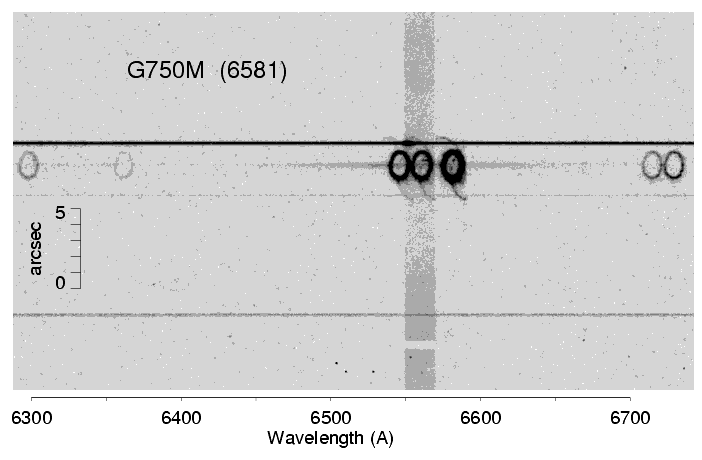
The first-order gratings can also be used "slitless" to obtain two-dimensional spectra of targets, or pseudo "images." Slitless spectroscopic data will not be fully calibrated by the STScI pipeline, and it will require directed post-observation data processing by the user, as ambiguous overlap of wavelengths from different parts of sources can occur in the image (see Section 12.1). Figure 4.9 shows an example of the use of the
Figure 4.9: STIS G750M 6581 Å 52X2 Spectral Image of SN1987A. This shows the images of the inner circumstellar ring in [OI], H52X2slit with theG750Mgrating to obtain such a series of emission line images of SN1987A.
Note that for the FUV-MAMA first-order modes, the projection of the spectrum on the detector has deliberately been shifted 120 low-resolution pixels or 3 arcseconds below center (3 arcseconds above center prior to March 15, 1999) to avoid having the spectrum fall on the shadow of the repeller wire (see also Section 7.5 and Section 11.1.2). This shift applies to all data taken with the
G140LandG140Mgratings, regardless of the aperture used.Note also that the monthly offsetting of MAMA first-order spectral modes can additionally shift the projection of the spectrum on the detector by up to ~ ±40 low-resolution
AXIS2pixels (about 1 arcsecond). See Section 7.5 for further discussion.The
0.2X0.2aperture is now supported for use with all first-order gratings. This is intended to be used for observations where a long slit might allow light from another target into the aperture, thereby creating either contamination problems or bright object concerns. Note, however, that the use of such a short slit will make background subtraction more difficult, especially at wavelengths where airglow lines are important.4.2.3 STIS Pseudo-aperture Positions
A number of "pseudo-aperture" positions have been defined for STIS spectroscopy which allow a target to be placed at positions other than the geometrical center of the aperture without the need to specify a POS TARG. These include the E1 and E2 positions which place the target closer to the CCD readout to minimize losses due to charge transfer inefficiency (CTI), and the D1 aperture positions, which can be used to place a faint target near the bottom of the FUV MAMA dectector, where the dark current is significantly reduced. Note that the E1 positions may be used with any first-order STIS CCD grating. The E2 positions may only be used with
G750MandG750L. The D1 positions may only be used with theG140LandG140Mgratings.Here we describe these pseudo-aperture locations and their intended purposes. Note that all of these pseudo-apertures define new positions within existing apertures. As a result, the
APERTUREkeyword in the headers of the archived data will contain the name of the parent aperture, while thePROPAPERkeyword will contain the aperture name specified in the Phase II proposal. For example, if the Phase II proposal requests the52X0.1D1position, theAPERTUREkeyword will be set to52X0.1, while thePROPAPERkeyword will be52X0.1D1.E1 Aperture Positions to decrease CTE Loss
As the STIS CCD detector has accumulated radiation damage over time, the Charge Transfer Efficiency (CTE) has decreased (see Section 7.2.6). For faint sources observed near the center of the CCD detector, this can result in loss of 18% or more of the detected signal during the readout. Since the amount of these CTE losses depends on both the observed signal and background counts, there is no simple way to correct for these losses, and they can significantly affect the shape of a measured spectrum. Noticeable effects can be seen even in well exposed spectra. In addition to its effects on the counts from the observed astronomical source, CTE effects re-distribute some of the electrons in hot pixels and cosmic rays into "tails" that lag behind during the readout. These tails add significant background noise to long exposures that is not taken into account by the STIS Exposure Time Calculator (ETC), and which can be difficult to remove.
All of these effects can be significantly ameliorated by moving the location of the source image on the detector closer to the amplifier, thereby reducing the number of parallel transfers that occur during the readout. To this end, new aperture positions (
52X0.05E1, 52X0.1E1, 52X0.2E1, 52X0.5E1,and52X2E1) have been defined near row 900 on the STIS CCD detector for use with the STIS first-order gratings. The use of these new aperture positions is strongly recommended for the observation of faint sources. For high signal-to-noise observations of bright targets we recommend continuing to use the regular aperture positions near the center of the detector. Extensive calibration observations were planned during cycles 11 and 12 to ensure that the calibration at the E1 aperture positions is of the same quality as it is for sources observed at the usual location on the STIS CCD. Further information regarding the use of these new aperture positions can be found in Section 7.2.7.E2 Aperture Positions for Better Fringe Flats
In 1999, the E1 aperture positions were introduced to allow first-order CCD spectra to be positioned at row 900 near the CCD readout amplifier, thereby reducing the effects of Charge Transfer Inefficiency (CTI). This works well, however, for
G750LandG750Mspectra taken near row 900, the fringe flats have to be done using the52X0.1aperture rather than the0.3X0.09aperture, which is usually used for fringe flats near the center of the detector (see Section 11.2.3 for a more detailed discussion of IR fringe flats). Unfortunately, the52X0.1slit is shifted by about one pixel in the dispersion direction from the centers of the wider long slits. This misalignment reduces the accuracy of fringe subtraction.To address this, we have defined three new aperture locations:
52X0.2E2,52X0.5E2, and52X2E2. When these apertures are specified, the target is placed off-center in the slit, at a position coincident with the52X0.1E1aperture. This improves the match between the fringes in the target and lamp spectra. Be aware, however, that the52X0.2E2aperture position is offset sufficiently from the physical center of the aperture that there will be noticeable changes in the aperture throughput.These
E2aperture positions should only be used forACCUMexposures with theG750LorG750Mgratings when fringe flats with the52X0.1aperture are also being done. If a peakup is desired before using theE2apertures, the peakup should be done using the52X0.1E1aperture.D1 Aperture Positions for Low FUV Dark Current
The FUV MAMA suffers from an irregular dark glow that varies unpredictably in intensity. When this glow is absent, the typical dark rate of the FUV MAMA detector is about 6x10⁻⁶ cnts/pixel/s. When the glow is strong, it can enhance the dark current to as much as 1x10⁻⁴ cnts/pixel/s over a large fraction of the detector. For first-order spectra, the best way to minimize this extra dark current is to put the target at a location on the detector where the extra dark current is small.
For first-order spectra of faint sources less than about 1" in angular extent, we recommend that this be done by placing the target about 2" above the bottom edge of the FUV MAMA detector. Since for the
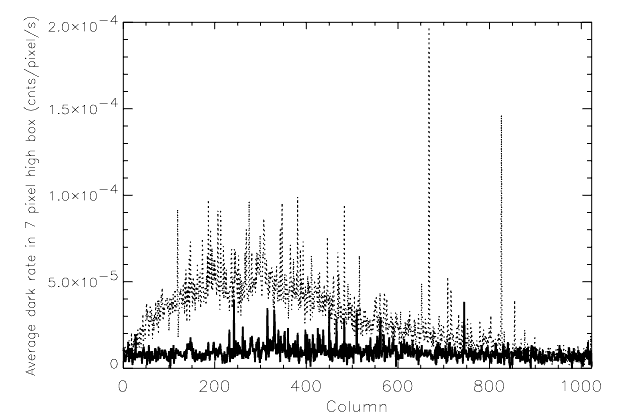
G140LandG140Mthe regular aperture positions are projected about 3" below the center (in order to avoid the shadow of the FUV MAMA repeller wire), an additional displacement of about -6.8" is required in the cross-dispersion, or y, direction. This can reduce the extra dark current by up to a factor of 6 (see Figure 4.10). ForG140Lobservations, the default D1 position will place the spectrum about 2 arcseconds above the bottom edge of the detector. The monthly offsetting of the spectral location (see Figure 7.5) will shift this by as much as ±1 arcsecond. Because of the larger cross dispersion plate scale of theG140M, variations of the default spectral position for differentG140MCENWAVEvalues, and the monthly spectral offsetting,G140Mspectra taken at the D1 aperture positions will be located 3 to 5 arcseconds above the bottom edge of the FUV MAMA detector.Note that the background subtraction might be more difficult due to the proximity to the edge of the detector, depending on the extent of the target. Therefore, use of this position is recommended only for objects sufficiently faint that the FUV MAMA dark current is the major limitation on the achievable accuracy.
The
Figure 4.10: The FUV MAMA mean dark current as a function of the detector column number (in a seven pixel high extraction box near the standard extraction position located 3" below the detector center)-(dotted line)- is compared with that in a box near the proposed pseudo-aperture position 6.8" further down (solid line). The data used are an average of 116 dark monitor exposures, each of 1380 seconds, taken between July 2001 and September 2002. This illustrates the typical reduction in the dark current affecting first-order spectra that will result from putting the target 2" above the bottom of the detector.D1apertures listed in the Table 4.4 will be supported for first-order spectroscopicACCUMorTIME-TAGobservations with theG140LandG140M. The52X0.1D1and52X0.05D1are also supported for CCD ACQ/PEAK observations. Note that the25MAMAD1,F25QTZD1, andF25SRF2D1aperture locations are intended only for first-order FUV MAMA slitless spectroscopy. Users who wish to offset faint imaging targets to avoid the worst of the FUV dark current should look at Figure 7.18 or consult with a STIS Instrument Scientist via help@stsci.edu.
Sensitivity Differences at the Pseudo-aperture Positions
The throughput of the E1 and D1 apertures as a function of wavelength is similar to that of the corresponding regular positions. However, there is some vignetting of the gratings that changes the overall system throughput slightly with varying position along the slit. At the E1 positions, the overall low dispersion throughputs are decreased by 2 to 3%, while at the D1 position the
G140Lthroughput is increased by 2 to 7%. Throughput changes for the medium resolution gratings are not well characterized, but should be similar. Since these throughput changes do not depend simply on the wavelength, but also on the grating and the position on the detector, they are handled in the pipeline calibration by the use of low-order flat fields (lfl files) rather than by a change in aperture throughput curve.The throughput of the
52X2E2and52X0.5E2positions are similar to that of the corresponding E1 positions. For the52X0.2E2aperture, the throughput is about 20% lower than for the52X0.2E1position.
Table 4.4: Gratings supported with STIS pseudo-aperture positions.
4.2.4 Detailed First-Order Spectroscopic Information
The properties of each of the first-order gratings are described in detail, grating by grating, in Chapter 13; see the second-to-last column of Table 4.1 for easy reference to the appropriate page for each grating.
The detailed properties of the long slits (e.g., throughputs and line spread as functions of wavelength), plate scales, and encircled energies for the first-order gratings are presented under Section 13.4, Section 13.5, and Section 13.6.
1The MAMA first-order modes have varying spatial plate scales; see Chapter 13.
|
|||||
|
Space Telescope Science Institute http://www.stsci.edu Voice: (410) 338-1082 help@stsci.edu |