Space Telescope Imaging Spectrograph Instrument Handbook for Cycle 14
 |
 |
 |
 |
 |
|
| Space Telescope Imaging Spectrograph Instrument Handbook for Cycle 14 | |||||
| ||||||
11.4 Fixing Orientation on the Sky
STIS users, particularly those using the long slit to observe extended sources, will commonly wish to specify the orientation of the slit on the sky. Observers planning coordinated parallel observations may also wish to specify the orientation of the HST focal plane, so as to place the appropriate instrument to cover a given patch of sky. When you set the orientation of the telescope, you effectively constrain the times when your observation can be scheduled, since HST must maintain a spacecraft orientation (sometimes called roll angle) which keeps its solar panels roughly perpendicular to the incoming sunlight.
The orientation of the spacecraft (and therefore of the STIS long slits which are fixed in relation to the HST focal plane) is controlled by the
ORIENTspecial requirement, which is entered during Phase II. The Phase II Proposal Instructions will contain a detailed description of orientations and how to specify them. A specific orientation can be set, or a range of allowed orientations (e.g., 90-110 degrees) can be given. The tighter the constraints, the more difficult it will be to schedule the observation.The
ORIENTparameter gives the orientation of the HST focal plane projected onto the sky and is defined by the U2 and U3 axes. Figure 3.2 shows the HST focal plane containing all the HST instruments, with the U2 and U3 axes defined. Figure 11.1 shows the relationship between these axes and the PA of the long slit on the sky. Note that the long slit is approximately aligned with the detector'sAXIS2, i.e., it is directly perpendicular to the dispersion axis (AXIS1). The important point to note is that if you fix the orientation of the long slit on the sky to be PA, where
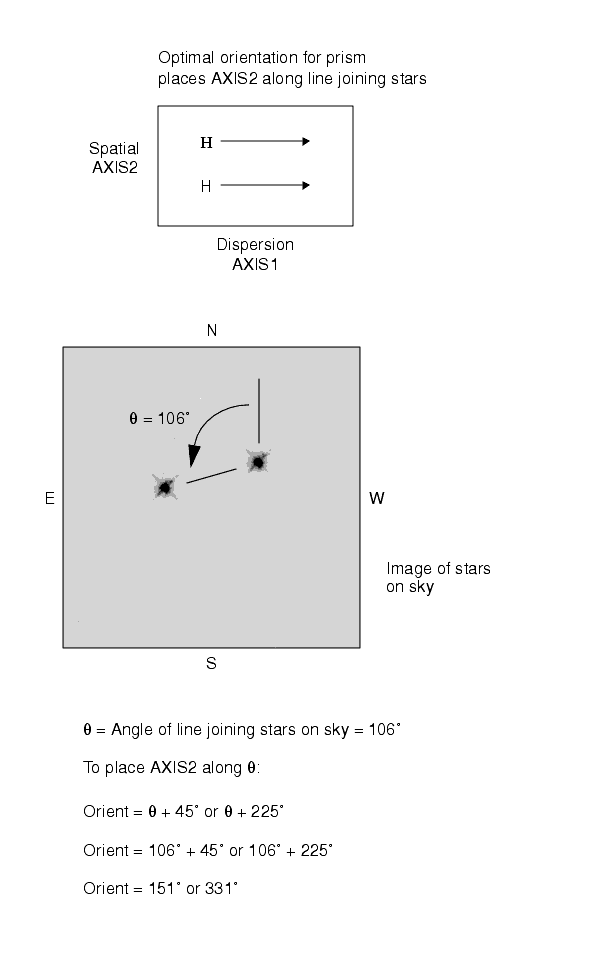
ORIENTparameter (which determines where the other HST instruments lie for parallel observations) is given asPRISMmode observations, if you wish to fix the orientation of the spatial direction (i.e., perpendicular to the dispersion) to be X, then theORIENTparameter should be set to X+45 or X+225 degrees. It is possible during Phase II to specify more than one permissibleORIENTrange.Users who wish to determine their orientation requirements using existing HST images should consult the HST Observatory Support Group's instructions at
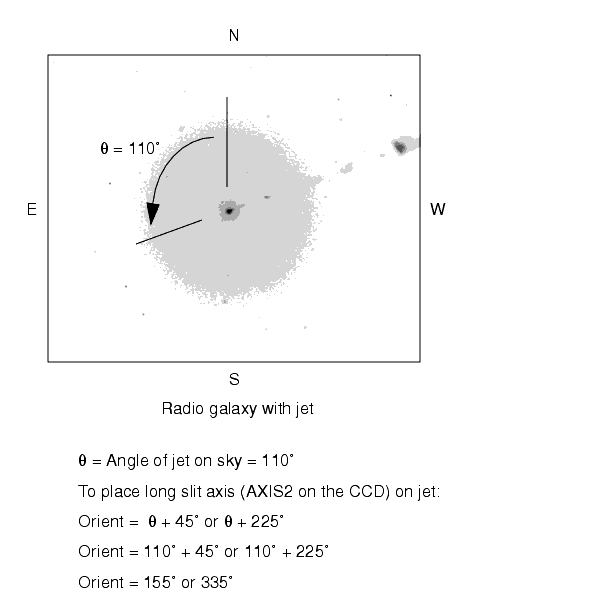
http://www.stsci.edu/instruments/observatory/faq.html. It is especially important to be careful when using HST data taken before 15 Sept. 1997, as for such data there may be errors of ~0.5°in theORIENTand PA_V3 header keywords.We show two examples below. Figure 11.10 illustrates how to set the
Figure 11.10: Placing the STIS Long Slit Along the Jet of M87ORIENTparameter to place the long slit along the M87 jet. Figure 11.11 illustrates how to set theORIENTparameter to fix the dispersion axis forPRISMobservations to be perpendicular to a double star system.
Figure 11.11: Placing Dispersion Direction Perpendicular to a Binary Star System
This relation between ORIENT and position angle will satisfy most needs. Observers with extremely stringent orientation requirements should be aware that each STIS aperture has a specific U3 offset angle which is close to, but not equal to, 45
°. In Table 11.2 below we list the offset angles for all supported spectroscopic slits. If ultimate precision is required, observers may wish to use the offset angles given in this table instead of the standard 45°. Observers should also note that the position angles for the 52'' long slits have recently been revised by up to 0.33°.
Table 11.2: Offset angles between supported STIS slits and the spacecraft orientation reference vector U3.
|
|||||
|
Space Telescope Science Institute http://www.stsci.edu Voice: (410) 338-1082 help@stsci.edu |