Space Telescope Imaging Spectrograph Instrument Handbook for Cycle 14
 |
 |
 |
 |
 |
|
| Space Telescope Imaging Spectrograph Instrument Handbook for Cycle 14 | |||||
| ||||||
8.1 Introduction
All STIS spectroscopy using apertures less than 3 arcseconds in size and all coronagraphic observations will require an onboard STIS target acquisition (
ACQ) and possibly an acquisition/peakup (ACQ/PEAK) exposure to center the target in the scientific aperture. In this Chapter, we provide the basic information you need to choose an acquisition strategy for your program.STIS target acquisitions employ the CCD camera to image the target's field directly and onboard flight software processes the image to locate the position of the target. STIS acquisitions are very reliable, accurate (typically ±0.01 arcsecond for V < 21 point sources), and quick (~6 minutes). For the narrow slits (
0.1 arcsecond), an
ACQ/PEAKis required, which is accurate to ~5% of the slit width used in the peakup, and takes typically ~6 minutes. For particularly faint targets (V > 21) or complex diffuse sources, overheads will be somewhat more and accuracies somewhat reduced (see details below).For Phase I proposals, you do not need to determine the details of your acquisition, but need only to determine if an
ACQ, and possibly anACQ/PEAK, is required, include the necessary orbital time (which is normally dominated by the associated overheads), and assure yourself that your program can be accomplished.For Phase II, you will need to work out the details of your acquisition procedure, and we provide two tools to assist in this task, as well as examples of different TA scenarios (see Section 8.5). To determine the correct exposure time, we provide (via the STIS web page) a
Target Acquisition Exposure Time Calculator(TA ETC). The input and output parameters in the TA ETC (as compared with the Imaging ETC) are specifically designed to facilitate exposure-time estimates for target acquisition purposes. For example, the TA ETC input and output parameters take into account the following:
- The target acquisition can be done only with the CCD detector.
- The
CHECKBOX(see below) size is always 3 x 3 pixels for a point source, and n x n, where n is an odd number between 3 and 105, for diffuse sources.- The
CCDGAINis always 4.- The default S/N is 40 for the calculation of exposure time.
To determine the correct
checkboxsize forDIFFUSEtargets, we provide aTarget Acquisition Simulator(TAS), which implements the same algorithms as the flight software, and so should give results in good agreement with what will happen in orbit. The TAS takes as input an image, extracts a subarray centered on the coordinates provided, and searches for the brightest location by passing acheckboxover the subarray.Below we describe acquisition and peakup exposures for spectroscopy. More details on centering of targets behind the coronagraphic bars and wedges are described in Section 12.9, but examples are provided at the end of this chapter.
8.1.1 Initial Pointing
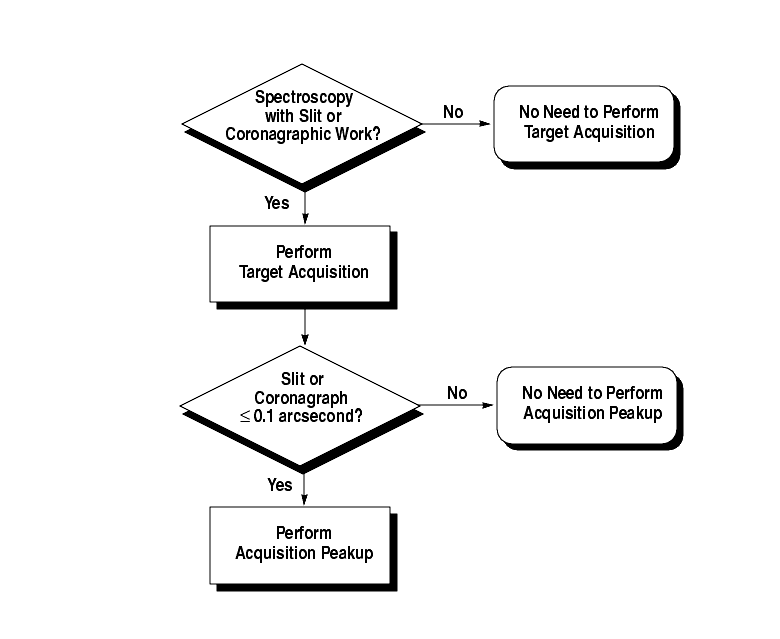
Following the initial guide-star acquisition for your visit, the target location in the aperture plane will be known to an accuracy of ~1-2 arcseconds. For scientific observations taken through spectroscopic slits which are less than 3 arcseconds in either dimension, and for imaging observations with one of the coronagraphic apertures, you will need to use an onboard STIS target acquisition and possibly an acquisition peakup exposure to center your target.
Figure 8.1 shows a decision flow for determining whether you require an acquisition or both an acquisition and a peakup to center your target.
Figure 8.1: Determining Acquisition Requirements
8.1.2 Acquisitions
STIS target acquisition exposures (
MODE=ACQ) always use theCCD, one of the filtered or unfiltered apertures forCCDimaging, and a mirror as the optical element in the grating wheel. Acquisition exposures center your target in the slit or behind a coronagraphic bar to an accuracy (2) of ~0.01 arcsecond for a point source, and 0.01 to 0.1 arcsecond for a diffuse object (larger targets have larger errors). A typical STIS point source target acquisition takes ~6 minutes.
8.1.3 Peakups
An acquisition peakup exposure (
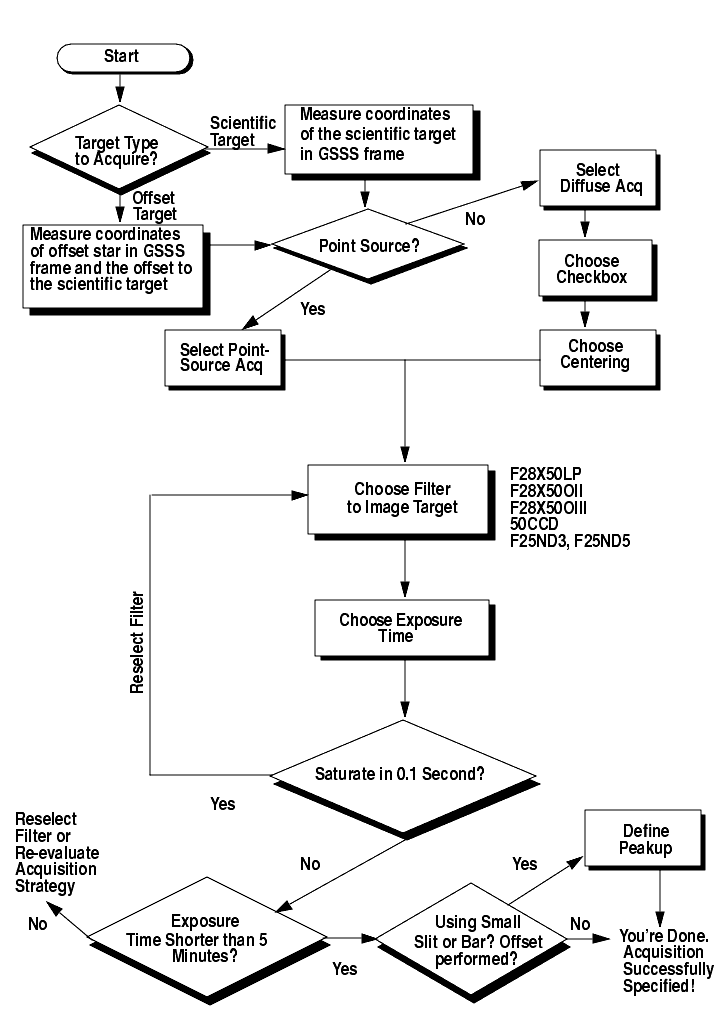
MODE=ACQ/PEAKUP) must be taken following the target acquisition exposure to refine the centering of point or point-like sources in slits less than or equal to 0.1 arcsecond wide (or tall). Peakup exposures use a slit or coronagraphic aperture and are taken with the CCD as the detector and with either a mirror or a spectroscopic element in position on the grating wheel. Typical target acquisition centering accuracies following a peakup sequence are 0.05 times the dimension of the slit or bar. Typical STIS imaging point source peakups take ~5-10 minutes; see Table 8.5 for the formulae needed to determine the duration of a peakup acquisition.Figure 8.2 shows the complete decision tree for STIS target acquisitions.
8.1.4 Drift Rates
For most exposures, two guide stars will be used to support the observation, enabling correction of drift. In some cases, however, it may not be possible to find a guide star pair to support the observation, or the observation may drop to single guide star mode because one of the guide stars cannot be acquired. In that case, the roll of the telescope is under GYRO control, which will allow a slow drift of the target on a circular arc centered on the single guide star. If you are informed that only single guide stars can be found for your observation, you can try to get a guide star pair by relaxing the scheduling requirements (e.g. expand the ORIENT range). If you must use a single guide star for a multiple-orbit visit, or if your observation is especially time-critical and would be significantly degraded by failure to single guide star mode, you should consider including a re-centering
ACQ/PEAKduring the visit.Table 8.1 gives what is generally the worst case object motion of the target on the detector for a single guide star observation. For example, if a science observation in an 0.2 arcsecond slit is 3 orbits in duration, then the target would move to the edge of the aperture; a 2 orbit visit would leave the target halfway toward the edge. Thus, only single orbit visits should be done on a single guide star. However, for science in a 2 arcsecond slit, the motion over 4 orbits only takes the target 13% of the way to the edge of the slit. Thus, if high photometric accuracy is not required, a single guide star should be sufficient for the larger slits.
Table 8.1: Single Guide Star Target Position Shift in Arcseconds vs. Time and Orbits.
For a completed observation, you can use information in the headers of the archived files to make a better estimate of the drift of the target for a single guide star observation. The rate of the drift of the radiant of the circle traced by the target about the guide star is unknown for any particular observation, but typically is expected to be in the range of 1.0 to 1.5 milliarcsec/sec. To calculate the approximate magnitude of the drift of the target on the detector, you will need to find the distance of the target from the acquired guidestar. The header of the observation log file jif.fits identifies the acquired guidestar (GSD_ID) and gives its right ascension (GSD_RA) and declination (GSD_DEC) in degrees. For example, for a target 10 arcmin from the guidestar, a drift of the guidestar-to-target radiant of 1 milliarcsec/sec during a 1000 second exposure would cause the target to move 0.0029 arcsec on the detector. The direction of the motion on the detector can be deduced from header keywords in the science data describing the position angle of the detector (e.g., PA_APER), in combination with the direction perpendicular to the radiant.
Figure 8.2: Process of Defining a Target Acquisition Scheme
|
|||||
|
Space Telescope Science Institute http://www.stsci.edu Voice: (410) 338-1082 help@stsci.edu |