Space Telescope Imaging Spectrograph Instrument Handbook for Cycle 14
 |
 |
 |
 |
 |
|
| Space Telescope Imaging Spectrograph Instrument Handbook for Cycle 14 | |||||
| ||||||
12.9 Coronagraphic Spectroscopy
STIS offers the capability to perform spectroscopic observations with occulting bars located in the long slits, and imaging observations with occulting bars in the coronagraphic mask
50CORON. Coronagraphic imaging is described in detail in Chapter 5.Barred Spectroscopy
The
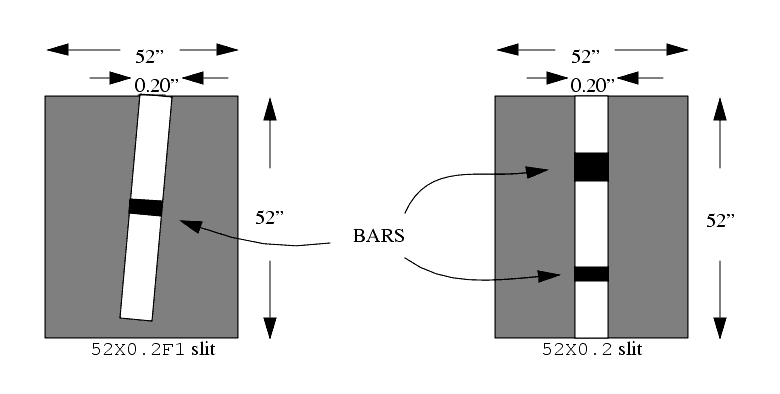
52X0.2F1aperture is the same physical slit as52X0.2with the target centered on the smaller of the two occulting bars (i.e., 0.5 arcseconds), instead of at the center of the52X0.2long slit. When this aperture is specified the slit wheel is rotated slightly to bring the bar into the center of the detector's field of view. This results in a tilt of 1.30o with respect toAXIS2(i.e., the spatial axis perpendicular to the dispersion). Also, the full 52 arcseconds length of the long-slit field of view is decreased by about 20% for CCD spectroscopy.This occulting bar is well suited to scientific programs conducting spectroscopy of faint extended material around a bright central source. Typical examples of such a program include QSO host galaxies, dynamics of jets in young stellar objects, and spectroscopy of resolved binaries. Observers performing barred spectroscopy should be sure to consult the section Section 13.7.3. Spectroscopic observations with the 0.5 arcsecond occulting bar are limited to first-order spectroscopic modes.
To simplify the use of the occulting bar, an aperture name,
52X0.2F1, has been assigned for the occulting bar itself, as well as an aperture name for a reference position located just off the bar. The reference aperture is used if the observer wishes to peakup the source in the slit, prior to offsetting to place the target behind the occulting bar. (Note that peakdowns behind the occulting bar, while possible in principle, are not recommended in practice).The table below shows the complete set of aperture names and their application for the 0.5 arcsecond fiducial on the
52x0.2slit. An example of an acquisition into the52X0.2F1aperture is provided in Chapter 8.
There are two important ramifications you should be aware of when using the
Figure 12.7: A cartoon illustrating the 1.30º tilt of the 52X0.2F1 aperture52X0.2F1aperture: (1)ORIENTspecification and (2) fringing correction.
Specifying ORIENT with the 52X0.2F1 Aperture
The ORIENT special requirement parameter is a specified position angle of the orientation reference vector U3, which is offset by 45o from the STIS detector spatial axis (
AXIS2), in the direction North through East. Given a position angle on the sky ofand taking into account the additional 1.30o offset for the
52X0.2F1aperture:ORIENT =For example, if we want to place the STIS
52X0.2F1aperture along the jet of M87 (the example in Figure 11.10 for a standard slit), we would do the following. Given a position angle of 110o on the sky:ORIENT = 110o + 46.30o = 156.3o or ORIENT = 110o + 226.30o = 336.3oCorrecting Fringing for the 52X0.2F1 Aperture
The STIS CCD shows fringing for wavelengths longward of 7000 angstroms with the
G750LandG750Mgratings, limiting the signal-to-noise that can be obtained in these modes. The fringing is caused by interference of multiple reflections between the two surfaces of the CCD. (See Chapter 7 for details.) The recommended way to correct for fringing is by using contemporaneous fringe flats in conjunction with your science observations. A contemporaneous flat field exposure may be included in the Phase II template by usingCCDFLATas the target name. It is the observers' responsibility to include contemporaneous flat fields in their Phase II proposals.In case of point-source spectra, contemporaneous fringe flats are normally taken using a short slit which is concentric with the long slit used for the science exposures. In the special case of the
52X0.2F1aperture, however, we recommend obtaining long slit fringe flats to fully sample the PSF, since the spatial coverage of the short slit is only a few CCD pixels larger than that of the occulting bar of the52X0.2F1slit. A short slit fringe flat does give a somewhat better fringe correction for point sources than a long slit fringe flat so if you are additionally taking an unocculted image of your star with52X0.2, we still recommend obtaining a short slit flat as well as a long slit flat to rectify that image.Please refer to the Instrument Science Reports
1997-15(Revision A) for more details about near-IR fringe flats;1997-16that deals with fringing in spectrograms of extended sources:1998-19(Revision A) that deals with fringing in spectrograms of point sources and current fringing analysis, as well as details related to the52X0.2F1aperture; and1998-29that is a tutorial on the use of IRAF tasks in the stsdas.hst_calib.stis package to remove fringing.
|
|||||
|
Space Telescope Science Institute http://www.stsci.edu Voice: (410) 338-1082 help@stsci.edu |