Space Telescope Imaging Spectrograph Instrument Handbook for Cycle 14
 |
 |
 |
 |
 |
|
| Space Telescope Imaging Spectrograph Instrument Handbook for Cycle 14 | |||||
| ||||||
12.8 Parallel Observing with STIS
The second servicing mission installed solid-state data recorders on HST. The volume capacity of these recorders is roughly ten times that of the mechanical tape recorders in use for Cycles 1 through 6. Coupled with changes to the ground system and the flight software of the second-generation instruments designed to fully exploit this capability, this translates into a greatly increased capability for parallel observing.
STIS can be used to observe simultaneously with WFPC2, FGS, and ACS. Figure 3.2 shows the HST field of view following ACS installation. The three infrared cameras of NICMOS (which themselves could be operated in parallel), STIS, WFPC2, and ACS are all shown, with their fields of view drawn to scale, in their relative focal-plane positions. The three STIS cameras share a common field of view, and only one can be used at a time.
The policy for proposing for parallel observations and technical advice on parallel observing are provided in the Call for Proposals/Phase II Proposal Instructions. We remind you that there are two types of parallel observations:
- Coordinated parallels, in which you explicitly link the taking of exposures in parallel to your own prime scientific exposures.
- Pure parallels, in which exposures are taken in parallel with other observers' prime exposures.
Both coordinated and pure parallels must be explicitly proposed in Phase I. Implementing parallels requires significant resources; only those recommended by the TAC process will be implemented. If you are considering coordinated parallels, you may wish to consider constraining the orientation of HST, to place an object of interest in the parallel instrument's field of view.
Orientconstraints do affect observation scheduling, however, and should not be entered lightly (see Chapter 11).12.8.1 Using STIS in Parallel with Other Instruments
Observations for which STIS is the parallel instrument are likely to be most useful when the full STIS field of view is used. If you wish to use a small slit, the STIS should be used as prime, and the other imaging instruments used in parallel with it.
If STIS is used as the secondary instrument in coordinated parallel observations, the STIS exposures cannot contain both external and internal exposures. Assuming the first exposure is external, all STIS exposures will be declared external. Therefore no internal exposures are allowed. This includes any user specified internals, such as fringe flat fields, as well as automatic internals, such as autowavecals. If STIS is used as the prime instrument, this restriction does not apply.
The MAMA detectors cannot be used for pure parallel observing. The MAMA detectors can be used in coordinated parallel observing if an explicit
ORIENTis specified and precise RA and Dec coordinates for the parallel field are given (see Section 2.7).Four types of STIS exposures which have particular scientific utility with STIS as the parallel instrument are:
- Optical imaging taking advantage of the ability to go deep very fast with the
50CCDwide-open mode.- Optical slitless spectroscopy.
- Ultraviolet slitless spectroscopy (available only for coordinated parallels with exact
orientspecification).- Prism and ultraviolet imaging observations (available only for coordinated parallels with exact
orientspecification).12.8.2 The STIS Archival Pure Parallel Program
Following on the recommendations of the Cycle 7 HST Time Allocation Committee, and following the advice of the Parallels Working Group, an HST Archival Pure Parallel Program was begun at the start of Cycle 7. This program was designed to maximize the scientific return from HST to the community by taking parallel data with instruments that are not being used as the prime instrument. The data immediately become nonproprietary and are available through the HST Archive. This program continues today.
The STIS Archival Pure Parallel observing program consists of:
G750Lslitless spectroscopy to search for star-forming galaxies and AGN out of the plane, and brown dwarfs in the plane.50CCDandF50X28LPimaging in the outskirts of nearby galaxies and globular clusters for stellar-population studies.- Short (
1 orbit)
50CCDimages of extragalactic fields to study cosmic shear.- Narrowband [O II] and [O III] CCD images of the outskirts of nebulae in the Galactic Plane.
- Deep CCD imaging of extragalactic fields.
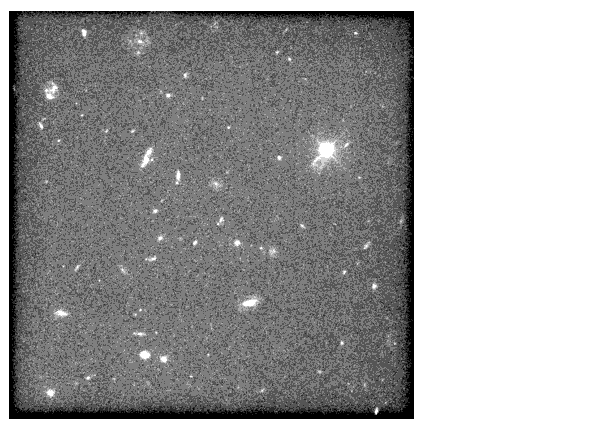
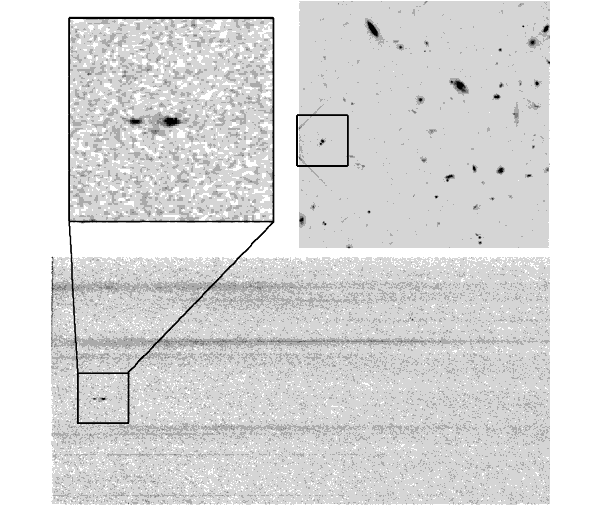
Figure 12.5 shows an example of a deep
50CCDSTIS Archival Pure Parallel image and Figure 12.6 shows an example of slitless spectroscopy from the Archival Pure Parallel Program. An overview of the HST Pure Parallels for all HST instruments can be found atFigure 12.5: Deep 50CCD STIS Pure Parallel Image from the Archival Pure Parallel Program, with 3.72 hours of Integration Time. (Figure courtesy of Ed Smith.)
http://www.stsci.edu/instruments/parallels/.
Figure 12.6: G750L Slitless Spectroscopy from the Archival Pure Parallel Program Showing the Detection of a High Redshift Emission Line in a Galaxy. (Figure courtesy of Jon Gardner, see also Gardner et al. 1997, in the1997 HST Calibration Workshop Proceedings.) Left and below are the G750L slitless spectra. Top right is the image of the field.
|
|||||
|
Space Telescope Science Institute http://www.stsci.edu Voice: (410) 338-1082 help@stsci.edu |