Space Telescope Imaging Spectrograph Instrument Handbook for Cycle 14
 |
 |
 |
 |
 |
|
| Space Telescope Imaging Spectrograph Instrument Handbook for Cycle 14 | |||||
| ||||||
8.2 STIS Onboard CCD Target Acquisitions (ACQ)
8.2.1 How it Works
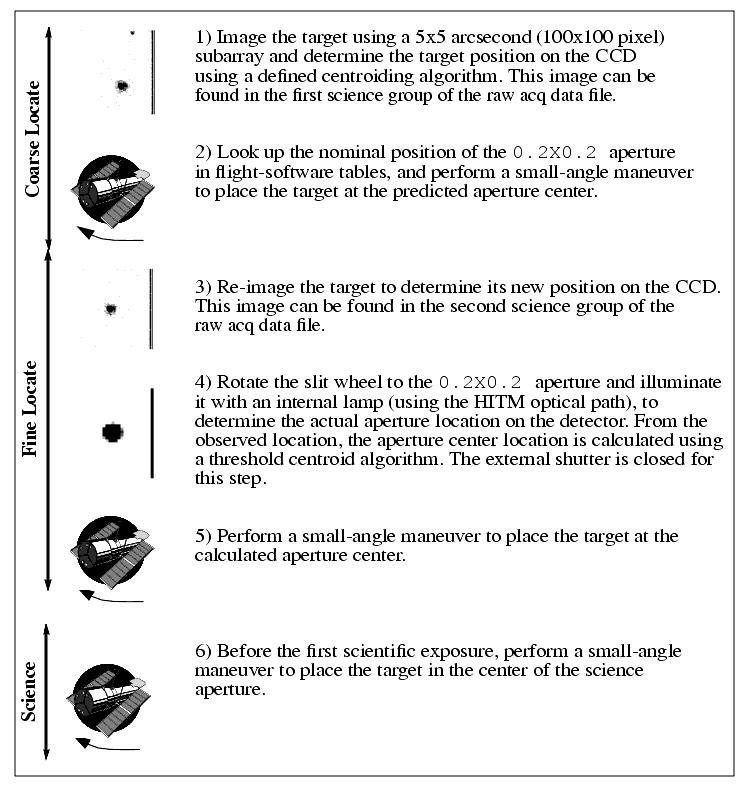
Acquisition exposures are controlled by the Flight Software (FSW). Figure 8.3 highlights the basic steps in the acquisition process. The sequence comprises two discrete stages: the coarse-locate phase (steps 1-2) and the fine-locate phase (steps 3-5); a sixth step centers the target in the science aperture. The coarse-locate phase is performed to place the target as close as possible to the aperture center prior to the final telescope move. This step ensures that the final slew needed to move the target into the aperture is a small one, and it minimizes uncertainties in the calculation of the required slew caused by detector or optical distortions.
Figure 8.3: Target Acquisition Schematic
- The target is located. A pair of 5 x 5 arcsecond (100 x 100 pixel) CCD images is taken of the sky using a user-selected filtered or unfiltered imaging aperture; for diffuse acquisitions, the field will be larger (see Section 8.2.2). The images are offset by 3 pixels in both X and Y to allow for removal of hot pixels via dithering. The flight software processes the images as needed (to realign the images, remove the bias level, flag bad pixels, and remove cosmic rays)1 and applies one of two possible finding algorithms to determine the coordinates of the target. The "bright" column at the edge of the acquisition field is an artifact of the subarray readout and is ignored by the flight software.
- The spacecraft is then moved to place the target at the nominal center of the
0.2X0.2slit.- The target is re-imaged and the target coordinates are redetermined. This second target location is performed to minimize the final slew in step 5, and to reduce the error associated with that slew.
- The location of the
0.2X0.2slit is determined relative to the target. The external shutter is closed (to prevent a possible overlight condition), the0.2X0.2slit is rotated into position by the slit wheel, and an image is obtained with the slit illuminated by a HITM line lamp (see Calibration-Lamp Systems for a description of the HITM optical path). The slit image is processed and a finding algorithm is then used to determine the coordinates of the center of the slit.
- The flight software calculates the offset between the target location and the
0.2X0.2slit, and performs a small-angle maneuver of HST to place the target in the center of the aperture.- The object is placed in the science aperture (by a small-angle maneuver) just prior to the execution of the scientific exposure. If another science exposure is made with a different aperture, the pointing is automatically adjusted to account for any difference in the locations of the science apertures.
An acquisition exposure produces scientific data, which include the images of the target produced in steps 1 and 3, and the image of the
0.2X0.2slit produced in step 4. These data will be returned to you with your scientific data as part of the pipeline products, and they can be analyzed with the tastis tool in STSDAS.8.2.2 Target-Location Algorithms
STIS supports two basic types of acquisitions: point source acquisitions (
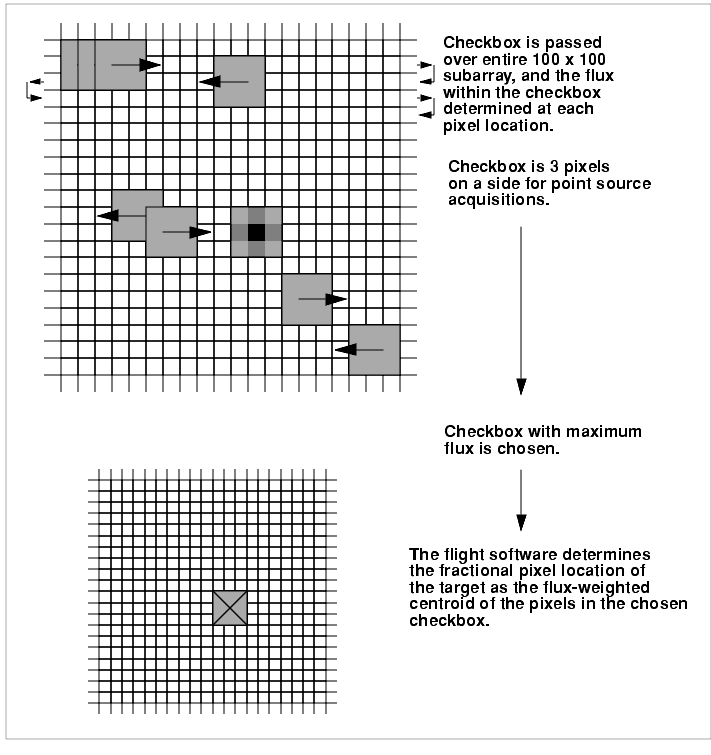
ACQTYPE=POINT)and diffuse-source acquisitions (ACQTYPE= DIFFUSE).Diffuse-source acquisitions are appropriate for sources that exhibit smooth or peaked surface brightness on some size scale, such as centers of galaxies, some planets and planetary satellites (see Section 8.2.5), or nebulae.To locate the target, the flight software first passes a square checkbox over the image and determines the flux contained within the checkbox at each pixel in the subarray. The flight software then selects the checkbox with the maximum flux and determines the target center within that checkbox according to the type of acquisition specified.
Point source Acquisition
For point source acquisitions (
Figure 8.4: How the Checkbox Works for Point source AcquisitionsACQTYPE=POINT), the checkbox size is fixed at 3x3 pixels (0.15x0.15 arcsecond) and the flight software determines the target location by finding the flux-weighted centroid of the pixels in the brightest checkbox (see Figure 8.4).
Diffuse Acquisition
For diffuse acquisitions (
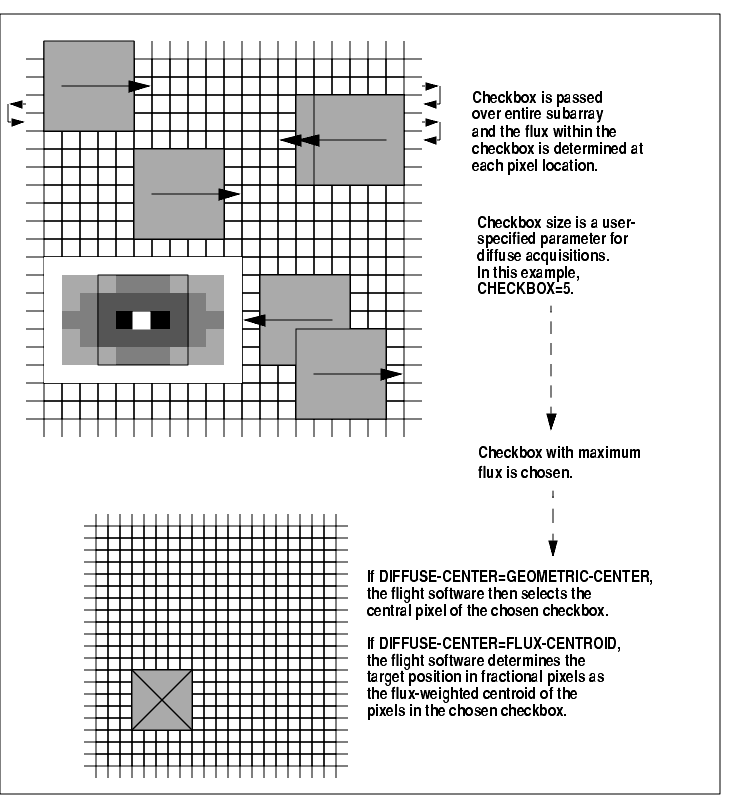
Figure 8.5: How the Checkbox Works for Diffuse AcquisitionsACQTYPE=DIFFUSE), the flight software determines the target location either by finding the flux-weighted centroid of the pixels in the brightest checkbox or by determining the geometric center of the brightest checkbox (see Figure 8.5).
For
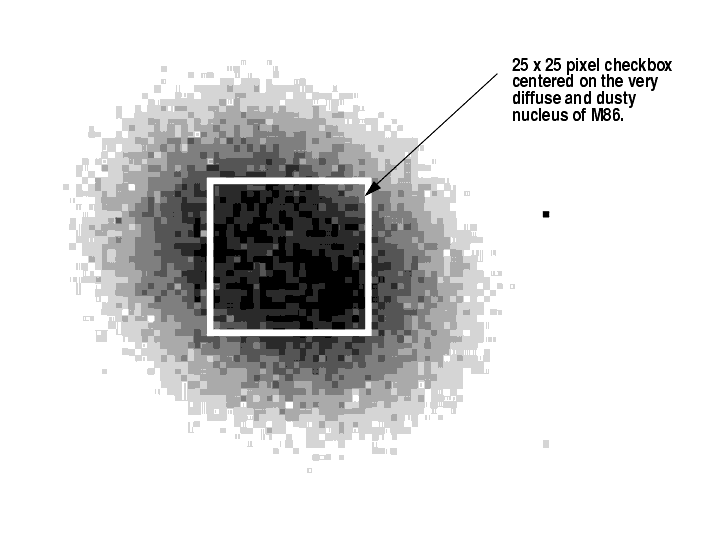
DIffuseacquisitions, the user must specify both the target acquisition centering method (Diffuse-center=geometric-CENTERorFLUX-centroid) and the checkbox size. The user setsCheckbox=n, where n must be an odd number between 3 and 105: the checkbox will then have dimension n x n pixels.CHECKBOXshould be set to the minimum size which ensures that the brightest checkbox will be the one centered on the region of interest (i.e., if your object is peaked within a region of 1 arcsecond, setCHECKBOX=21(= 1 + (1 arcsecond/0.05 arcsecond pixel-1)). The maximum checkbox is 105 pixels on a side, or ~5x5 arcseconds. The subarray used for a diffuse-source acquisition target image isCHECKBOX+101 pixels on a side. TheSTIS Target Acquisition Simulatorcan be used to determine the optimalCHECKBOXsize.Figure 8.6 shows a simulated example of a diffuse source, the nucleus of the galaxy M86, acquired using a diffuse-source acquisition.
Figure 8.6: Simulated Diffuse Acquisition of Elliptical Galaxy M86. Created by running the flight-software algorithm on a STIS image. CHECKBOX=25 produced good centering. Smaller values caused checkbox to center on local brightness enhancements offset from galaxy center.
8.2.3 Selecting Target Acquisition Parameters
To plan your acquisition, you must select:
- The target you are going to acquire (scientific target or offset object).
- The type of acquisition, point or diffuse, and if you are performing a diffuse acquisition, the target acquisition centering algorithm and checkbox size.
- The filtered
APERTUREto be used for target imaging during the acquisition.- The exposure time for the image used to determine the location of the target.
- The program aperture, which determines if you need a peakup acquisition.
Figure 8.2 shows the flow of specifying a target acquisition scheme.
Selecting the Acquisition Object
The first step is to determine what object you are going to use for your target acquisition. Note that the STIS software will always acquire the brightest object in the 5x5 arcsecond search area. If your target is isolated, or if there are no brighter objects in the STIS bandpass you have selected (see below) within 5 arcseconds of your target, then you can acquire your target directly. If there are brighter targets nearby, then you will need to acquire an offset target (generally the brightest nearby star), and then perform a slew to the scientific target. The offset technique is also recommended for precise pointing to specific surface or atmospheric features for large (>~4 arcseconds) planetary targets such as Mars, Jupiter, and Saturn, with the offset target being a planetary satellite (see Section 8.2.5 for further details). Note that HST performs small-angle maneuvers (SAM) quite accurately, with a 3 arcsecond maneuver having an error of 0.003 arcsecond, while a 2 arcminute maneuver (the maximum to ensure that a single set of guide stars can be used for both targets) yields a 0.02 arcsecond error. The offset should not significantly affect target acquisition centering accuracy even in the smallest echelle slits, and your target acquisition centering uncertainty will generally be dominated by your knowledge of the absolute offset between the acquisition star and your target. If you are uncertain whether a nearby object is brighter than your target in the STIS bandpass, it is safest to select an isolated object and perform your acquisition on it.
If you are observing a diffuse source, you should first check to see if there is a suitable star which you can use as an acquisition target; an offset can then be used to move to the desired position, as needed. If you wish to acquire a diffuse object directly, then it is important to know your source structure as seen at ~0.1 arcsecond resolution to properly plan your acquisition strategy if you need accurate (a few tenths of an arcsecond) centering. We recommend that you first check the HST archive to determine if your target has been observed by HST with WF/PC-1, WFPC2, FOC, STIS or ACS. If it has, that exposure can be used to determine the optimal acquisition strategy using the
Target Acquisition Simulator. If it has not yet been observed with HST, we suggest you take an early acquisition image, either with the STIS or with WFPC2, which you can use to determine your optimal acquisition strategy. This is particularly important if your program requires placement of a narrow slit accurately on a diffuse object.Once you have selected your acquisition object, you need to measure its coordinates (when possible, i.e. not for moving targets) in the Guide Star reference frame; information on measuring coordinates can be found on the following web page:
http://www-gsss.stsci.edu/support/phase2.htmlYou will need to include the
PLATE-IDalong with your coordinates so that we can be certain to select the guide stars for your observation from the same plate on which your measurement was based. If you are deriving coordinates from WFPC2 data (i.e., from the metric task) or other HST data (i.e., from the xy2rd task), you still need to provide aPLATE-ID; see Section 8.4 for instructions on determining thePLATE-IDfrom HST data.Selecting the Acquisition Type
If you are acquiring a point-like object, you should select the point source acquisition (ACQTYPE=POINT). This selection will find the flux-weighted centroid of the object using a 3 x 3 checkbox. If you are acquiring a diffuse object, you should select the diffuse source acquisition (ACQTYPE=DIFFUSE). A diffuse acquisition will also require selecting the target acquisition centering algorithm (DIFFUSE-CENTER= FLUX-CENTROID or GEOMETRIC-CENTER) and a checkbox size (CHECKBOX=3-105). Note that selecting a DIFFUSE acquisition with CHECKBOX=3 and DIFFUSE-CENTER=FLUX-CENTROID is equivalent to selecting the POINT source algorithm. A
Target Acquisition Simulatoris available to assist you in selecting the best checkbox size if you have an image at a similar resolution to that of STIS and in a similar bandpass.Selecting the Imaging Aperture
The apertures available for target acquisitions are the same set that can be used for CCD imaging and are listed in Table 8.2 below. They include the visible longpass filter, the clear unfiltered aperture, the [O III] narrowband filter, the [O II] narrowband filter, and the neutral-density filters which provide attenuations for bright sources of 10-3 and 10-5.
F28X50LPis the preferred target acquisition aperture. The longpass filter is preferred (compared to the clear50CCDaperture) because it blocks the ultraviolet photons, which can otherwise elevate the detector dark count in the subsequent scientific exposures (see Section 7.2.8). For bright sources which saturate the CCD in 0.1 second with the longpass filter (see Table 8.3), you can use either the narrowband [O III] (F28X50OIII) or [O II] (F28X50OII) filters as the acquisition aperture, or one of the neutral density filters. The [O II] and [O III] filters can also be used to locate the target in the light of an emission line. Note that the [O III] filter has a large red leak at> 10,000 Å (see Chapter 14), so it should be used with caution; the [O II] filter has no measurable red leak.
Determining Exposure Time for the ACQ Exposure
To achieve robust target location:
- A minimum signal-to-noise ratio of at least 40 (over the checkbox) or 1700 electrons (425 DN) must be obtained on each target image obtained during the
ACQexposure. Higher signal-to-noise ratios should be considered if practical (see below).- For DIFFUSE acquisitions with large checkbox sizes (i.e., CHECKBOX > 9), a contrast relative to surrounding regions of at least 40 electrons pixel-1 (or equivalently 10 DN pixel-1) must be obtained for the region of the source being "found".
- The target image cannot be allowed to saturate the CCD full well (144,000 electrons).
- The exposure time must be less than 5 minutes for point source acquisitions and less than the maximum allowed (see below) for diffuse acquisitions.
- A
CCDGAINof 4 is used for all acquisition images.It should be considered that the count rates recommended above are the minimum count rates needed for the acquisition to have a high chance of success. However, obtaining ACQ images with significantly higher signal-to-noise ratios than these minima do provide an additional degree of protection against failures caused by a poor estimate of the source count rate or by a bad initial pointing that puts the target just outside the acquisition subarray (in the latter case, the diffraction spikes or the wings of the PSF may well be detected in the initial image and moved to the detector center, allowing the ACQ to succeed during the fine-locate phase). Such deeper exposures are therefore recommended if the additional overheads are small compared to the overhead time for ACQ exposures (typically 6 minutes), and if there is no chance of saturating the CCD. For a point source, the full well limit of 144,000 electrons in the central pixel corresponds to an ETC S/N estimate of about 400:1.
The maximum possible exposure time for a point source acquisition (
ACQTYPE=POINT) exposure is 5 minutes; this limit restricts acquisitions to sources brighter than 24.5 mag in V. This limit is imposed because, for longer exposure times, the target acquisitions become compromised by coincident cosmic-ray impacts, which will lead to acquisition failures. The maximum possible exposure time for a diffuse acquisition(ACQTYPE=DIFFUSE)depends on the checkbox and is given by:
The minimum exposure time allowed for an acquisition is 0.1 second. Table 8.3 gives the limiting magnitudes at which the CCD will saturate in a 0.1 second exposure; sources brighter than these limits cannot be acquired with the CCD using these filters. Remember that the ND filters can also be used to acquire targets; these filters provide attenuations of 10-3 (7.5 magnitudes) and 10-5 (12.5 magnitudes) relative to the clear (
50CCD)filter. Note that the ND filters are contained in the slit wheel with other slits and apertures, and so cannot be used in conjunction with other filters. The table illustrates that it is possible to image any star using a filter from the suite, including the neutral-density filters, available for STIS.
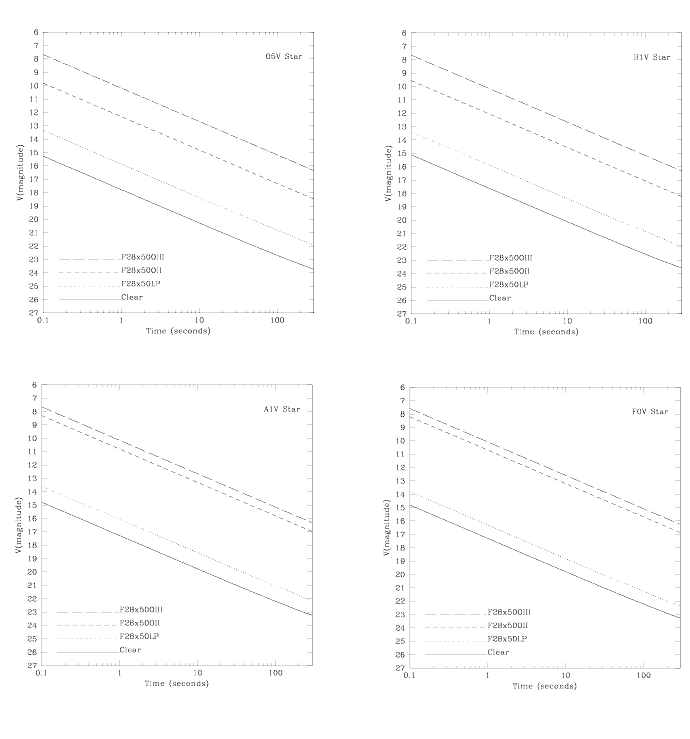
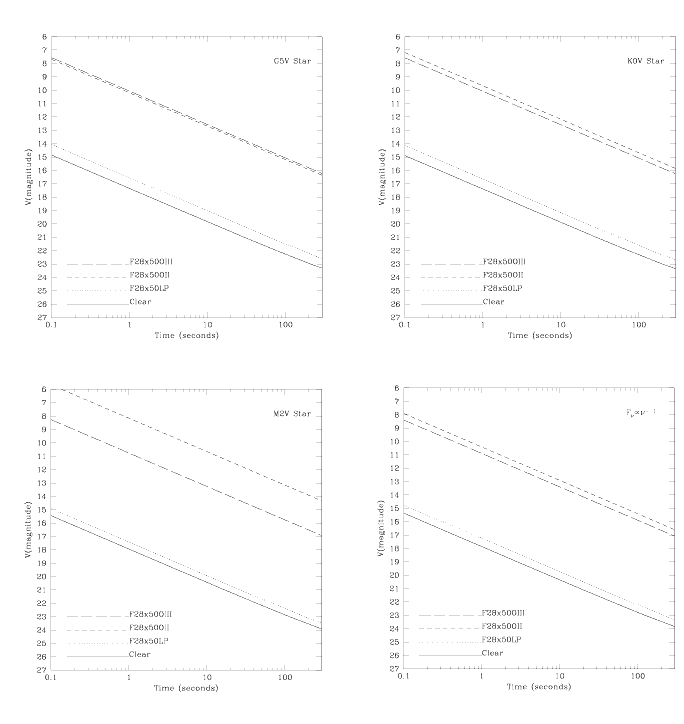
Figure 8.7 and Figure 8.8 can help you estimate exposure times-they plot exposure time versus V magnitude to achieve a signal-to-noise ratio of 40 for stars having a range of spectral types, for the clear, longpass, [O III], and [O II] filters. To determine the exact exposure time for your target, you should use the
Figure 8.7: Time to Achieve a Signal-to-Noise ratio of 40 for CCD AcquisitionsSTIS Target Acquisition Exposure Time Calculator(see Section 8.5). Note that the overheads in target acquisitions are substantially longer than most exposure times, so as long as you do not approach saturation (i.e., come within 30% of the full well) you should increase your exposure time by a factor of at least a few above the minimum required (e.g., if the exposure time to obtain a S/N of 40 is 0.3 second, then you should lengthen it to 1 second if no saturation occurs). Also consider whether a shorter exposure in a higher throughput filter might give better S/N (see Table 8.3 for the brightest magnitude as a function of filter and target spectral type which can be observed without saturating the acquisition exposure). The exposure time entered into your Phase II template is the time for each of the two exposures in the ACQ sequence, unlike the case ofCR-SPLITobservations where it is the total time.
Figure 8.8: Time to Achieve a Signal-to-Noise ratio of 40 for CCD Acquisitions
8.2.4 Specifying Acquisitions in Phase II
Acquisition exposures must be specified during Phase II before the scientific exposures for which they are intended. The user requests a target acquisition exposure by specifying
MODE=ACQon the APT Phase II exposure parameters page and setting the optional parameterACQTYPE=POINTorACQTYPE=DIFFUSE. IfACQTYPE=DIFFUSEis selected, the observer must also specifyDIFFUSE-CENTERandCHECKBOX.Exposure-Time Calculator and Phase II examples are provided in Section 8.5.
8.2.5 Solar-System Acquisitions
The ACQ procedure can be used for solar system targets as well as fixed targets. The difference is in the specification of the target position, which is outlined in chapter 4 of the HST Phase II Proposal Instructions. For satellites less than 0.1 arcsec in diameter, a point source ACQ is sufficient. For satellites of greater diameter,
ACQTYPE=DIFFUSEwithDIFFUSE-CENTER=GEOMETRICand aCHECKBOXsize chosen to match the satellite diameter are recommended. To acquire a planetary feature or a satellite transiting the planet, another satellite in the system can generally be used as an offset target. If precise pointing to a specific feature is not required, then blind pointing (which is generally accurate to ~1-2") can be used for larger targets such as Mars, Jupiter, and Saturn. The types of acquisitions recommended for the most common solar system targets is summarized in Table 8.4.The coordinates of the planets and their satellites are derived from ephemerides obtained by STScI from JPL. The accuracies of the ephemerides are maintained by JPL at the following web site:
http://ssd.jpl.nasa.gov/sat_eph.html.Contact
help@stsci.eduto find out which sets of ephemerides are currently being used. Your Program Coordinator can provide information on tracking for a specific visit.Special care must be taken when tracking satellites with rapidly changing direction or velocity. Observers should be aware that moving targets are tracked by HST with the assumption that the object is moving on a linear track with constant velocity. Depending on the visit structure, the same linear track may continue through several exposures. The scheduling software sets a generally appropriate limit on the duration of a linear track which depends on the target being tracked, but not on details of the target motion at the time. In some situations (for example, near the inflection point of an orbit), the approximation could result in inadequate tracking when using a narrow slit. If this may be a problem, the observer can consult the Program Coordinator of his/her proposal to find out how long the same track will be used for a series of exposures, and whether it is possible to break the visit into shorter tracks. Alternatively, one can plan to observe during a more linear part of the orbit.
Acquisition exposure times can be accurately estimated using the
STIS Target Acquisition ETC: use the Kurucz model G2 V (solar spectrum), and normalize it using the V magnitude for point-like (0.1 arcsec) objects or the V magnitude per arcsec2 and the appropriate target size in arcseconds for more extended targets.
For convenience, we summarize the types of acquisitions recommended for the most common solar-system targets in Table 8.4 below. If precise pointing to a specific feature is not required, then blind pointing (which is accurate to ~1-2) can be used for the larger targets such as Mars, Jupiter, and Saturn.
1The processing done by the FSW is rudimentary: a single, pre-determined, bias number is subtracted, bad pixels are set to the average of the 4 adjacent pixels, negative-valued pixels are set to zero, and each pixel is assigned the minimum from the two images (as a form of cosmic-ray and hot pixel rejection). Hence, ACQ exposures are not suited for accurate photometry.
|
|||||
|
Space Telescope Science Institute http://www.stsci.edu Voice: (410) 338-1082 help@stsci.edu |