Space Telescope Imaging Spectrograph Instrument Handbook for Cycle 14
 |
 |
 |
 |
 |
|
| Space Telescope Imaging Spectrograph Instrument Handbook for Cycle 14 | |||||
| ||||||
4.4 Objective-Prism Spectroscopy
The STIS
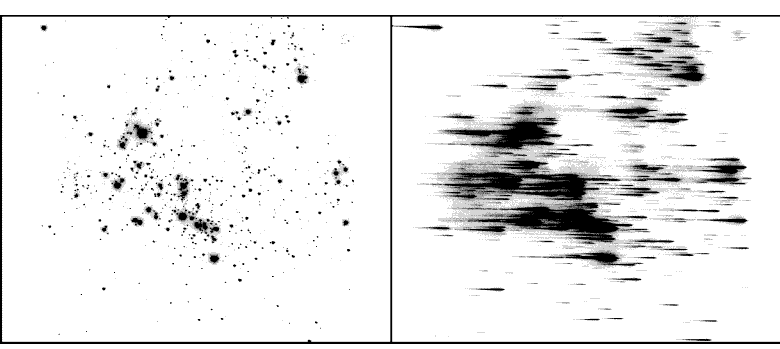
PRISMis used with theSTIS/NUV-MAMAand provides spectra from 1150 to 3620 Å at resolving powers of up to ~2500 in the far-ultraviolet declining to ~10 at optical wavelengths. In Figure 4.12 we compare a direct NUV MAMA image of the star cluster NGC 604 with aPRISMexposure of the same field. This example illustrates the power of the prism mode to simultaneously provide spectra covering a wide wavelength range of many objects in a single field of view. Note that the ACS also has the capability of performing slitless UV spectroscopy. See Section 4.1.2 for a comparison of these capabilities.As can be seen in Figure 4.12, an NUV objective-prism spectrum does not cover the full range of the detector in the dispersion direction. In many cases, there will be a significant number of counts only over an extent of ~200 pixels due to the large dispersion and low sensitivity at short wavelengths. This characteristic can be an advantage over a grating such as the
G230Lin crowded fields, since it reduces the possibility of overlap between different sources.The
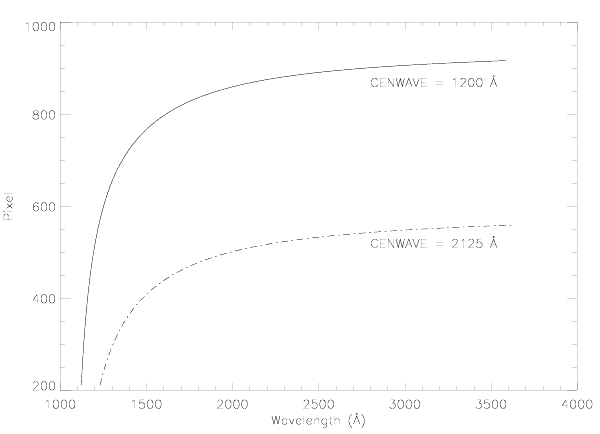
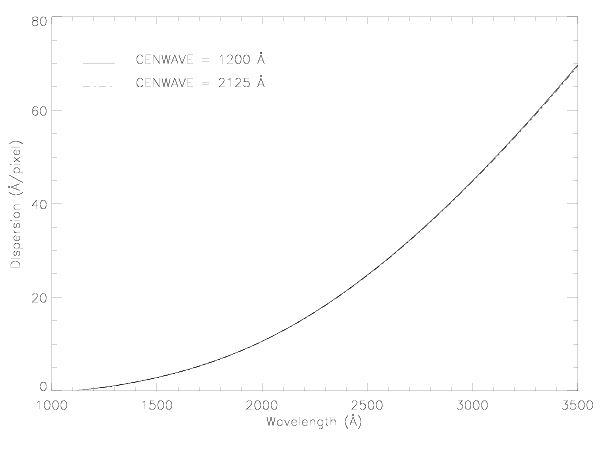
Figure 4.12: NUV-MAMA image (left) and objective-prism exposure (right) of NGC 604, a Scaled OB Association, obtained under GO program 9096. The dispersion direction is nearly parallel to the x-axis.PRISMcan be used at two wavelength settings, 1200 and 2125 Å. These are approximately the wavelengths that will lie at the center ofAXIS1on the detector for the two settings. The relationship between wavelength and pixel number along the central spectral trace is shown in Figure 4.13 for each setting. The dispersion as a function of wavelength is shown in Figure 4.14 for each setting.
Figure 4.13: Wavelength vs. Pixel Number along the Central Spectral Trace for thePRISMat wavelength settings 1200 and 2125 Å.
Figure 4.14: Dispersion as a function of wavelength for the PRISM at wavelength settings 1200 Å (solid) and 2125 Å (dot-dash). The lines for the two settings nearly overlap.
The
prismcan be used with the clear MAMA aperture (25MAMA) or with either longpass ultraviolet filtered aperture (F25SRF2orF25QTZ) to provide a 25x25 arcsecond field of view (see also F25SRF2-NUV-MAMA, Longpass and F25ND5-NUV-MAMA). The longpass filterF25SRF2blocks geocoronal Lyman-1216 Å and the
F25QTZlongpass filter blocks both geocoronal Lyman-PRISMspectroscopy, as are the52X0.05, 52X0.1, 52X0.2, 52X0.5,and52X2long slits.Observers will generally want to also obtain a direct image of the field when taking an objective prism spectrum, so they can later determine the centering of the objects in their prism data. Because the
PRISMand the mirrors used for imaging are both in the Mode Selection Mechanism, zero-point shifts will occur between thePRISMand imaging data (see Slit and Grating Wheels). For a discussion of the observations needed to measure these shifts, see Section 12.1.Note that slitless
PRISMspectroscopy produces images in which, a priori, the wavelength at a given pixel is not known, and source-dependent overlap of spectra can occur. For these reasons, slitlessPRISMspectroscopic data will not be calibrated automatically by the STScI pipeline. Instead, users will have to reduce and analyze their data off-line. The Spectrographs Branch at STScI is currently working on a self-extraction tool for objective-prism data.
|
|||||
|
Space Telescope Science Institute http://www.stsci.edu Voice: (410) 338-1082 help@stsci.edu |