Cosmic Origins Spectrograph Instrument Handbook for Cycle 17
 |
 |
 |
 |
 |
|
| Cosmic Origins Spectrograph Instrument Handbook for Cycle 17 | ||||
|
13.1 Apertures
COS has four apertures. Two (PSA and BOA) are used for science exposures (i.e, they see the sky via HST's optics). Two (WCA and FCA) are used for obtaining wavelength calibration lamp exposures and flat-field exposures. We include the FCA here for completeness, but note that observers may not obtain flat-field exposures on their own; that is a calibration activity of STScI.
The COS science apertures are field stops in the aberrated beam and are not traditional focal-plane entrance slits like those used on STIS and earlier HST spectrographs. Thus, they do not project sharp edges on the detectors. Because COS is a slitless spectrograph, the spectral resolution depends on the nature of the astronomical object being observed. Although COS is not optimized for observations of extended objects, it can be used to detect faint diffuse sources with lower spectral resolution than would be achieved for point (< 0.1 arcsec) sources.
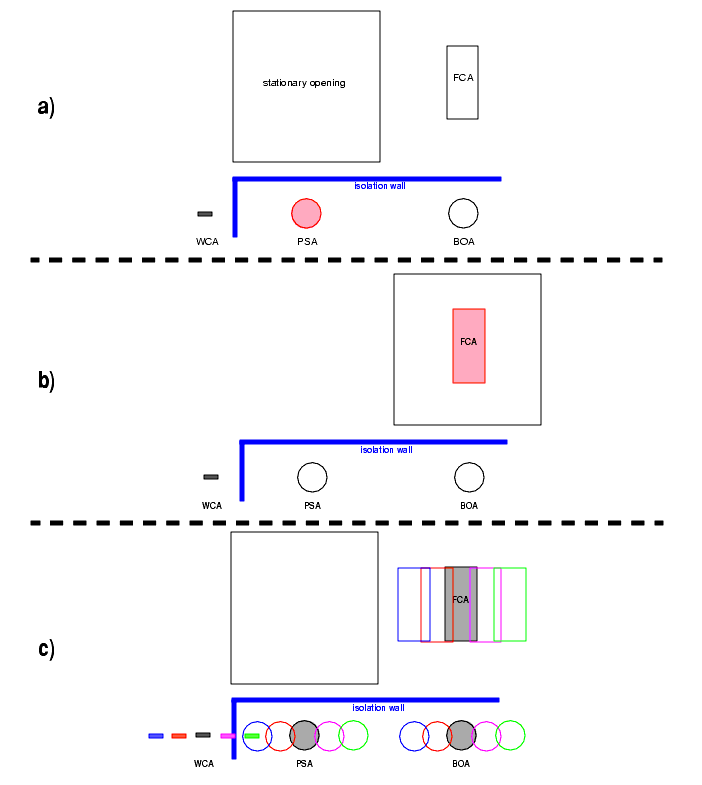
The four apertures are cut into a single plate and so have fixed relationships to one another. There is an isolation wall on the plate so that light entering either calibration aperture cannot reach the portion of the detector used for science. The dimensions of the apertures are given in the table below, and their sizes and positions are shown in Figure 13.2.
Table 13.1: COS aperture dimensions
13.1.1 The Aperture Mechanism (ApM)
The aperture plate is mounted on a mechanism that has two degrees of freedom. The Aperture Mechanism (ApM) is used routinely to select between the two science apertures, the PSA and the BOA. The aperture chosen by the observer is moved into place so that either aperture occupies exactly the same physical location when a science spectrum is exposed. This is necessary, of course, because COS' optics work properly only for point sources centered in the aperture, and, in particular, the off-axis aberrations are particularly severe in the NUV channel.
The relative locations of the COS apertures are shown in Figure 13.2. Note that when the BOA is in use that it is not possible to get light from the wavelength calibration lamp via the WCA. For this reason it is not possible to use TIME-TAG mode with FLASH=YES when the BOA is used. Also note that the ApM must be moved to place the FCA over the stationary opening to let deuterium lamp light into the spectrograph. Flat field exposures are not taken by observers but are instead done as part of the COS calibration program by STScI.
Finally, the ApM will be used occasionally to relocate the area of the FUV XDL detector that records the science spectrum. This will be done because each use of the XDL depletes charge in the area exposed. Over time this reduces the sensitivity of that portion of the detector, and so there is an advantage in moving to a fresh area. Plans for COS call for such a movement to be done up to four times after launch, thus using five different XDL locations.
Figure 13.2: The arrangement of COS apertures.
The large cross-hatched square in the upper left is a stationary opening. In the nominal position (a), the PSA, in red, is available for science observing and the WCA for wavecals. The FCA will not admit light into the spectrograph because it is not over the stationary opening. The BOA will admit light, but it will be optically degraded by being off-axis. Note the isolation wall (blue) that prevents calibration light from either the wavecal or flat-field lamp from entering a science aperture.
In (b), the aperture plate has been moved so that the FCA is over the stationary opening, to enable a flat-field exposure.
In (c), alternate positions for the PSA are shown. These will be used periodically to allow access to fresh areas of the XDL detector. Note the BOA, WCA, and FCA are all on the same plate and so move in lock-step with the PSA.
13.1.2 Primary Science Aperture
The Primary Science Aperture (PSA) is a 2.5 arcsec (700 µm) diameter field stop located on the HST focal surface near the point of maximum encircled energy. This aperture transmits essentially all of the light from a well-centered aberrated stellar image delivered by the HST optics. The PSA is expected to be used for observing in almost all instances.
13.1.3 Bright Object Aperture
The Bright Object Aperture (BOA) is also 2.5 arcsec (700 µm) in diameter with a neutral density (ND2) filter that permits COS to observe targets five magnitudes (factor of approximately 200) brighter than the Bright Object Protection limits allow through the PSA. The BOA is offset 3.70 mm in the cross-dispersion direction from the PSA on the aperture plate. The BOA must be moved with the Aperture Mechanism to the (currently used) position of the PSA for science observations. Thus, science spectra obtained through either the PSA or BOA will utilize the same detector region (for a given channel) and may employ the same flat-field calibration. Nonetheless, the BOA is open to light from the sky when the PSA is being used for science and vice versa, therefore bright object screening for the field-of-view must include both apertures.
The throughput versus wavelength for the BOA is shown in Figure 3.7.
13.1.4 Wavelength Calibration Aperture
The Wavelength Calibration Aperture (WCA) is offset from the PSA by 2.5 mm in the cross-dispersion direction, on the opposite side of the PSA from the BOA. Light from external sources can not illuminate the detector through the WCA.
The wavelength calibration spectrum can be used to assign wavelengths to pixel coordinates for science spectra obtained through either the PSA or BOA. The size of the WCA is 20 microns in the dispersion direction by 100 microns in the cross-dispersion direction. The wavelength calibration spectra will be obtained at WAC's nominal offset position from the PSA on both the NUV and FUV detectors. If the BOA is moved to the PSA position and used for science observations, the WCA aperture will be moved 3 mm away from its nominal position. Hence, in order to obtain wavecal spectra for BOA observations, the WCA must be moved back into its nominal position before the wavecal exposure is taken. Not only does this place the wavecal spectrum in the correct location on the detector, but it ensures that the Flat-field Calibration Aperture is masked from transmitting any photons from the wavecal lamps during the wavecal exposure. As a result of this requirement, TIME-TAG observations with FLASH=YES are not possible with the BOA.
13.1.5 Flat-field Calibration Aperture
A Flat-field Calibration Aperture (FCA) is offset by ~2 mm in the dispersion direction and by 3.7 mm in the cross-dispersion direction from the PSA. The size of the FCA is 0.75 mm by 1.75 mm. External light can only go through the PSA and BOA science apertures; light from the internal calibration lamps can only go through the WCA and FCA apertures. The FCA must be moved to project the flat-field continuum spectrum along the desired detector rows (e.g., at the PSA position). While not in use, the FCA is stowed at a position that does not transmit any light from an internal (or external) light source - e.g., the wavelength calibration lamp. After moving the FCA to the desired position, the flat-field spectrum falls along the same detector rows as the PSA or BOA science spectra (though is displaced in wavelength).
Table 13.1 shows the sizes of the COS science and calibration apertures, and Figure 13.2 shows their placement on the aperture plate. Because both science apertures always view the sky when the external shutter is open, the STScI target screening procedure must ensure that no bright targets are within a ~4 arcsec radius of either aperture for all observations. Since the spacecraft orientation may not be known and either of the science apertures could be specified, it may be prudent to screen the entire region within a ~17 arcsec radius of the nominal aperture position.
|
Space Telescope Science Institute http://www.stsci.edu Voice: (410) 338-1082 help@stsci.edu |
| |
|
|
|
|