Cosmic Origins Spectrograph Instrument Handbook for Cycle 17
 |
 |
 |
 |
 |
|
| Cosmic Origins Spectrograph Instrument Handbook for Cycle 17 | ||||
|
13.1 AperturesChapter 13:
Reference Material
13.1.1 The Aperture Mechanism (ApM)
13.1.2 Primary Science Aperture
13.1.3 Bright Object Aperture
13.1.4 Wavelength Calibration Aperture
13.1.5 Flat-field Calibration Aperture
13.2 COS Mechanisms
13.2.1 Optics Select Mechanism 1 (OSM1)
13.2.2 Optics Select Mechanism 2 (OSM2)
13.2.3 External shutter
13.3 COS Optical Elements
13.3.1 FUV Gratings
13.3.2 NUV Gratings
13.3.3 Mirrors
Here we provide some additional information on the design of COS. These details are not needed for most uses of the instrument and so distract from the description in Chapter3, A Tour through COS, but this information may be helpful in some cases and is needed for a complete documentation of the instrument.
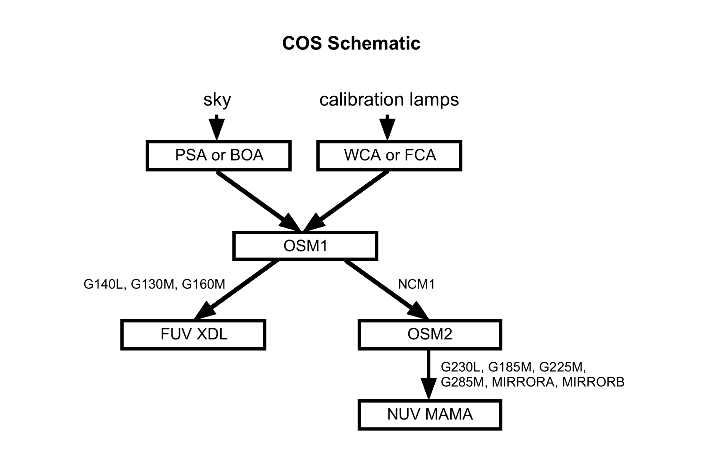
The logical flow through COS (Figure 13.1) starts with the Aperture Mechanism (ApM) and its four apertures. From there the light goes to Optics Select Mechanism 1 (OSM1), which holds the three FUV gratings (G130M, G160M, G140L) and a mirror (NCM1). If an FUV grating has been selected, the light then goes to the FUV detector.
If NCM1 has been placed into position, it corrects the beam for spherical aberration and magnifies it by a factor of about four. The light then goes to a collimator, NCM2, and then to OSM2. OSM2 holds the four NUV gratings (G185M, G225M, G285M, G230L) and a flat mirror (TA1 = MIRRORA). The NUV gratings are plane gratings (see below), and the dispersed light from them goes to three camera mirrors (NCM3a, b, c) and then to the detector, forming three separate stripes.
Figure 13.1: Schematic of the light flow through COS.
Some elements in this diagram are explained in this chapter.
|
Space Telescope Science Institute http://www.stsci.edu Voice: (410) 338-1082 help@stsci.edu |
| |
|
|
|
|