Cosmic Origins Spectrograph Instrument Handbook for Cycle 17
 |
 |
 |
 |
 |
|
| Cosmic Origins Spectrograph Instrument Handbook for Cycle 17 | ||||
|
3.3 The Design of COS
3.3.1 Optical Configuration
In most spectrographs, the light from the telescope is focused on a slit, and the instrument's optics then re-image the slit onto the detector. In such a design, the slit width and how the slit is illuminated determine the resolving power and line spread function (LSF).
COS is different: it is essentially a slitless spectrograph with an extremely small field of view. The entrance "aperture" is a field stop located near the point of maximum encircled energy. It is round, and 700 µm in diameter, corresponding to 2.5 arcsec on the sky. Because the apertures are not located at HST's focus, they are slightly out of focus at the detector. It is the sky that is imaged onto the detector, not the entrance aperture. COS' optics are designed for a point source that is centered in the aperture. Anything larger than 0.1 arcsec or off-center by more than about 0.1 arcsec will produce a degraded spectrum. For example, a source that is 0.5 arcsec in diameter will yield a spectrum with R
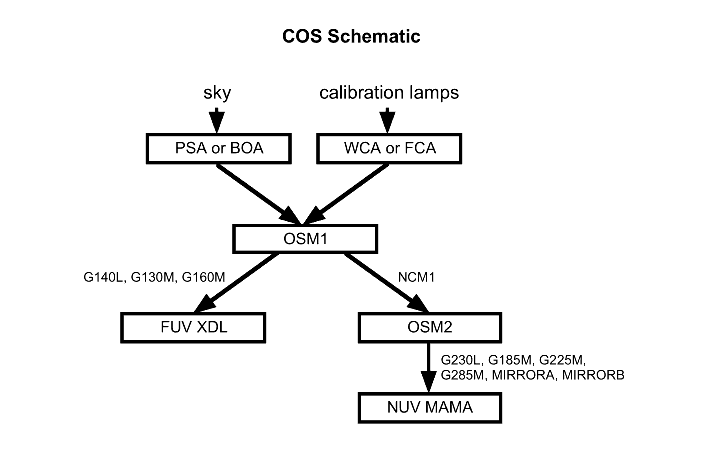
Figure 3.6: Schematic of the light flow through COS.5,000 instead of 20,000.
The elements in this diagram are explained in this chapter.
COS has a simple optical design that minimizes the number of reflections required to disperse and detect ultraviolet light in its two optical channels. COS has especially high throughput in the far ultraviolet, below about 2050 Å. The instrument is designed specifically for high-throughput spectroscopy of point sources. It may also be used to observe extended objects, but with limited spatial information and significantly degraded spectral resolution.
Light enters COS through one of two 2.5 arcsec diameter circular apertures and encounters an optical element that enables far-ultraviolet (FUV; 1150 to 2050 Å) or near-ultraviolet (NUV; 1700 to 3200 Å) observations. Figure 3.6 above shows the optical path of COS schematically. Here we explain the various elements of the optics. The next section describes COS' apertures. The gratings and mirrors are mounted on two mechanisms, OSM1 and OSM2, which are described next. The detectors are discussed in the next chapter. Some additional details of the design are provided in Chapter 13 on page 143.
3.3.2 Apertures
COS has two circular science apertures that are 2.5 arcsec (700 µm) in diameter. There are also two calibration apertures. A general description of COS' apertures is provided here, with some additional details in "Apertures" on page 144.
The COS science apertures are field stops in the aberrated beam and are not traditional focal-plane entrance slits like those used on STIS and earlier HST spectrographs. Thus, they do not project sharp edges on the detectors. Because COS is a slitless spectrograph, the spectral resolution depends on the nature of the astronomical object being observed. Although COS is not optimized for observations of extended objects, it can be used to detect faint diffuse sources with lower spectral resolution than would be achieved for point (< 0.1 arcsec) sources.
Because both science apertures always view the sky when the external shutter is open, the STScI target screening procedure must ensure that no bright targets are within a ~4 arcsec radius of either aperture for all observations. Since the spacecraft orientation may not be known and either of the science apertures could be specified, it may be prudent to screen the entire region within a ~17 arcsec radius of the nominal aperture position.
Primary Science Aperture
The Primary Science Aperture (PSA) is a 2.5 arcsec (700 µm) diameter field stop located on the HST focal surface near the point of maximum encircled energy. This aperture transmits about 95% of the light from a well-centered, aberrated stellar image delivered by the HST optics. The PSA is expected to be used for observing in almost all instances.
Bright Object Aperture
The Bright Object Aperture (BOA) is also 2.5 arcsec (700 µm) in diameter with a neutral density (ND2) filter that permits COS to observe targets six magnitudes (factor of approximately 200) brighter than the Bright Object Protection limits allow through the PSA. The BOA is offset 3.70 mm in the cross-dispersion direction from the PSA on the aperture plate. The BOA must be moved with the Aperture Mechanism to the nominal position of the PSA for science observations. Thus, science spectra obtained through either the PSA or BOA will utilize the same optical path and detector region (for a given channel), and so may employ the same flat-field calibration. Nonetheless, the BOA is open to light from the sky when the PSA is being used for science and vice versa; therefore bright object screening for the field-of-view must include both apertures.
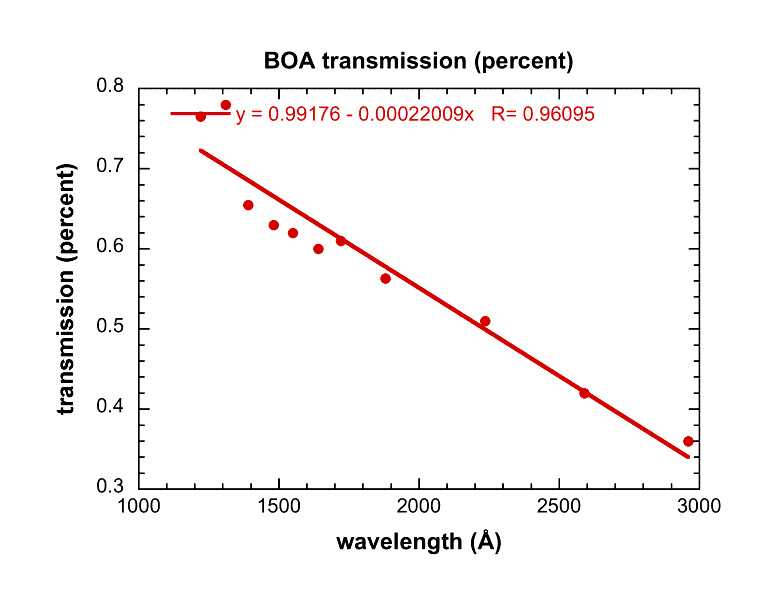
The transmission of the BOA is wavelength dependent, and is shown below. The straight line fit is given by transmission (in percent) = 0.99 -
Figure 3.7: Measured transmission of the COS BOA as a function of wavelength.(Å)/4500.
Wavelength Calibration Aperture
The Wavelength Calibration Aperture (WCA) is offset from the PSA by 2.5 mm in the cross-dispersion direction, on the opposite side of the PSA from the BOA. Light from external sources cannot illuminate the detector through the WCA; instead the WCA is illuminated by the Pt-Ne lamp.
The wavelength calibration spectrum can be used to assign wavelengths to pixel coordinates for science spectra obtained through either the PSA or BOA. The size of the WCA is 20 microns in the dispersion direction by 100 microns in the cross-dispersion direction. The wavelength calibration spectra will be obtained at the WCA's nominal offset position from the PSA on both the NUV and FUV detectors. If the BOA is moved to the PSA position and used for science observations, the WCA aperture will be moved 3 mm away from its nominal position. Hence, in order to obtain wavecal spectra for BOA observations, the WCA must be moved back into its nominal position before the wavecal exposure is taken. Not only does this place the wavecal spectrum in the correct location on the detector, but it ensures that the Flat-field Calibration Aperture is masked from transmitting any photons from the wavecal lamps during the wavecal exposure. As a result of this requirements,
FLASH=YES(TAGFLASH) operation is not possible with the BOA.Flat-field Calibration Aperture
A Flat-field Calibration Aperture (FCA) is offset by ~2 mm in the dispersion direction and by 3.7 mm in the cross-dispersion direction from the PSA. The size of the FCA is 0.75 mm by 1.75 mm. The FCA must be moved to project from the on-board flat-field continuum lamp to create a spectrum along the desired detector rows (e.g., at the PSA position). When not in use, the FCA is stowed at a position that does not transmit any light from an internal (or external) light source. After moving the FCA to the desired position, the flat-field spectrum falls along the same detector rows as the PSA or BOA science spectra (though is displaced in wavelength).
3.3.3 The FUV and NUV Channels
FUV channel optical design
The COS FUV channel covers the wavelength range 1150 to 1775 Å at low- and moderate spectral resolution. In the FUV channel, the light from HST's OTA illuminates a single optical element, one of three concave holographically-ruled diffraction gratings. An optic selection mechanism (OSM1) configures either the low-dispersion grating or one of two medium-dispersion gratings for the observation. The grating disperses the light, corrects for HST's spherical aberration, and focuses the light onto a crossed delay-line (XDL) micro-channel plate (MCP) detector. The XDL is described below (FUV Detector (MCP+XDL)), but it is important to note that it consists of two independent segments with a physical gap between them. This gap prevents a single continuous spectrum from being obtained in one setting, but it also enables geocoronal Lyman-
to be placed there in some set-ups, thereby eliminating the local high count rates that line can cause.
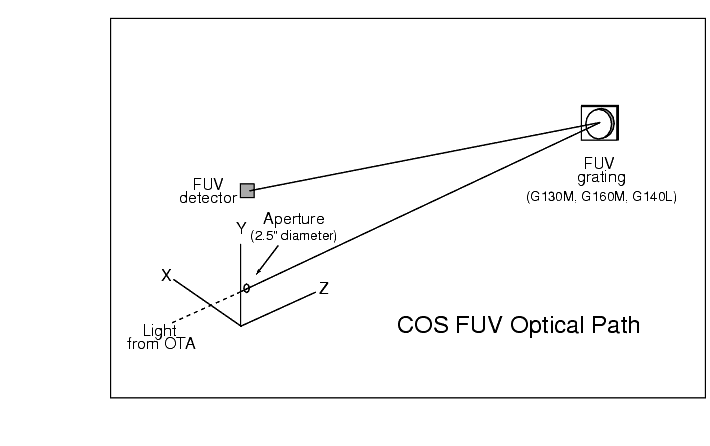
The same OSM1 mechanism may also be used to place a mirror (NCM1) in the light path in place of the grating for NUV observations, as described in the next section. The COS FUV optical path is illustrated schematically in Figure 3.8.
The FUV channel is fundamentally a Rowland spectrograph, modified to meet the specific needs of HST. As noted, there is only one reflection between the aperture and the detector. The gratings have aspheric concave surfaces that compensate for spherical aberration. Holographically generated grooves provide dispersion and correct the astigmatism. Ion-etching creates a blaze that optimizes the grating efficiency over a narrow range of wavelengths. Details on the gratings are provided in "COS Optical Elements" on page 149.
Figure 3.8: The COS FUV optical path.
Two gratings, G130M and G160M, are used to cover the range 1150 to 1775Å wavelength range at medium resolution (R = 20,000 to 24,000). Each medium-dispersion grating covers roughly 300 Å in one exposure. A third grating, G140L, can be used to observe the 1230 to 2050 Å region at lower resolution (R = 2500 to 3500). The short wavelength cut-off of the low-dispersion grating is designed to avoid bright geocoronal Lyman-
Although the nominal wavelength range of the G140L spectrum is 1230 to 2050 Å, this spectrum takes up only part of one detector segment. The grating actually directs light out to 2400 Å onto this detector segment, but the XDL sensitivity to these longer wavelengths is extremely low. On the other detector segment, the G140L grating disperses light between ~100 - 1100 Å. Again the sensitivity to these wavelengths is very low, limited in this case by the reflectance of the OTA mirrors and COS optics. Calculations predict that the effective area below 1150 Å plummets rapidly but is not zero.
NUV channel optical design
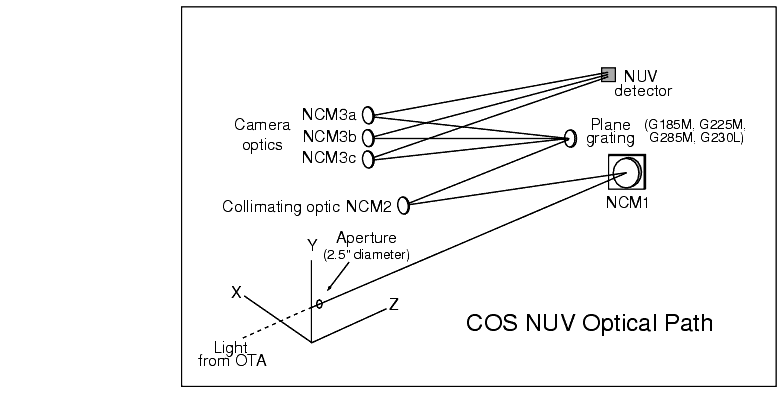
The COS NUV channel covers the wavelength range 1700 to 3200 Å at moderate spectral resolution. The NUV channel is fundamentally a Czerny-Turner design, fed by a mirror (NCM1) mounted on the OSM1. The NCM1 corrects the input beam for spherical aberration, magnifies it by a factor of ~4, and directs it to a collimating optic, NCM2. The collimated beam is then directed to one of several gratings mounted in the Optics Select Mechanism 2 (OSM2). The OSM2 contains several flat, first-order gratings and a mirror (TA1). Three medium-dispersion gratings, G185M, G225M, and G285M, deliver resolutions R = 20,000 to 24,000 over the wavelength range 1700 to 3200 Å. The dispersed light from the gratings is imaged onto a MAMA detector by three camera optics (NCM3a, b, c). The spectra appear as three non-contiguous ~35-40 Å stripes on the MAMA detector, allowing ~105-120 Å wavelength coverage per exposure. The gratings can be scanned with slight rotations of the OSM2 to cover the entire NUV wavelength band. The NCM3a,b,c mirrors are spaced such that three exposures will produce a continuous spectrum from the beginning of the short wavelength stripe in the first exposure to the end of the long wavelength stripe in the third exposure. In other words, two intermediate grating settings will cover the wavelength gap between the stripes in the first exposure.
A low-dispersion grating, G230L, delivers ~400 Å coverage per stripe with a resolution of ~1.1 Å (R = 1550 - 2900). The first-order science spectrum from G230L over the 1700 to 3200 Å region is captured in three separate exposures using four spectral stripes on the detector. The optical design places 1700 Å at the beginning of the first stripe A and 3200 Å at the end of the second stripe B of a single exposure. Three exposures will be required for complete, contiguous coverage of the 1700-3200 Å region, with some overlap between each exposure.
Figure 3.9: The COS NUV optical path (schematic).
Over the FUV wavelengths the NUV MAMA detector actually has a QE of several percent, and second-order light from the FUV could appear on the detector with some gratings. To eliminate this second-order light, the coatings on the NUV optics are optimized for wavelengths above 1600 Å, but have some throughput at FUV wavelengths. The four optical bounces in the NUV channel will therefore effectively reduce unwanted 2nd-order light, such as from Lyman-
3.3.4 Detectors
See also Chapter 4, "Detector Performance" on page 37.
FUV Detector (MCP+XDL)
The COS FUV detector is a windowless MCP (micro-channel plate) with a XDL (crossed delay line) anode that is similar to detectors used on the Far Ultraviolet Spectroscopic Explorer (FUSE). The detector is a photon counter with two segments, each of which has an active area of 10 × 85 mm, with a gap of 9 mm between them. The two detector segments are independently operable to provide redundancy. The active area of 10 × 85 mm is digitized to 1,024 × 16,384 pixels, with the long axis being in the direction of dispersion. The locations of detected events are recorded in pixel units. However, note that the XDL is an analog device and does not have physical pixels in the usual sense, and the location of an event is determined by the electronics as they occur. This lack of pixels creates some uncertainty in the exact location of an event and can limit the achieved signal-to-noise for this reason.
The FUV XDL is optimized for the 1150 to 1775 Å bandpass, with a cesium iodide photocathode. The front surface of the XDL is curved with a radius of 826 mm to match the curvature of the focal plane.
When photons strike the photocathode they produce photoelectrons which are then multiplied by micro-channel plates. There are two stacks, one for each detector segment, and each with three curved plates. An electron cascade typically produces a gain of 10 million, resulting in measurable charge clouds of 2 to 3 picocoulombs, each several mm in diameter.
The XDL's quantum efficiency is improved with a grid of wires placed in front of the detector (i.e., in the light path). However, these wires create shadows in the spectrum that must be removed during data reduction.
The location of charge events is determined by the crossed delay lines. There is one anode for each detector segment, and each anode has separate traces for the dispersion and cross-dispersion axes.
The electronics that create the digitized time signals also generate pulses which emulate counts located at the edges of the anode, beyond the illuminated regions of the detector. These "e-stims" or "stim pulses" have several purposes. They provide a first-order means of tracking and correcting distortions. They are also used for determining dead-time corrections.
NUV Detector (MAMA)
The COS NUV detector is a MAMA (Multi-Anode Micro-channel Array) that is essentially identical to that used for the NUV in STIS (it is, in fact, the STIS NUV flight spare). The NUV optics focus light through the MgF2 window onto the Cs2Te photocathode. A photoelectron generated by the photocathode then falls onto a micro-channel plate (MCP) and the MCP then generates a cloud of about 700,000 electrons. The active area of the coded anode array is 25.6 mm square and is divided into 1024 × 1024 pixels on 25 µm centers.
The window is stepped since the photocathode must protrude into the tube body to within 0.25 mm of the MCP. At this spacing and with a photocathode-to-MCP gap potential of 800 volts, the spatial resolution at 2500 Å is 35 µm FWHM. A photoelectron emitted by the photocathode has a 68% probability of being collected by the MCP.
3.3.5 On-board Calibration Lamps
Four calibration lamps are mounted on the calibration subsystem. Light is directed from the lamps to the aperture mechanism through a series of beam-splitters and fold mirrors.
Pt-Ne wavelength calibration lamps
COS has two identical Pt-Ne hollow cathode wavelength calibration lamps on its internal calibration platform whose spectra contain emission lines suitable for determining the wavelength scale of any spectroscopic mode. Either lamp may be used for wavelength calibration exposures, but the choice is not user-selectable. We anticipate that one lamp will be used until it fails and then operations will be switched to the other.
The Pt-Ne lamps are used to obtain wavelength calibration exposures, either as a separate wavecal for
ACCUMexposures, or during aTIME-TAGexposure whenFLASH=YESis specified. The light from the Pt-Ne lamp reaches the spectrograph through the WCA (wavelength calibration aperture). The WCA spectrum is displaced at an off-axis position relative to the PSA, projected 2.5 mm away from the PSA spectrum on the FUV detector. On the NUV detector, the corresponding WCA spectral stripe lies 9.3 mm away from the associated PSA science strip.The Pt-Ne lamps will also be used during
ACQ/IMAGEtarget acquisition sequences to provide a geometrical reference point that will define the relationship between a known location at the aperture plane and the detector pixel coordinates in which the measurements are made.Deuterium flat-field calibration lamps
Similarly, COS has two identical deuterium hollow cathode flat-field calibration lamps. The deuterium lamps may also be used interchangeably. Usage of these lamps for flat-field calibrations is restricted to observatory calibration programs. The light from these lamps enters the spectrograph through the FCA (flat-field calibration aperture).
3.3.6 Mechanisms
COS uses four moving mechanisms to carry out its normal science observations: an external shutter, the Aperture Mechanism (ApM), the Optics Select Mechanism 1 (OSM1), and the Optics Select Mechanism 2 (OSM2).
External Shutter
The external shutter is a paddle shaped arm, with a shutter blade made up of a thin, circular disc approximately 1.5 inches in diameter. It is located at the front of the COS enclosure in the optical path before the aperture mechanism. When closed, the shutter blocks all external light from entering the COS instrument and prevents light from the COS internal lamps from exiting the instrument. The shutter travel-time is <500 msec. The opening and closing of the external shutter is not used to determine the duration of an exposure. The external shutter will only be opened by a command at the beginning of every external exposure and is closed at the end of every external exposure, with the possible exception of one or more phases of target acquisition. The external shutter will be closed autonomously by the COS flight software whenever any over-light condition is triggered by an external or internal source or when the HST take-data-flag goes down indicating loss of fine lock.
Aperture Mechanism (ApM)
The ApM is located near the HST OTA focal surface in the forward, lower portion of the COS enclosure. (Details are provided in "The Aperture Mechanism (ApM)" on page 145). The ApM positions the aperture block which contains the Primary Science Aperture (PSA), Bright Object Aperture (BOA), Wavelength Calibration Aperture (WCA), and Flat-field Calibration Aperture (FCA). The ApM is used to position the PSA at the optimum position along the optical beam to maximize throughput of a focused aberrated point source. The ApM is used to move the BOA to the position of the PSA for observations of bright targets (for both the FUV and NUV channels). Finally, the ApM is used to move the FCA to the desired position for obtaining flat-field exposures for PSA or BOA science spectra. The WCA need not be moved for wavelength calibration exposures associated with PSA science spectra. When the ApM is moved in the cross-dispersion direction for BOA science exposures, it must be commanded back to its nominal (PSA) position to project the WCA spectrum in the appropriate place for wavelength calibrations.
The ApM is not moved for FP-POS dithering, which is accomplished by small motions of the gratings. The three FUV gratings on the OSM1 will be at the same focus position and, hence, will require no movement of the ApM when switching between optics. However, we expect that the ApM will generally need to be moved when switching between the FUV and NUV channels (using the NCM1 optic on OSM1) so as to provide the best optical performance.
Additional information on the aperture mechanism is provided in "The Aperture Mechanism (ApM)" on page 145.
Optics Select Mechanism 1 (OSM1)
The optics mounted on OSM1 receive the input light beam from the HST OTA through the ApM and direct it to the FUV detector or the NUV channel, depending on which optic is rotated into place. The optic positioned by this mechanism will be the first reflecting surface that the light encounters once it enters the instrument. The mechanism will position any one of four different optics into the beam. The OSM1 contains the G130M, G160M, and G140L gratings, and the NCM1 mirror. The gratings direct light to the FUV detector while the mirror directs light to the NUV channel. The four optics mounted on OSM1 are arranged at 90-degree intervals.
Once an optic is positioned by OSM1, the mechanism must allow for small adjustments in 2 degrees of freedom. Rotational adjustments are required to move the spectra on the FUV detector in the dispersion direction for FP-POS positioning in the FUV channel and for recovering wavelengths that fall on the FUV detector gap. Translational adjustments are required to refocus the instrument on orbit in order to optimize the focus of each of the FUV gratings and the NCM1 mirror, and to accommodate any instrument installation misalignments or any modifications to the location of the HST secondary mirror. The translational motions are in the z-direction (towards or away from the HST secondary).
Optics Select Mechanism 2 (OSM2)
The NUV optics mounted on OSM2 receive light from the NCM2 collimating mirror and direct the spectrum or image to the three camera mirrors (NCM3a,b,c). The OSM2 contains the G185M, G225M, G285M, and G230L gratings, and the TA1 mirror. OSM2 rotates but does not translate. Rotations move the spectrum or image in the dispersion direction on the NUV detector. The gratings are flat and each medium resolution grating must be positioned at one of ~6 discrete positions in order to achieve full wavelength coverage. Small rotational adjustments will also be used for FP-POS positioning. The five optics on OSM2 are distributed at 72-degree intervals.
|
Space Telescope Science Institute http://www.stsci.edu Voice: (410) 338-1082 help@stsci.edu |
| |
|
|
|
|