Wide Field Camera 3 Instrument Mini-Handbook for Cycle 16
 |
 |
 |
 |
|
| Wide Field Camera 3 Instrument Mini-Handbook for Cycle 16 | |||
|
5. Observing with WFC3
This section addresses the general questions that arise when observers choose between planning to use WFC3 in a future observing cycle vs. proposing for an existing imaging instrument for Cycle 16.
To support such decisions, this section also presents detailed specifications for the WFC3 spectral elements, and gives guidance on the anticipated WFC3 performance. There is also a brief discussion of parallel observations (i.e., simultaneous observations with WFC3 and ACS). It must be remembered, however, that these specifications, although as accurate as possible at this writing, are still preliminary and subject to possible changes.
5.1 Choosing the Optimum Scientific Instrument
When facing the decision whether to propose WFC3 observations in a future cycle, or to propose now for other existing scientific instruments, observers should carefully evaluate the capabilities of WFC3 and compare them to those of the other HST instruments, in the context of their own scientific goals.
Observers should especially note that WFC3 intentionally provides some redundancy with the ACS and NICMOS instruments, in order to provide some protection against potential failures of either of those instruments. On the other hand, WFC3 also differs sufficiently from those instruments (in fact, it largely complements them). Therefore, observers do need to give careful consideration to instrument capabilities in order to optimize the observations. The primary factors to consider in choosing the best instrument are areal coverage, spatial resolution, wavelength coverage, sensitivity, and availability of specific spectral elements. Table 2 lists the primary characteristics of the imaging instruments that will be available on HST following a successful SM4.
For some research programs, the instrument choice may be dictated by the need for a particular spectral element. In this regard, WFC3 offers considerable capability because of its broad complement of wide-, medium-, and narrow-band filters both at UV/optical and near-IR wavelengths, as well as one UV grism and two near-IR grisms for slitless spectroscopy. See Table 4 and Table 5 below.
For studies at optical wavelengths, the trade-offs to consider when deciding between WFC3/UVIS and ACS/WFC include pixel size, field of view and, to some extent, throughput. WFC3 is generally preferable when angular resolution has higher priority than field of view, because of its finer pixel size. On the other hand, ACS/WFC has higher throughput than WFC3/UVIS at wavelengths longward of 400 nm (see Figure 4), and hence it should be used if the highest possible sensitivity at such wavelengths is crucial. However, considerations of degraded charge-transfer efficiency (CTE) should also be kept in mind, since ACS will have been in the high-radiation space environment for about six years at the time when WFC3 may come on line.
At UV wavelengths, WFC3/UVIS is the only imager on HST to offer a large field of view combined with high throughput. However, its spectral coverage does not extend shortward of 200 nm, whereas ACS/SBC and STIS/FUV-MAMA (if STIS operation is restored during SM4) both reach down to 115 nm (STIS/NUV-MAMA reaches 160 nm), and also offer finer spatial sampling (see Table 2). Thus, WFC3 will be the choice whenever both large field of view and coverage down to 200 nm are required (e.g., multi-wavelength surveys). However, if observations at extreme far-UV wavelengths are necessary, or if the highest available spatial sampling is a primary requirement, then ACS/HRC, ACS/SBC, or the STIS UV channels should be considered.
At near-IR wavelengths WFC3/IR offers a much larger field of view and, generally, higher throughput than NICMOS. It also offers greatly improved sensitivity and ease of data reduction and calibration, due to the accurate bias subtraction made possible by the presence of reference pixels. However, WFC3 sensitivity is limited to wavelengths shortward of ~1700 nm, and WFC3 has coarser pixel sizes than NIC1 and NIC2.
5.2 Specifications for UVIS and IR Spectral Elements
As described above, the spectral elements for WFC3 have been chosen to cover many scientific applications, from color selection of distant galaxies, to accurate photometry of stellar sources and narrow-band imaging of nebular gas. The WFC3 filter suite was defined by the SOC, with input from the astronomical community. To reflect the importance of the blue and ultraviolet wavelength regimes and the high short-wavelength sensitivity of the WFC3 UVIS channel, several near-UV filters are included in the UVIS filter set. Spanning the entire wavelength region are filters consistent with the WFPC2, ACS, and NICMOS sets, various widely used photometric systems, and the Sloan survey filters. The shape of the passband of some filters has been designed for specific purposes, such as providing maximum throughput (e.g., some of the near-UV filters) or matching the response of the detector to provide photometric accuracy (e.g., the H band in the IR channel, as discussed in Section 4.4). Table 4 and Table 5 list the available passbands for the UVIS and IR channels, respectively, and their characteristics.
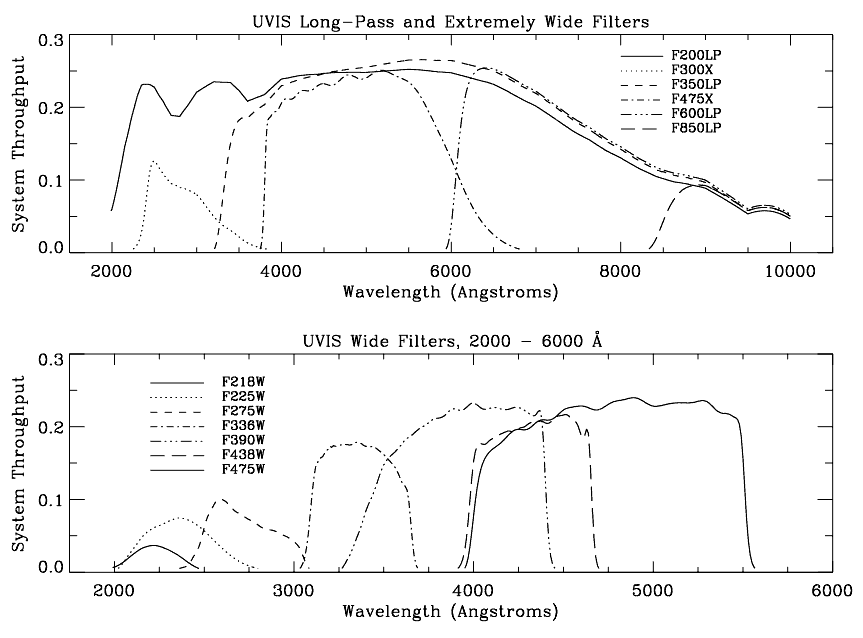
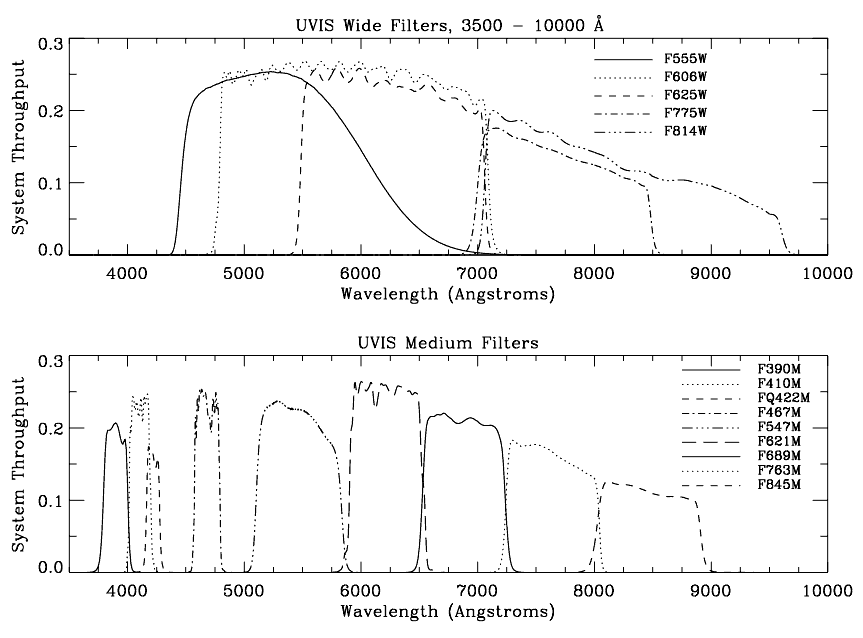
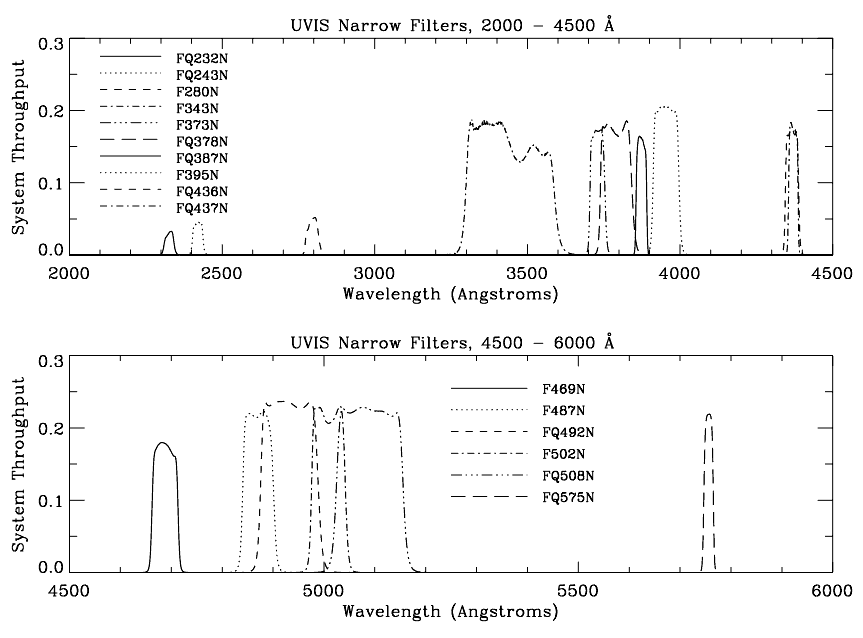
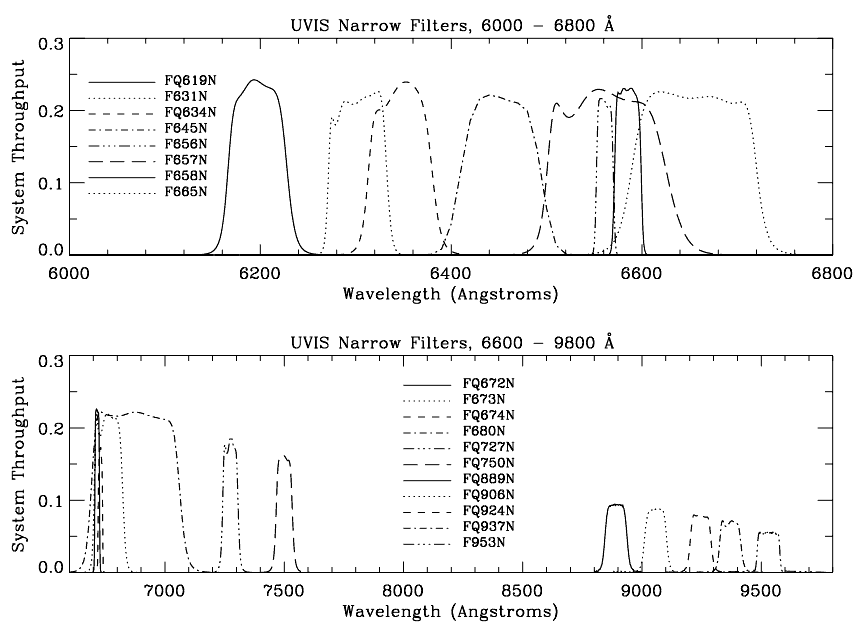
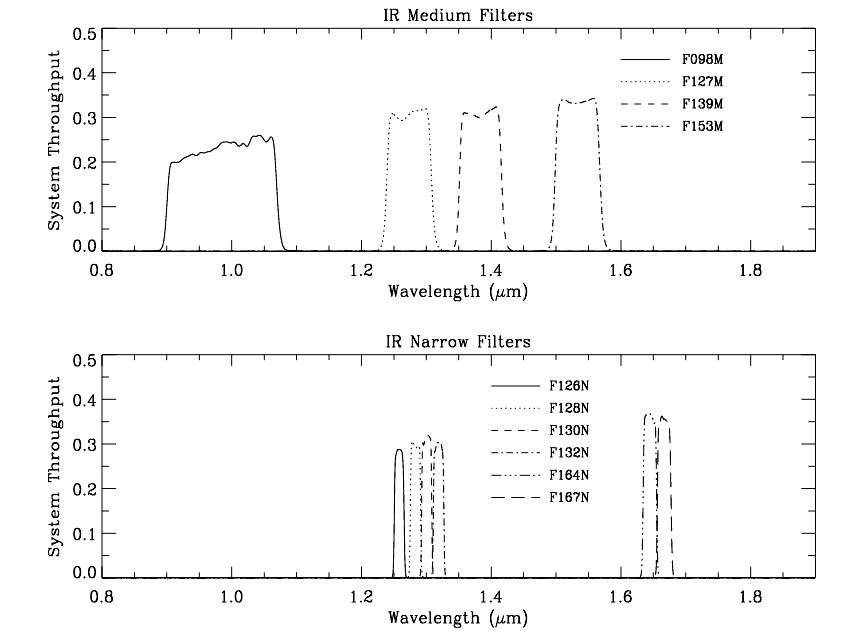
Figure 6 through Figure 11 present detailed plots of the total system throughput for each of the UVIS and IR filters. The throughput calculations include the quantum efficiencies of the UVIS flight CCD and of the IR flight candidate detector FPA 129.
Figure 6: Integrated system throughput of the WFC3 UVIS long-pass and extremely wide filters (top panel) and of the wide-band filters covering 2000-6000 A (bottom panel). The throughput calculations include the HST OTA, WFC3 UVIS-channel internal throughput, filter transmittance, and the QE of the UVIS flight detector. Throughputs in all plots below ~3200 A include correction for quantum yield. Instrument throughput is not yet well-characterized below 2000 A and above 10,000 A.
Figure 7: Integrated system throughput of the WFC3 UVIS wide-band filters covering 3500-10,000 A (top panel) and the medium-band filters (bottom panel). The throughput calculations include the HST OTA, WFC3 UVIS-channel internal throughput, filter transmittance, and the QE of the UVIS flight detector.
Figure 8: Integrated system throughput of the WFC3 UVIS narrow-band filters covering 2000-4500 A (top panel) and the narrow-band filters covering 4500-6000 A (bottom panel). The throughput calculations include the HST OTA, WFC3 UVIS-channel internal throughput, filter transmittance, and the QE of the UVIS flight detector.
Figure 9: integrated system throughput of the WFC3 UVIS narrow-band filters covering 6000-6800 A (top panel) and the narrow-band filters covering 6600-9800 A (bottom panel). The throughput calculations include the HST OTA, WFC3 UVIS-channel internal throughput, filter transmittance, and the QE of the UVIS flight detector.
Figure 10: Integrated system throughput of the WFC3 IR wide-band filters, presented in two panels for clarity. The throughput calculations include the HST OTA, WFC3 IR-channel internal throughput, filter transmittance, and the QE of the FPA129 flight candidate IR detector.
Figure 11: Integrated system throughput of the WFC3 IR medium-band filters (top panel) and narrow-band filters (bottom panel). The throughput calculations include the HST OTA, WFC3 IR-channel internal throughput, filter transmittance, and the QE of the FPA129 flight candidate IR detector.
Table 4: WFC3 UVIS Channel Filters and Grism
Name1
(Å)
Transmission4340 + [O III] 4363
4861
6562
1The spectral-element-naming convention is as follows for both the UVIS and IR channels. All filter names begin with F, and grisms with G; if the filter is part of a four-element quad mosaic, a Q follows F. Then there is a three-digit number giving the nominal effective wavelength of the bandpass, in nm (UVIS channel) or nm/10 (IR channel). (For long-pass filters, the number is instead the nominal blue cutoff wavelength in nm.) Finally, for the filters, one or two letters indicate the bandpass width: X (extremely wide), LP (long pass), W (wide), M (medium), or N (narrow).
2Filters intended for imaging in a redshifted bandpass are given descriptions similar to the following: "z (H
3"Pivot wavelength" is a measure of the effective wavelength of a filter (see A. Tokunaga & W. Vacca 2006, PASP, 117, 421). It is calculated here based only on the filter transmission. Values are approximate for the long-pass filters.
4Full width at 50% of peak transmission for wide and medium bands, and at 10% of peak transmission for narrow bands. For long-pass filters, the widths are approximate and include convolution with the detector QE.
5km-agt (km-amagat) is a unit of vertical column density, equal to 2.69×1024 molecules/cm2.
5
Table 5: WFC3 IR Channel Filters and Grisms
(nm)
Transmission
1See footnote 1 of Table 4 for naming conventions.
2"Pivot wavelength" is defined as in Table 4.
3Full width at 50% of peak transmission.
5.3 Anticipated WFC3 Performance
Table 6 presents the predicted limiting-magnitude performance of WFC3 and compares it with that of the ACS and NIC3 cameras. The calculations are based on a 3×3 pixel extraction box on a point source. The limiting ABMAG at a S/N of 10 was calculated for a 1-hour and a 10-hour exposure. The throughput curves for the WFC3 filters listed in column 2 were used; for ACS and NIC3, the most similar wide-band filter was used, and its name is given in column 3. The ACS/HRC camera was assumed for the NUV and U-band comparison; ACS/WFC was assumed for B, V, and I; and NIC3 for J and H. The FPA 129 IR detector was assumed for the WFC3/IR calculations.
An online exposure-time calculator (ETC) is planned for release in mid-2007 and will be linked on the WFC3 web site.
Table 6: Anticipated limiting-magnitude performance of WFC3 compared with those of ACS and NIC3. The table gives limiting ABMAGs at a S/N of 10 for the indicated WFC3 filters and for ACS or NIC3 for their most similar filters. WFC3 UVIS comparisons are with the ACS HRC channel (NUV and U) and the ACS WFC channel (B, V, I). WFC3 IR comparisons are with NIC3 (J and H).
5.4 Parallel Observations
The ability of the HST system to support simultaneous operations with WFC3 and ACS, as well as possible enhancements of its data-volume capabilities, are still being evaluated as of this writing. Whether it will be possible to support parallel observations with WFC3 and ACS, therefore, is not known at this time.
|
Space Telescope Science Institute http://www.stsci.edu Voice: (410) 338-1082 help@stsci.edu |
| |
|
|
|