Cosmic Origins Spectrograph Instrument Handbook for Cycle 17
 |
 |
 |
 |
 |
|
| Cosmic Origins Spectrograph Instrument Handbook for Cycle 17 | ||||
|
7.5 Imaging Acquisitions
We anticipate that most observers most of the time will acquire their target using the COS/NUV configuration in ACQ/IMAGE mode. Ordinarily both COS detectors will be available for use, and so there is no time penalty in switching from an NUV acquisition to an FUV spectrum.
In
ACQ/IMAGEmode the following steps occur:
- The Pt-Ne calibration lamp is turned on and the location of its image is measured. This then determines the location of the science aperture (either the
PSAor theBOA), given the known offset between the two. This operation is done with the external shutter closed.- The shutter is then opened and a target acquisition image is obtained. The telescope is not moved, meaning that an acquisition using
ACQ/IMAGEwill be successful only if the target lies within the aperture at this point. An area of 4 × 4 arcsec, centered on the aperture, is then read out.- A 9 × 9 checkbox array is then passed over the 4 × 4 arcsec image. First, the pixel with the most counts is identified. In the unlikely instance that two pixels have equal counts, the first one encountered is used. The 9 × 9 array centered on that brightest pixel is then analyzed using a flux-weighted centroiding algorithm to calculate the expected target position.
- Finally, HST is moved to place the calculated centroid at the center of the selected aperture. Another exposure is taken and recorded for later downlink as a verification of the centering.
7.5.1 Exposure times and count rates
The best way to determine actual count rates, exposure times, and the overall time needed for an acquisition is to use the COS acquisition ETC and APT. Here we provide less accurate information to give you a general idea of what happens.
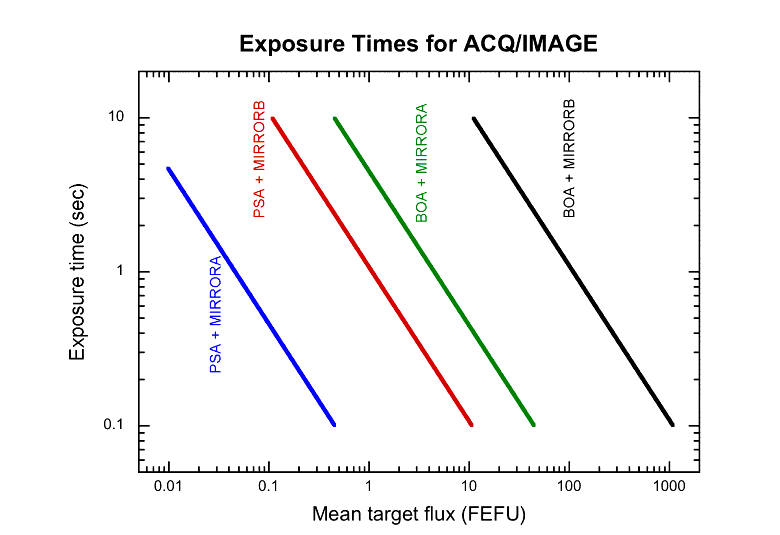
Figure 7.1: Exposure time needed for ACQ/IMAGE mode.
The time is given as a function of target flux. This calculation assumes a flat source spectrum.
Figure 7.1 shows acquisition exposure times needed to reach S/N = 40 for various combinations of mirrors and apertures. A flat source spectrum is assumed.
7.5.2 Imaging acquisitions with mediocre coordinates
If you are not confident that your source will fall within the aperture after the initial pointing by HST, it is possible to scan a larger area of sky, also in undispersed light. The procedure is the same as for an NUV acquisition in dispersed light (see NUV Dispersed-Light Acquisitions below), except that the spectral element is chosen to be
MIRRORAorMIRRORB. Use ofSCAN-SIZE=3, for example, is adequate to find the object if it falls within 3 arcsec of the aperture center.
|
Space Telescope Science Institute http://www.stsci.edu Voice: (410) 338-1082 help@stsci.edu |
| |
|
|
|
|