Cosmic Origins Spectrograph Instrument Handbook for Cycle 17
 |
 |
 |
 |
 |
|
| Cosmic Origins Spectrograph Instrument Handbook for Cycle 17 | ||||
|
4.2 The NUV MAMA
4.2.1 MAMA properties
The COS NUV detector is a MAMA (Multi-Anode Micro-channel Array) that is essentially identical to that used for the NUV in STIS (it is, in fact, the STIS NUV flight spare). The COS MAMA has a semi-transparent cesium telluride photocathode on a magnesium fluoride window; this allows detection of photons with wavelengths from 1150 to 3200 Å.
The NUV optics focus light through the MgF2 window onto the Cs2Te photocathode. A photoelectron generated by the photocathode then falls onto a micro-channel plate (MCP) and the MCP then generates a cloud of about 700,000 electrons. The active area of the coded anode array is 25.6 mm square and is divided into 1024 × 1024 pixels on 25 µm centers.
The window is stepped since the photocathode must protrude into the tube body to within 0.25 mm of the MCP. At this spacing and with a photocathode to MCP gap potential of 800 volts, the spatial resolution at 2500 Å is 35 µm FWHM. A photoelectron emitted by the photocathode has a 68% probability of being collected by the MCP. The MCP multiplies the detected photoelectron to generate a space charge saturated pulse containing ~7 × 10⁵ electrons.
A single curved MCP manufactured by Litton Electro-Optical Systems is used to multiply photoelectrons generated by the photocathode into a charge pulse containing ~7 × 10⁵ electrons. The channel curvature suppresses ion feedback to the proximity focused photocathode and greatly improves the detector efficiency over a chevron MCP configuration.
4.2.2 MAMA spectral response
The inherent spectral response of the COS NUV MAMA is essentially identical to that of the STIS NUV MAMA. However, the overall optical train of COS differs from STIS, so that the COS throughputs are greater.
4.2.3 MAMA non-linearity
As noted in Non-linear photon counting effects (dead-time correction), the MAMA detector is expected to be essentially linear over the count rate range permissible. For count rate limits, see "Safety First: Bright Object Protection" on page 84.
4.2.4 Detector format
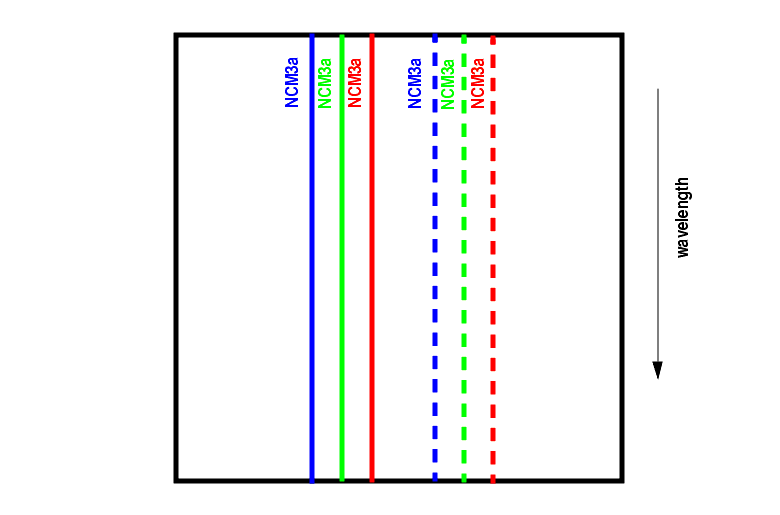
As noted in the instrument description, the NUV channel creates three spectrum stripes on the MAMA detector, and there are three separate stripes for the science data and for the wavelength calibration data. This is shown schematically in the following figure. Note that each stripe is separated by 2.80 mm from its neighbor, and there is a gap of 3.70 mm between the reddest science stripe and the bluest calibration stripe.
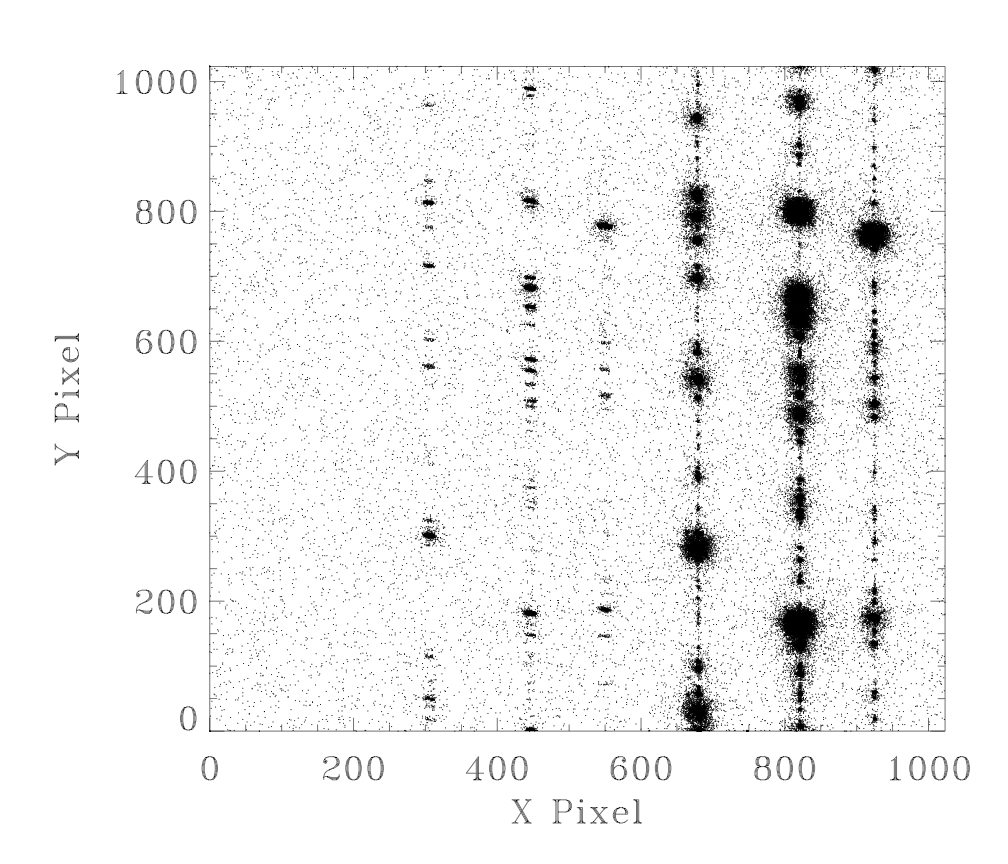
Shown below is an example of an NUV spectrum obtained during ground testing.
Figure 4.4: Test data for an NUV spectrum.
Shown is a comparison spectrum, with both the WCA and the PSA illuminated by the lamp in this set-up. Note the "science" spectrum on the left and the comparison spectrum each have three stripes.
Figure 4.5: Spectrum layout for the COS MAMA.
The blue, and red stripes correspond to the shortest- and longest wavelengths, with green being intermediate. The stripes on the left are the science spectra and those on the right are wavelength calibration spectra.
4.2.5 Read-out format, A-to-D conversion, etc.
The COS NUV MAMA is read out as a 1024 × 1024 array, but in all other respects the data are handled in the same way as for the FUV detector.
|
Space Telescope Science Institute http://www.stsci.edu Voice: (410) 338-1082 help@stsci.edu |
| |
|
|
|
|