Cosmic Origins Spectrograph Instrument Handbook for Cycle 17
 |
 |
 |
 |
 |
|
| Cosmic Origins Spectrograph Instrument Handbook for Cycle 17 | ||||
|
3.1 COS' Location in the HST Focal Plane
COS will be installed in one of the axial instrument bays near the rear of HST. It will replace COSTAR, which was installed in the first servicing mission, in 1993, to provide correcting optics for the other axial instruments that were in HST at the time (FOC, FOS, and GHRS).
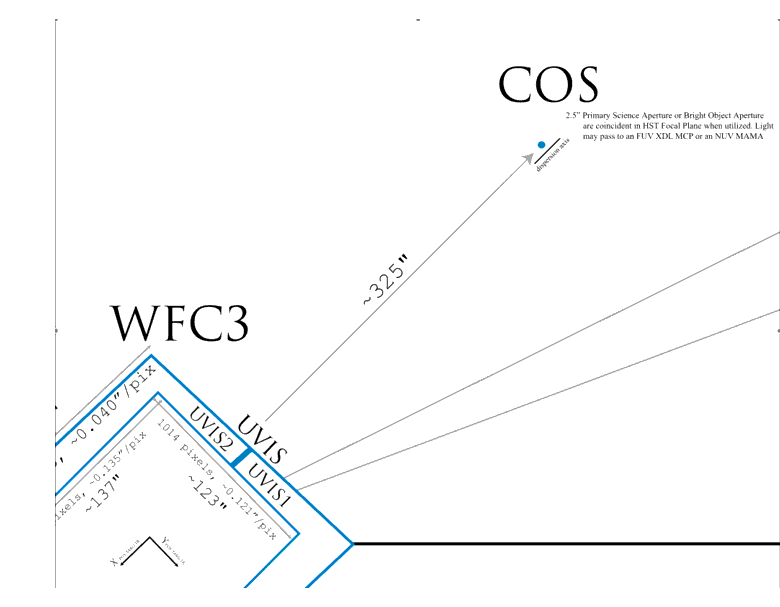
The location of the COS aperture in the HST focal place is shown in Figure 3.1. Note the relative orientation of the HST V2 and V3 axes (the V1 axis is along HST's optical axis), as well as the relative locations and orientations of the other instruments. Note that the Primary Science Aperture (PSA) of COS is 325 arcsec from the V1 axis, and that COS is located in the +V2, -V3 quadrant.
The apertures are very small, of course, so an enlargement of the region around them is also shown in Figure 3.2. Note that the direction along the dispersion of a COS spectrum corresponds to motion equally in V2 and V3 in a direction radially away from the center of the HST field of view. Specifically, increasing wavelength is in the direction of +V2 and -V3 for both the FUV and NUV.
Figure 3.1: A schematic view of the HST focal plane.
This drawing shows the entire HST focal plane and the apertures of the scientific instruments as it will appear after SM4.
Figure 3.2: An enlargement of the HST focal plane in the region of the COS aperture.
Shown is the region from WFC3 to COS. Note that the direction of dispersion for COS is radially away from the HST optical axis and that the COS aperture is 325 arcsec from the optical axis (V1).
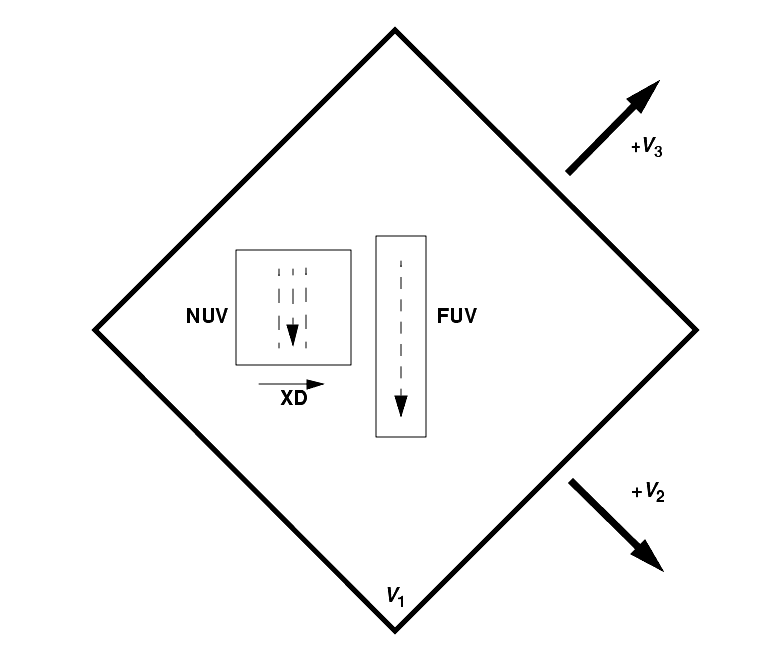
Figure 3.3: Schematic layout of the COS detectors.
This view is from the front of the telescope looking aft, with the V1 axis being at the bottom tip of the square. The dashed arrows show the direction of increasing wavelength for the two detectors, and "XD" shows the increasing wavelength for the NUV cross-dispersion direction. For both the FUV and NUV, increasing wavelength is in the (+V2, -V3) direction.
|
Space Telescope Science Institute http://www.stsci.edu Voice: (410) 338-1082 help@stsci.edu |
| |
|
|
|
|