


|
|

4. Choosing Between COS and STIS
4.1 General Considerations
The spectral resolution, wavelength coverage, and sensitivity required for an observation will often be the most important factors involved in deciding whether to use COS or STIS for an ultraviolet spectroscopic observation of a point source. Spectral resolutions and wavelength coverages available for each instrument are summarized above in Tables 3 and 4. Sensitivities are compared in Table 5.
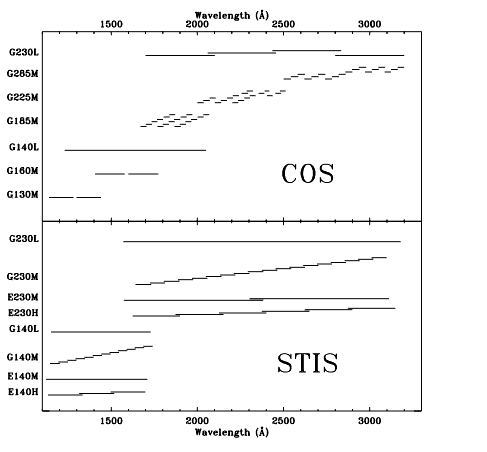
Wavelength ranges for selected COS and STIS spectroscopic modes are shown in Figure 7. Note that multiple wavelength settings may be required in some modes to cover the entire NUV channel (e.g., COS and STIS M gratings). Observing programs needing full wavelength coverage may benefit from observations made with lower sensitivity or lower resolution modes requiring fewer exposures to cover the entire wavelength range.
COS has limited scientific imaging capabilities in the 1700 to 3200 Å bandpass. The field of view is limited to the aperture size of 2.5 arcsec, which may be sufficient for point source target confirmation. Most observing programs that require two-dimensional imaging at ultraviolet wavelengths should use another HST instrument, such as ACS, STIS, or WFC3.
Figure 7: Wavelength coverages available with common COS and STIS spectroscopic modes. Ranges for different grating tilts are offset in the vertical direction. Additional settings may be available for some modes.
4.2 Recommended Choices
In Table 7 we list some typical types of spectroscopic observations and recommendations as to whether observers should use COS or STIS for their observations. These are general guidelines only, with the ultimate choice of instrument left as a decision to the proposer.
Table 7: Which Instrument Is Right For Your Observation - COS or STIS?
|
Your Company Your Company's Web Site Voice: (555) 555-1234 Fax: (555) 555-5678 Your Company's E-mail Address |
|
|
 coverage than STIS echelle
 t < 32 ms is required