|
|

3. Throughputs and Sensitivities
3.1 Throughputs and Effective Areas
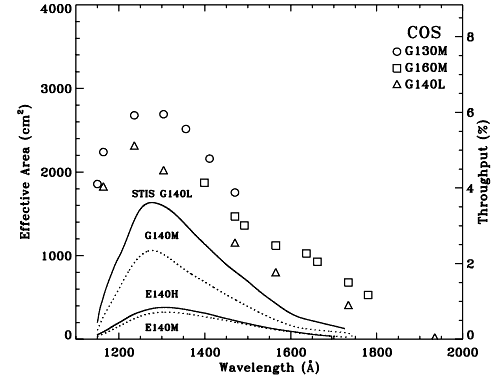
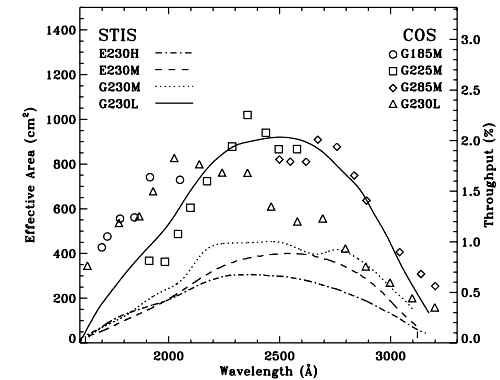
Initial measurements of the throughputs of the COS optical systems during ground tests indicate that the instrument is performing at least as well as expected. The testing indicates that COS should be considerably more sensitive than STIS and earlier generation HST instruments at comparable spectral resolutions. Preliminary results for the end-to-end system throughputs of the COS FUV and NUV channels are shown in Figures 3 and 4. These estimates are appropriate for a point source centered in the COS primary science aperture. The throughput and effective area calculations include the throughput of the HST OTA and degradation of the light beam prior to entry into the COS instrumentation, as described by Burrows (1988, STScI internal memo). At FUV wavelengths, the peak effective area is expected to reach ~2700 cm2 near 1300 Å with the G130M grating. At NUV wavelengths, the peak effective area is expected to reach ~1000 cm2 near 2350 Å with the G225M grating.
For comparison, similar calculations for several STIS MAMA spectroscopic modes covering the same ultraviolet wavelengths are also shown in Figures 3 and 4. At FUV wavelengths, the system throughput with the COS medium-resolution mode is at least a factor of 7 higher than for the STIS medium-resolution echelle mode (E140M) and is a factor of ~2 or more higher than for the STIS low-resolution mode (G140L), neglecting STIS slit transmission losses (which are typically 30% or more). At NUV wavelengths, the COS medium-resolution throughput is at least a factor of 2 higher than it is for the STIS medium-resolution echelle mode (E230M) and exceeds the throughput of the STIS low-resolution mode (G230L) at
Figure 3: HST/COS FUV effective areas and throughputs. Values for several STIS modes are also shown for comparison with the COS values. All values are system end-to-end values that include the performance of the HST OTA, as described by Burrows (1988). All STIS values shown assume full slit transmission.< 2200 Å.
Figure 4: HST/COS NUV effective areas and throughputs. Values for several STIS modes are also shown for comparison with the COS values. All values are system end-to-end values that include the performance of the HST OTA, as described by Burrows (1988). All STIS values shown assume full slit transmission.For clarity, we have not shown the STIS G230MB and G230LB throughput curves in Figure 4. Above 2400 Å, the STIS G230LB throughput exceeds 2.3%, and at
3.2 Point Source Sensitivities
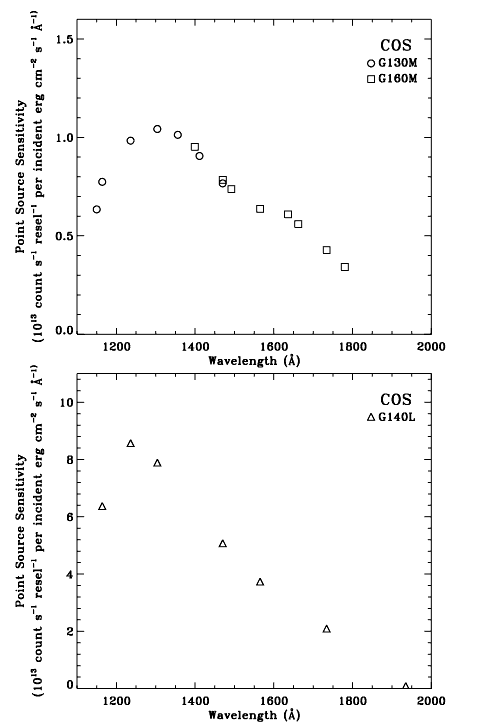
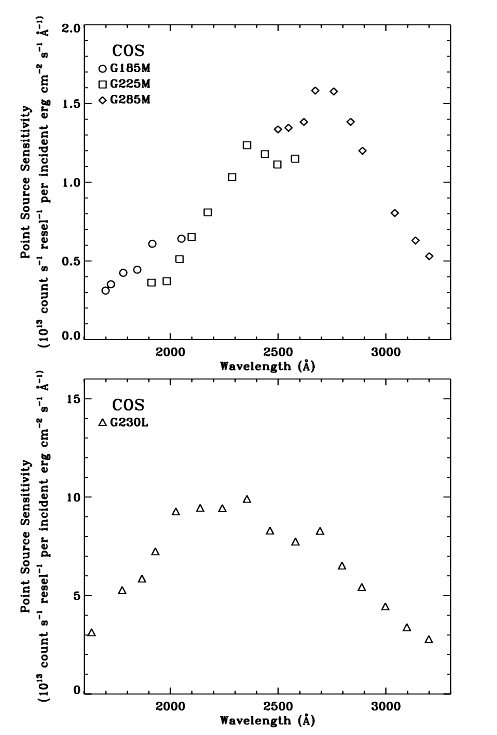
Figures 5 and 6 show the point source sensitivities (S
t) for a source flux (F
3.3 Bright Limits
Microchannel plates are susceptible to degradation if exposed to bright sources of ultraviolet light. Like STIS, COS will have a set of bright limit restrictions that will preclude some objects from being observed. Since the throughput of COS is considerably higher than that of STIS, it may be necessary to observe some bright sources with STIS rather than COS, or to use the bright object aperture with COS (see Section 2.3).
COS has two general types of bright limits: global and local. At FUV wavelengths, the ACCUM mode global bright limit is ~60,000 cnt s-1 segment-1, and the local count rate limit is ~1.67 cnt s-1 pix-1 (~100 cnt s-1 resel-1). At NUV wavelengths, the ACCUM mode global bright limit is ~170,000 cnt s-1, and the local count rate limit is ~200 cnt s-1 pix-1 (~1800 cnt s-1 resel-1). The NUV ACCUM mode global count rate limit can be increased slightly at the expense of Doppler compensation during the course of the exposure.
Figure 5: COS FUV point source sensitivities.
Table 5: COS/STIS Sensitivity ComparisonNote: Backgrounds are not included in the listed sensitivities. In background- limited situations, the expected S/N calculated from these numbers must include background information, and comparisons of different instrument modes will depend upon the details of the background and the spectral bin size adopted. Values for all STIS modes assume 2 pixels per resolution element and no slit transmission losses. Use of the 0.2 x 0.2 arcsec aperture reduces the STIS values by factors of 1.3 (2800 Å) to 1.8 (1300 Å). Use of the 0.2 x 0.06 arcsec slit reduces the STIS values by factors of 1.7 (2800 Å) to 2.6 (1300 Å). The STIS echelle values do not account for scattered light, which is a substantial component of the background (especially for E140M); including echelle scattered light will further reduce the STIS values of STable 6 contains approximate estimates of the bright limit fluxes for the medium- and low-resolution COS modes at several wavelengths using the count rate limits listed in Table 2. Below each flux limit we also list the approximate corresponding visual magnitude of an unreddened O9 V star. The final operational screening limits set by STScI may be more restrictive than those listed in Table 6.
Users should note that the minimum exposure time allowed for COS exposures is 0.1 second. Exposures shorter than a few minutes will be dominated by overheads associated with setting up the exposure and obtaining wavelength calibration exposures. The maximum exposure time allowed for a single exposure (or FP-POS sub-exposure) is 6500 seconds.
Table 6: COS Bright LimitsNote: Bright limits are for point sources centered in the PSA. These numbers increase by a factor of ~100 [5 magnitudes] if the BOA is used. Global limits assume either a flat spectrum or an unreddened O9 V stellar spectrum observed in ACCUM mode. For the medium-resolution modes, the global limits are appropriate for a spectral region centered roughly on the specified wavelength. For the low-resolution modes, the global limits are appropriate for grating tilts with central wavelengths of 1230 Å and 2635 Å. Screening limits adopted for nominal operations may be more restrictive than those listed in this table.3.4 Backgrounds
For faint sources, backgrounds can be a significant source of counts detected by COS and must be considered when making exposure time estimates if flux levels are less than ~10-15 erg cm-2 s-1 Å-1. The background events arise mainly from radioactive decays in the materials used to construct the microchannel plates and associated hardware. For the windowless FUV MCP detector, the on-orbit background rate is expected to be similar to the rate of ~0.5 - 0.8 cnt s-1 cm-2 (~7.5x10⁻⁷ cnt s-1 pix-1) measured for the FUSE MCP detectors. However, like the STIS NUV MAMA, the COS NUV MAMA suffers significantly increased background levels due to fluorescence caused by impurities in its MgF2 window. The expected on-orbit background level is ~34 cnt s-1 cm-2 (~2.1x10⁻⁴ cnt s-1 pix-1), which is about a factor of 4 lower than the background level found for the STIS flight MAMA (Ball SER COS-NUV-001). Low energy thermal ions are excluded from the COS detectors through the use of ion repeller grids. Scattered light is not expected to be a significant source of background on either COS detector since the COS first-order diffraction grating rulings have very low scatter (<2x10⁻⁵ / Å). Full characterization of the intrinsic pre-flight backgrounds and on-orbit backgrounds for both COS detectors will be performed to assess the impact of the detector and scattered light backgrounds on observations of faint objects.
Your Company
Your Company's Web Site
Voice: (555) 555-1234
Fax: (555) 555-5678
Your Company's E-mail Address