7.1 Designing an ACS Observing Proposal
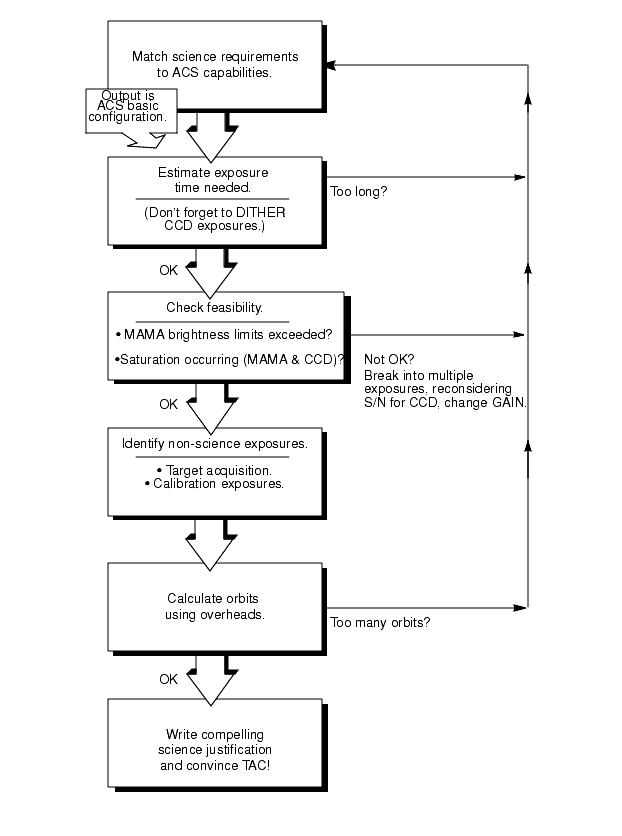
In this section, we describe the sequence of steps you will need to take when designing your ACS observing proposal. The process is an iterative one, as trade-offs are made between signal-to-noise ratio and the limitations of the instrument itself. The basic sequence of steps in defining an ACS observation are:
- Identify science requirements and select the basic ACS configuration to support those requirements.
- Estimate exposure time to achieve the required signal-to-noise ratio, determine GAIN selection, CR-SPLIT, dithering, and mosaic strategy, and check feasibility, including saturation and bright-object limits.
- Identify any additional target acquisition (coronagraph) and calibration exposures needed.
- Calculate the total number of orbits required, taking into account the overheads.
Figure 7.1: Defining an ACS observation.7.1.1 Identify Science Requirements and Define ACS Configuration
First and foremost, of course, you must identify the science you wish to achieve with ACS. Basic decisions you will need to make are:
As you choose your science requirements and work to match them to the instrument’s capabilities, keep in mind that those capabilities differ greatly depending on whether you are observing in the optical or near-UV with the CCD, or in the far-UV using the MAMA detector. Trade-offs are described in Table 7.1
.
Imaging
For imaging observations, the base configuration is detector (Configuration), operating mode (MODE=ACCUM), and filter. Chapter 5 presents detailed information about each ACS imaging mode.
Special Uses
We refer you to Chapter 6 if you are interested in any of the following special uses of ACS: slitless spectroscopy, polarimetry, and coronagraphy.
7.1.2 Use of Available-but-Unsupported Capabilities
A set of core ACS capabilities to support scientific observations has been established. In addition there are a few capabilities with ACS, some of which are mentioned in this Handbook, for which limited access is available. These capabilities are “available-but-unsupported,” but, in consultation with an ACS Instrument Scientist, may be requested. These include a few apertures, limited interest optional parameters, some GAIN options, and filterless (CLEAR) operation. If you find that your science cannot be obtained using fully supported modes, or that it would be much better with use of these special cases, then you may wish to consider use of an unsupported mode.
Use of unsupported modes comes at a price; they should only be used if the technical requirements and scientific justifications are particularly compelling. The following caveats apply:
- Calibrations for available-but-unsupported modes will not be provided by STScI. It is the observer’s responsibility to obtain such calibrations as needed.
- STScI adopts a policy of shared risk with the observer for the use of these modes. Requests to repeat failed observations taken with unsupported capabilities will not be honored if the failure is related to use of this capability.
- User support from STScI will be more limited.
Phase I proposals that include use of unsupported ACS capabilities must include the following:
During the Phase II proposal submission process, use of available-but-unsupported modes requires formal approval from the ACS-WFPC2 Team at STScI. To request permission for use of an available-but-unsupported mode, please send a brief e-mail to your Program Coordinator (PC) that addresses the above four points. The PC will relay the request to the contact scientist or relevant ACS instrument scientist, who will decide whether the use will be allowed. This procedure ensures that any potential technical problems have been taken into account. Note also that archival research may be hindered by use of these modes. As a result, requests for use of unsupported modes which do not adequately address the above four points, or which will result in only marginal improvements in the quality of the data obtained, may be denied, even if the request was included in your approved Phase I proposal.
The current list of available-but-unsupported items are:
7.1.3 Determine Exposure Time and Check Feasibility
Once you’ve selected your basic ACS configuration, the next steps are:
- Estimate the exposure time needed to achieve your required signal-to-noise ratio, given your source brightness. (You can use the ACS Exposure Time Calculator for this; see also Chapter 9 and the plots in Chapter 10).
- For observations using the CCD detectors, ensure that for pixels of interest, you do not exceed the per pixel saturation count limit of the CCD full well or the 16 bit word size at the GAIN setting you choose.
- For observations using the MAMA detector, ensure that your observations do not exceed brightness (count rate) limits.
- For observations using the MAMA detector, ensure that for pixels of interest, your observations do not exceed the limit of 65,535 accumulated counts per pixel per exposure imposed by the ACS 16 bit buffer.
To determine your exposure-time requirements, consult Chapter 9 where an explanation of how to calculate a signal-to-noise ratio and a description of the sky backgrounds are provided. To assess whether you are close to the brightness, signal-to-noise, and dynamic-range limitations of the detectors, refer to Chapter 4.
If you find that the exposure time needed to meet your signal-to-noise requirements is too great, or that you are constrained by the detector’s brightness or dynamic-range limitations, you will need to adjust your base ACS configuration. Table 7.2 summarizes the options available to you and steps you may wish to take as you iterate to select an ACS configuration which is both suited to your science and is technically feasible.
Table 7.2: Science feasibility guide.
1Splitting CCD exposures affects the exposure time needed to achieve a given signal-to-noise ratio because of the readnoise.
7.1.4 Identify Need for Additional Exposures
Having identified a sequence of science exposures, you need to determine what additional exposures you may require to achieve your scientific goals. Specifically:
- For coronagraphy, determine what filter and target-acquisition exposure will be needed to acquire your target in the target acquisition aperture. This target acquisition zeroes out the position errors inherent in the guide stars.
- If the success of your science program requires calibration to a higher level of precision than is provided by STScI calibration data, and if you are able to justify your ability to reach this level of calibration accuracy yourself, you will need to include the necessary calibration exposures in your program, including the orbits required for calibration in your total orbit request.
7.1.5 Data Volume Constraints
If ACS data are taken at the highest possible rate for more than a few orbits or in the Continuous Viewing Zone (CVZ), it is possible to accumulate data faster than it can be transmitted to the ground. High data volume proposals will be reviewed and, on some occasions, users may be requested to break the proposal into different visits. Consider using sub-arrays, or take other steps to reduce data volume.
7.1.6 Determine Total Orbit Request
In this step, you place all of your exposures (science and non-science, alike) into orbits, including tabulated overheads, and determine the total number of orbits required. Refer to Chapter 8 when performing this step. If you are observing a small target and find your total time request is significantly affected by data-transfer overheads (which will be the case only if you are taking many separate exposures under 339 seconds with the WFC), you can consider the use of CCD subarrays to lessen the data volume. Subarrays are described in Section 7.3.1 (WFC), Section 7.3.2 (HRC), and in Section 8.2.1.
At this point, if you are happy with the total number of orbits required, you’re done! If you are unhappy with the total number of orbits required, you can adjust your instrument configuration, lessen your acquisition requirements, or change your target signal-to-noise or wavelength requirements, until you find a combination which allows you to achieve your science goals.
7.1.7 Charge Transfer Efficiency
All CCDs operated in a radiative environment are subject to a significant degradation in charge transfer efficiency (CTE). The degradation is due to radiation damage of the silicon, inducing the creation of traps that impede an efficient clocking of the charge on the CCD. Since reading out the ACS WFC requires 2048 parallel transfers and 2048 serial transfers, it is not surprising that CTE effects have begun to manifest themselves since first years of ACS operation.
Initial expectations for growth of CTE for the Wide Field Camera have proven to be pessimistic. Multiple iterations of special programs designed to track the growth of CTE over time show that the degradation proceeds linearly with time. Projected to early 2009 (7 years on orbit) a star with 100 total electrons, a nominal sky background of 30 electrons, and a placement at row 1024 (center) in one of the WFC chips would experience a loss of about 4% to 7% for an aperture of 5 pixel radius. A target placed at the WFC aperture reference point, near the maximum number of parallel shifts during readout, would have approximately twice the loss. Expected absolute errors after calibration of science data, at these low-loss levels, is expected to be of order 25% the relative loss. Since projection to 2009 involves a substantial extrapolation, reaching this level of accuracy for corrections will require new calibrations.
The aperture WFC1-CTE is available to mitigate CTE loss. This aperture has the same area as the WFC1 aperture except that the reference position is 200 pixels from the upper right corner of chip 1, in both the chips x- and y- direction. Therefore, WFC1-CTE is not appropriate for highly extended targets.
As the CTE effects continue to worsen in future cycles, users may want to consider using the post-flash capability (currently an “available-but-unsupported” mode) to add a background level to their images. This causes the Poisson noise from the background level to increase and imposes a non-uniform background, but to-date only marginally improves the CTE performance of the detector. In some cases adopting a broader filter (e.g. F606W) to obtain a higher background and higher source counts may be useful. At present, we do not recommend the use of the post-flash capability for any applications, but we will continue to track this carefully. An exception might be for astrometry (see ACS ISR 2007-04) of relatively bright objects for which proposers may wish to consider use of post-flash.
7.1.8 Image Anomalies
The ACS was designed with a requirement that no single straylight feature may contain more than 0.1% of the detected energy in the object producing it. This goal has generally been met, but during the extensive ground and SMOV test programs a few exceptions have been identified (Hartig et al. 2002, Proc SPIE 4854) such as the WFC elliptical haloes and the F660N ghosts.
While some of these anomalies exceed the specified intensity, some judicious planning of your science observations is recommended to help alleviate their effect on your data, especially if bright sources are expected in the field of view. For instance, the impact of diffraction spikes (which for ACS lie along x and y axes) and of CCD blooming (which occurs along the y direction) due to saturation of a bright star(s), can be reduced by choosing an ORIENT which prevents the source of interest from being connected to the bright star along either of these axes, Alternatively, a suitable ORIENT could move the bright star(s) into the interchip gap or off the field of view altogether. Similarly, the impact of WFC elliptical haloes can be minimized by avoiding a bright star in the quadrant associated with amplifier D.
SBC observations of bright objects may show optical ghosts possibly due to reflection between the back and front sides of the filter.
More details about the ACS image anomalies can be found in the ACS Data Handbook and at:
|
Space telescope Science Institute http://www.stsci.edu |