6.2 Coronagraphy
The ACS High Resolution Camera has a user-selectable coronagraphic mode for imaging faint objects (circumstellar disks, substellar companions) near bright point sources (stars or luminous quasar nuclei). The coronagraph suppresses the diffraction spikes and rings of the occulted source below the level of the scattered light, most of which is caused by surface errors in the HST optics. The coronagraph was added after ACS construction began, at which point it was impossible to insert it into the aberration-corrected beam. Instead, the system is deployed into the aberrated beam, which is subsequently corrected by the ACS optics. Although it is not as efficient as a corrected-beam coronagraph (especially for imaging close to the occulted source) the HRC coronagraph significantly improves the high-contrast imaging capabilities of HST. Care must be taken, however, to design an observation plan that properly optimizes the coronagraph’s capabilities and accounts for its limitations.
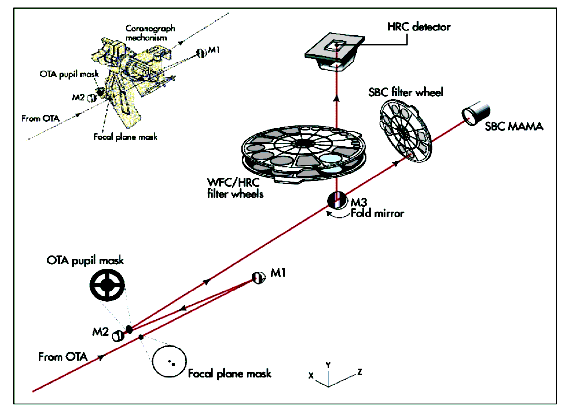
Figure 6.2: Schematic layout of the ACS HRC coronagraph.The upper left inset shows a schematic of the coronagraph mechanism that can be flipped in-and-out of the HRC optical path.
6.2.1 Coronagraph Design
A schematic layout of the ACS coronagraph is shown in Figure 6.2. The aberrated beam from the telescope first encounters one of two occulting spots. The beam continues to the M1 mirror, which forms an image of the HST entrance pupil on the M2 mirror, which corrects for the spherical aberration in the HST primary mirror. The coronagraph’s Lyot stop is placed in front of M2. A fold mirror directs the beam onto the CCD detector. The field is 29 x 26 arcseconds with a mean scale of 0.026 arcseconds/pixel. Geometric distortion results in effectively non-square pixels. The coronagraph can be used over the entire HRC wavelength range of l = 2000 Å to 10,000 Å using a variety of broad-to-narrowband filters.
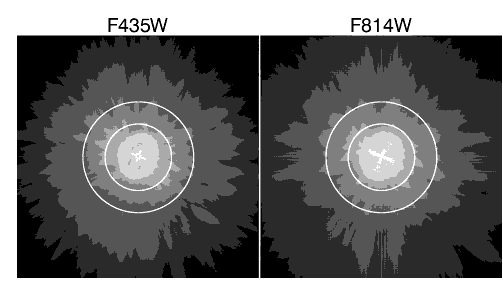
The occulting spots are placed in the plane of the circle of least confusion of the converging aberrated beam. The balance of defocus and spherical aberration at this location allows maximal occulted flux and minimal spot radius. The angular extent of the PSF in this plane necessitates larger spots than would be used in an unaberrated beam (Figure 6.3).
Figure 6.3: Simulated point spread functions at the plane of the occulting spots through filters F435W and F814W,shown with logarithmic intensity scaling.The elliptical, cross-shaped patterns in the cores are due to astigmatism at the off-axis ACS aperture. The astigmatism is corrected later by the ACS optics. The sizes of the two occulting spots (D=1.8 arcseconds and 3.0 arcseconds) are indicated by the white circles.
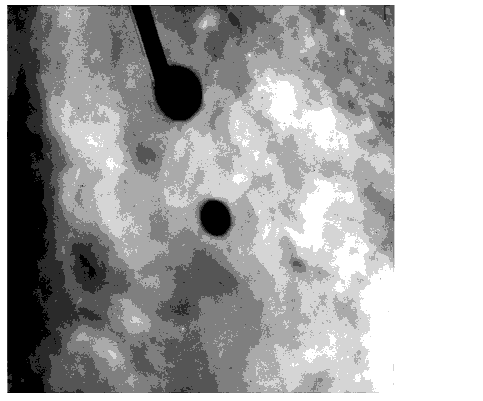
The occulting spots are solid (unapodized) metallic coatings deposited on a glass substrate that reduces the throughput by 4.5%. The smaller spot is 1.8 arcseconds in diameter and is at the center of the field. Its aperture name is CORON-1.8. The second spot, 3.0 arcseconds in diameter, is near the edge of the field (Figure 6.4) and is designated as aperture CORON-3.0. The smaller spot is used for the majority of the coronagraphic observations, as it allows imaging closer to the occulted source. The larger spot may be used for very deep imaging of bright targets with less saturation around the spot than would occur with the smaller spot. Its position near the edge of the field also allows imaging of material out to 20 arcseconds from the occulted source.
The Lyot stop is located just in front of the M2 aberration correction mirror, where an image of the HST primary is formed. The stop is a thin metal mask that covers all of the diffracting edges in the HST OTA (outer aperture, secondary mirror baffle, secondary mirror support vanes, and primary mirror support pads) at the reimaged pupil. The sizes of the Lyot stop and occulting spots were chosen to reduce the diffracted light below the level of the scattered light, which is unaltered by the coronagraph. The smaller aperture and larger central obscuration of the Lyot stop reduce the throughput by 48% and broaden the field PSF. The spots and Lyot stop are located on a panel attached to the ACS calibration door mechanism, which allows them to be flipped out of the beam when not in use. The inside surface of this door can be illuminated by a lamp to provide flat field calibration images for direct imaging. However, this configuration prevents the acquisition of internal coronagraphic flat fields.
In addition to the occulting spots and Lyot stop there is a 0.8 arcseconds x 5 arcseconds occulting finger (OCCULT-0.8) permanently located at the window of the CCD dewar. It does not suppress any diffracted light because it occurs after the Lyot stop. Its intended purpose was to allow imaging closer to stars than is possible with the occulting spots while preventing saturation of the detector. However, because the finger is located some distance from the image plane, there is significant vignetting around its edges, which reduces its effectiveness. It was originally aligned with the center of the 3.0 arcsecond spot, but shifting of the spots during launch ultimately placed the finger near the edge of the spot. Because of vignetting and the sensitivity of the occulted PSF to its position behind the finger, unocculted saturated observations of sources will likely be more effective than those using the occulting finger.
Figure 6.4: Region of the Orion Nebula imaged with the coronagraph and filter F606W.The silhouettes of the occulters can be seen against the background nebulosity. The 1.8 arcsecond spot is located at the center and the 3.0 arcsecond spot towards the top. The finger is aligned along one edge of the larger spot. This image has not been corrected for geometric distortion, so the spots appear elliptical.
6.2.2 Acquisition Procedure and Pointing Accuracy
The bright point source must be placed precisely behind the occulting spot to ensure the proper suppression of the diffracted light. The absolute pointing accuracy of HST is about 1 arcsecond, which is too crude to ensure accurate positioning behind the spot. An on-board acquisition procedure is used to provide better alignment. The observer must request an acquisition image immediately before using the coronagraph and must specify a combination of filter and exposure time that provides an unsaturated image of the source. To define an acquisition image in APT, specify HRC-ACQ as the aperture and ACQ as the opmode.
Acquisition images are taken with the coronagraph deployed. The bright source is imaged within a predefined 200 x 200 pixel (5 x 5 arcseconds) subarray near the small occulting spot. Two identical exposures are taken, each of the length specified by the observer (rather than each being half the length specified, as they would be for a conventional CR-SPLIT). From these two images, the on-board computer selects the minimum value for each pixel as a crude way of rejecting cosmic rays. The result is then smoothed with a 3 x 3 pixel boxcar and the maximum pixel in the subarray is identified. The centroid of the unsmoothed image is then computed within a 5 x 5 pixel box centered on this pixel. Based on this position, the telescope is then slewed to place the source behind the occulting spot.
Because the coronagraph is deployed during acquisition, throughput is decreased by 52.5% relative to a non-coronagraphic observation. Also, the Lyot stop broadens the PSF, resulting in a lower relative peak pixel value (see Section 6.2.6). Care must be taken to select a combination of exposure time and filter that avoids saturating the source but provides enough flux for a good centroid measurement. A peak pixel flux of 2000 e– to 50,000 e– is desirable. The HRC saturation limit is ~140,000 e-. Narrowband filters can be used, but for the brightest targets crossed filters are required. Allowable filter combinations for acquisitions are F220W+F606W, F220W+F550M, and F220W+F502N, in order of decreasing throughput. Be warned that the calibration of these filter combinations is poor, so estimated count rates from synphot or the APT ETC may be high or low by a factor of two.
Multiple on-orbit observations indicate that the combined acquisition and slew errors are on the order of ±0.25 pixels (±6 milliarcseconds). While small, these shifts necessitate the use of subpixel registration techniques to subtract one coronagraphic PSF from another (Section 6.2.5). The position of the spots relative to the detector also varies over time. This further alters the PSF, resulting in subtraction residuals.
6.2.3 Vignetting and Flat Fields
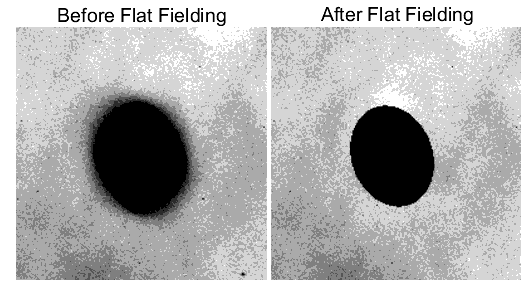
ACS coronagraphic flat fields differ from the standard flats because of the presence of the occulting spots and alteration of the field vignetting by the Lyot stop. The large angular size of the aberrated PSF causes vignetting beyond one arcsecond of the spot edge (Figure 6.4), which can be corrected by dividing the image by the spot pattern (Figure 6.5). To facilitate this correction, separate flat fields have been derived that contain just the spot patterns (spot flats) and the remaining static features (P-flats). For a full discussion see ACS ISR 2004-16.
Figure 6.5: Region of the Orion Nebula around the D = 1.8 arcseconds spot.(Left) The spot edge appears blurred due to vignetting. The image has not been geometrically corrected. (Right) The same region after the image has been corrected by dividing the flat field. The interior of the spot has been masked.
The ACS data pipeline will divide images by the P-flat. P-flats specific to the coronagraph have been derived from either ground-based or on-orbit data for filters F330W, F435W, F475W, F606W, and F814W. Other filters use the normal flats, which may cause some small-scale errors around dust diffraction patterns. The pipeline then divides images by the spot flat, using a table of spot positions versus date to determine the proper shift for the spot flat. However, there is a lag in determining the spot position, so it may be a month after the observation before the pipeline knows where the spot was on that date. So, coronagraph users should note that their data may be calibrated with an incorrect spot flat if they extract their data from the archive soon after they were taken. (Spot flats for the filters listed above are available for download from the ACS reference files Web page. For other filters, the available spot flat closest in wavelength should be used. The spot flat must be shifted by an amount listed on the reference files page to account for motions of the occulting spots.)
Because coronagraphic P-flats and spot flats exist only for the few filters listed above, observers are encouraged to use those filters. It is unlikely that coronagraphic flat fields for other filters will be available in the future.
6.2.4 Coronagraphic Performance
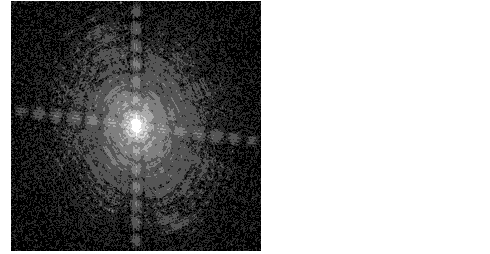
Early in Cycle 11, coronagraphic performance verification images were taken of the V = 0 star Arcturus (Figure 6.6 and Figure 6.7). This star has an angular diameter of 25 milliarcseconds and is thus unresolved by the coronagraph. The coronagraphic image of a star is quite unusual. Rather than appearing as a dark hole surrounded by residual light, as would be the case in an aberration-free coronagraph, the interior of the spot is filled with a diminished and somewhat distorted image of the star. This image is caused by the M2 mirror’s correction of aberrated light from the star that is not blocked by the spot. The small spot is filled with light, while the large one is relatively dark. Broad, ring-like structures surround the spots, extending their apparent radii by about 0.5 arcseconds. These rings are due to diffraction of the wings of the aberrated PSF by the occulting spot itself. Consequently, coronagraphic images of bright stars may saturate at the interior and edges of the spot within a short time. Within the small spot, the brightest pixels will saturate in less than one second for a V = 0.0 star, while pixels at edge of the larger spot will saturate in about 14 seconds.
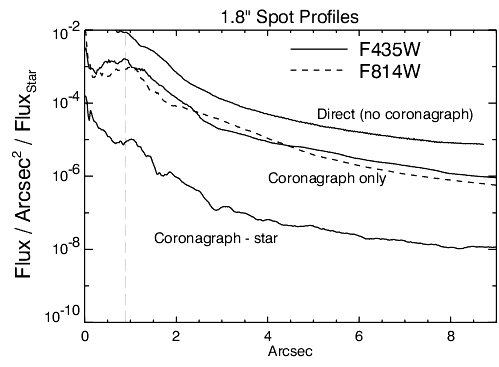
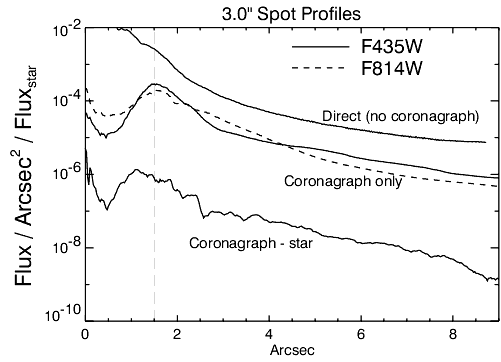
The measured radial surface brightness profiles (Figure 6.8) show that the coronagraph is well aligned and operating as expected. The light diffracted by the HST obscurations is suppressed below the level of the scattered light – there are no prominent diffraction spikes, rings, or ghosts beyond the immediate proximity of the spots. At longer wavelengths (l > 6000 Å) the diffraction spikes appear about as bright as the residual scattered light because the diffraction pattern is larger and not as well suppressed by the coronagraph. The spikes are more prominent in images with the large spot than the small one because the Lyot stop is not located exactly in the pupil plane but is slightly ahead of it. Consequently, the beam can “walk” around the stop depending on the field angle of the object. Because the large spot is at the edge of the field, the beam is slightly shifted, allowing more diffracted light to pass around the edges of the stop.
The coronagraphic PSF is dominated by radial streaks that are caused primarily by scattering from zonal surface errors in the HST mirrors. This halo increases in brightness and decreases in size towards shorter wavelengths. One unexpected feature is a diagonal streak or “bar” seen in both direct and coronagraphic images. It is about 5 times brighter than the mean azimuthal surface brightness in the coronagraphic images. This structure was not seen in the ground-test images and is likely due to scattering introduced by the HST optics. There appears to be a corresponding feature in STIS as well.
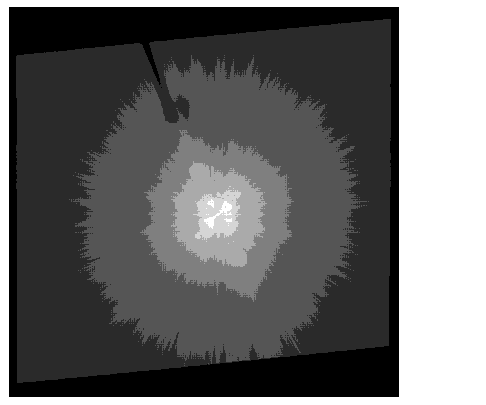
Figure 6.6: Geometrically corrected (29 arcseconds across) image of Arcturus observed in F814W behind the 1.8 arcseconds spot.This is a composite of short, medium, and long (280 seconds) exposures. The “bar” can be seen extending from the upper left to lower right. The shadows of the occulting finger and large spot can be seen against the scattered light background. Logarithmic intensity scale.
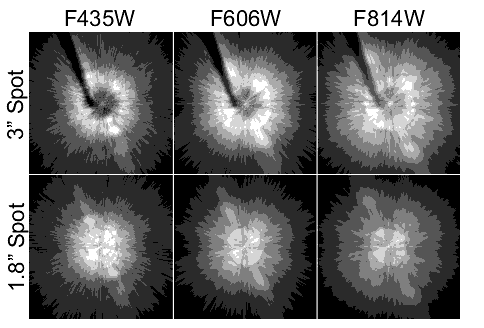
Figure 6.7: Regions around the occulting spots in different filters.The occulting finger can be seen in the 3 arcseconds spot images. Logarithmic intensity scaled.
Figure 6.8: Surface brightness plots derived by computing the median value at each radius.The brightness units are relative to the total flux of the star. The direct profile is predicted; the coronagraphic profiles are measured from on-orbit images of Arcturus. “Coronagraph-star” shows the absolute median residual level from the subtraction of images of the same star observed in separate visits.
6.2.5 Subtraction of the coronagraphic PSF
While the coronagraph suppresses the diffracted light from a bright star, the scattered light still overwhelms faint, nearby sources. It is possible to subtract most of the remaining light using an image of another occulted star. PSF subtraction has been successfully used with images taken by other HST cameras, with and without a coronagraph. The quality of the subtraction depends critically on how well the target and reference PSFs match.
As mentioned above, for any pair of target and reference PSF observations, there is likely to be a difference of 5 to 20 milliarcseconds between the positions of the stars. Because the scattered light background is largely insensitive to small errors in star-to-spot alignment (it is produced before the coronagraph), most of it can be subtracted if the two stars are precisely registered and normalized. Due to the numerous sharp, thin streaks that form the scattered light background, subtraction quality is visually sensitive to registration errors as small as 0.03 pixels (0.75 milliarcseconds). To achieve this level of accuracy, the reference PSF may be iteratively shifted and subtracted from the target until an offset is found where the residual streaks are minimized. This method relies on the judgment of the observer, as any circumstellar material could unexpectedly bias a registration optimization algorithm. A higher-order sampling method, such as cubic convolution interpolation, should be used to shift the reference PSF by subpixel amounts; simpler schemes such as bilinear interpolation degrade the fine PSF structure too much to provide good subtractions.
Normalization errors as small as 1% to 4% between the target and reference stars may also create significant subtraction residuals. However, derivation of the normalization factors from direct photometry is often not possible. Bright, unocculted stars will be saturated in medium or broadband filters at the shortest exposure time (0.1 seconds). An indirect method uses the ratio of saturated pixels in unocculted images (the accuracy improves with greater numbers of saturated pixels). A last-ditch effort would rely on the judgment of the observer to iteratively subtract the PSFs while varying the normalization factor.
In addition to registration offsets, positional differences can alter the diffraction patterns near the spots’ edges. The shape and intensity of these rings are very sensitive to the location of the star relative to the spot. They cannot be subtracted by simply adjusting the registration or normalization. These errors are especially frustrating because they increase the diameter of the central region where the data are unreliable. The only solution to this problem is to observe the target and reference PSF star in adjacent orbits without flipping the masks out of the beam between objects.
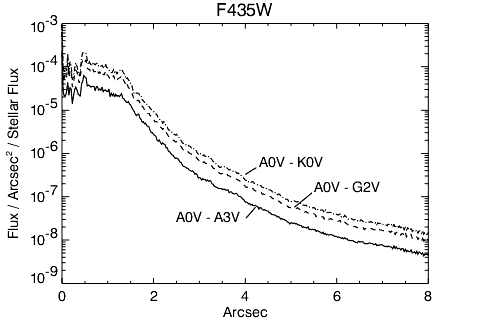
Color differences between the target and reference PSFs can be controlled by choosing an appropriate reference star. As wavelength increases, the speckles that make up the streaks in the coronagraphic PSF move away from the center while their intensity decreases (Figure 6.7). The diffraction rings near the spot edges will expand as well. These effects can be seen in images through wideband filters – a red star will appear to have a slightly larger PSF than a blue one. Thus, an M-type star should be subtracted using a similarly red star – an A-type star would cause significant subtraction residuals. Even the small color difference between A0 V and B8 V stars, for example, may be enough to introduce bothersome errors (Figure 6.9).
Figure 6.9: Predicted absolute mean subtraction residual levels for cases where the target and reference stars have mismatched colors.The brightness units are relative to the total flux of the target star.
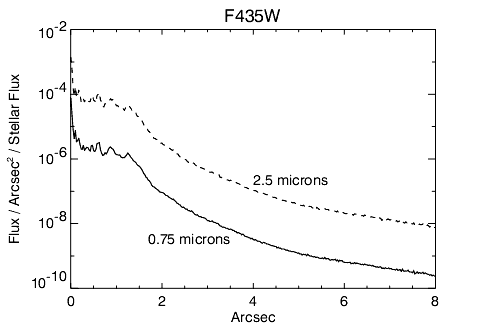
A focus change can also alter the distribution of light in the PSF. HST’s focus changes over time scales of minutes to months. Within an orbit, the separation between the primary and secondary mirrors varies on average by 3 mm, resulting in 1/28 wave rms of defocus @ l = 5000 Å. This effect, known as breathing, is caused by the occultation of the telescope’s field of view by the warm Earth, which typically occurs during half of each 96-minute orbit. This heats HST’s interior structure, which expands. After occultation the telescope gradually shrinks. Changes relative to the sun (mostly anti-sun pointings) cause contraction of the telescope, which gradually expands to "normal" size after a few orbits. The main result of these small focus changes is the redistribution of light in the wings of the PSF (Figure 6.10).
Figure 6.10: Predicted absolute mean subtraction residual levels for cases where the target and reference stars are imaged at different breathing-induced focus positions.The offset (0.75 or 2.5 mm) from perfect focus (0 mm) is indicated with respect to the change in primary-secondary mirror separation. The typical breathing amplitude is 3 to 4 mm within an orbit. The brightness units are relative to the total flux of the target star.
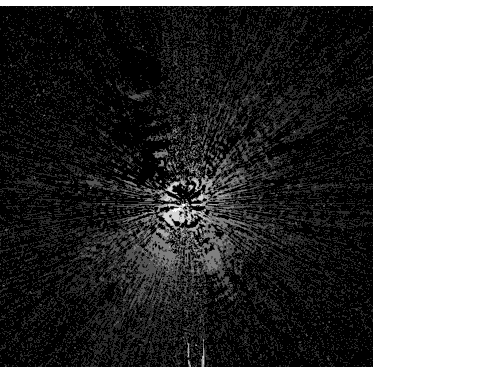
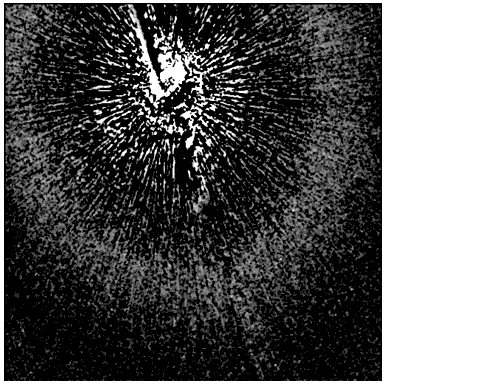
Plots of the azimuthal median radial profiles after PSF subtraction are shown in Figure 6.8. In these cases, images of Arcturus were subtracted from similar images of the star taken a day later. The images were registered as previously described. Combined with PSF subtraction, the coronagraph reduces the median background level by 250x to 2500x, depending on the radius and filter. An example of a PSF subtraction is shown in Figure 6.11. The mean of the residuals is not zero. Because of PSF mismatches, one image will typically be slightly brighter than the other over a portion of the field (Figure 6.12). The pixel-to-pixel residuals can be more than 10x greater than the median level (Figure 6.13). Note that these profiles would be worse if there were color differences between the target and reference PSFs.
One way to avoid both the color and normalization problems is to take images of the target at two different field orientations, and subtract one from the other. This technique, known as roll subtraction, can be done either by requesting a roll of the telescope about the optical axis (up to 30×) between orbits or by revisiting the target at a later date when the default orientation of the telescope is different. Roll subtraction only works when the nearby object of interest is not azimuthally extended. It is the best technique for detecting point source companions or imaging strictly edge-on disks (e.g. Beta Pictoris). It can also be used to reduce the pixel-to-pixel variations in the subtraction residuals by rotating and co-adding the images taken at different orientations. (This works for extended sources if another PSF star is used.) Ideally, the subtraction errors will decrease as the square root of the number of orientations.
The large sizes of the occulting spots severely limit how close to the target one can image. It may be useful to combine coronagraphic imaging with direct observations of the target, allowing the central columns to saturate. Additional observations at other rolls would help. PSF subtraction can then be used to remove the diffracted and scattered light.
Figure 6.11: Residual errors from the subtraction of one image of Arcturus from another taken in a different visit (filter = F435W, D = 1.8 arcseconds spot).The image is 29 arcseconds across and has not been geometrically corrected. Logarithmic intensity scaled.
Figure 6.12: Subtraction of Arcturus from another image of itself taken during another visit using the large (D = 3.0 arcseconds) spot and F435W filter.The image has been rebinned, smoothed, and stretched to reveal very low level residuals. The broad ring at about 13 arcseconds from the star is a residual from some unknown source – perhaps it represents a zonal redistribution of light due to focus differences (breathing) between the two images. The surface brightness of this ring is 20.5 magnitudes/arcsecond2 fainter than the star. The diameter, brightness, and thickness of this ring may vary with breathing and filter. The image has not been geometrically corrected.
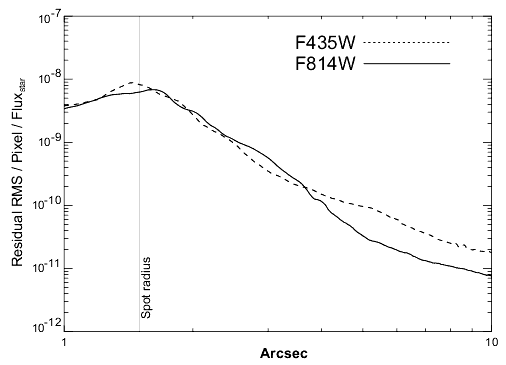
Figure 6.13: Plots of the azimuthal RMS subtraction residual levels at each radius for the large (3 arcseconds) spot.The flux units are counts per pixel relative to the total unocculted flux from the central source. These plots were derived from Arcturus-Arcturus subtractions represent the best results one is likely to achieve. The undistorted HRC scale assumed here is 25 milliarcseconds/pixel.
6.2.6 The Off-Spot PSF
Objects that are observed in the coronagraphic mode but that are not placed behind an occulting mask have a PSF that is defined by the Lyot stop. Because the stop effectively reduces the diameter of the telescope and introduces larger obscurations, this "off-spot" PSF is wider than normal, with more power in the wings and diffraction spikes (Figure 6.14). In addition, the Lyot stop and occulting spot substrate reduce the throughput by 52.5%. In F814W, the "off-spot" PSF has a peak pixel containing 4.3% of the total (reduced) flux and a sharpness (including CCD charge diffusion effects) of 0.010. (Compare these to 7.7% and 0.026, respectively, for the normal HRC PSF.) In F435W, the peak is 11% and the sharpness is 0.025 (compared to 17% and 0.051 for the normal F435W PSF). Observers need to take the reduced throughput and sharpness into account when determining detection limits for planned observations. Tiny Tim can be used to compute off-spot PSFs.
Figure 6.14: Image of Arcturus taken in coronagraphic mode with the star placed outside of the spot.The coronagraphic field PSF has more pronounced diffraction features (rings and spikes) than the normal HRC PSF due to the effectively larger obscurations introduced by the Lyot stop. The central portion of this image is saturated. It was taken through a narrowband filter (F660N) and is not geometrically corrected.
6.2.7 Occulting Spot Motions
STScI measures the positions of the occulting spots at weekly intervals using Earth flats. These measurements show that the spots move over daily to weekly time scales in an unpredictable manner. The cause of this motion is unknown. The spot positions typically vary by ~0.3 pixels (8 milliarcseconds) over one week, but they occasionally shift by 1 to 5 pixels over 1 to 3 weeks. During a single orbit, however, the spots are stable to within +/- 0.1 pixel when continuously deployed and they recover their positions within +/- 0.25 pixel when repeatedly stowed and deployed.
After the acquisition exposure, a coronagraphic target is moved to a previously measured position of an occulting spot. Unfortunately, ACS’s configuration prevents automatic determination of the spot’s position before a coronagraphic exposure, as can be done with NICMOS. Furthermore, unlike STIS, the target cannot be dithered until the flux around the occulter is minimized. Instead, STScI uploads the latest measured spot positions (which may be several days old) a few orbits before each coronagraphic observation. After acquisition, the target is moved to this appropriate spot position via a USE OFFSET special requirement. This procedure adds approximately 40 seconds to each visit and is required for all coronagraphic observations.
The uncertainties in the day-to-day spot positions can cause star-to-spot registration errors that affect coronagraphic performance. If the star is offset from the spot center by more than 3 pixels, then one side of the coronagraphic PSF will be brighter than expected and may saturate earlier than predicted. A large offset will also degrade the coronagraphic suppression of the diffraction pattern. Most importantly, slight changes in the spot positions can alter the coronagraphic PSFs of the target and reference stars enough to cause large PSF-subtraction residuals. Consequently, an observer cannot rely on reference PSFs obtained from other programs or at different times.
To reduce the impact of spot motion, observers should obtain a reference PSF in an orbit immediately before or after their science observation. A single reference PSF can be used for two science targets if all three objects can be observed in adjacent orbits and they have similar colors. (Note that SAA restrictions make it difficult to schedule programs requiring more than five consecutive orbits.) Otherwise, each target will require a distinct reference PSF. Additional orbits for reference PSFs must be included in the Phase 1 proposal.
6.2.8 Planning ACS Coronagraphic Observations
Exposure Time Estimation
Estimating the exposure times for coronagraphic observations is similar to estimating those for direct observations, except that the background signal from the occulted source must be considered. Generally, most coronagraphic observations are limited by the wings of the coronagraphic PSF. The APT Exposure Time Calculator includes a coronagraphic mode for estimating exposure times. They can be determined using the Web-based version of the ACS Exposure Time Calculator. The following steps are required:
- Determine which occulting mask to use
- Calculate the count rate for the circumstellar/circumnuclear science target
- Calculate the count rate for the bright source to be occulted
- Calculate the background signal from the wings of the occulted source’s PSF at the location of the target.
- Verify that background+target does not saturate at this location in the desired exposure time texp
- Calculate the signal-to-noise ratio S, given by:
Where:
- C = the signal from the science target in electrons/sec.
- Npix = the total number of detector pixels summed to achieve C.
- Bsky = the sky background in counts/sec/pixel.
- Bdet = the detector dark current in counts/sec/pixel.
- BPSF = the background in counts/sec/pixel from the wings of the occulted source’s PSF at the distance of the science target.
- Nread = the number of CCD readouts.
- t = the integration time in seconds.
- R is the readout noise of the HRC CCD = 4.7e-.
As an example we will determine the S/N achieved in detecting a M6 V star with a V magnitude of 20.5 at a distance of 4.25 arcseconds from a F0 V star with a V magnitude of 6, for an exposure time of 1000 seconds with the F435W filter. Using the ACS Exposure Time Calculator and considering the case for the 3.0 arcseconds occulting mask:
- M6V star count rate = 3.3 e-/second for a 5 ¥ 5 aperture (including 47.5% throughput of coronagraph)
Sky count rate = 0.0025 e-/second/pixel
Detector dark rate = 0.0037 e-/second/pixel- F0V count rate = 1.6 ¥ 107 e-/second for a 101 x 101 aperture
(101 x 101 aperture used to estimate total integrated flux)- At a distance 4.25 arcseconds from the central star, from Figure 6.8, the fraction of flux per 0.026 ¥ 0.026 arcseconds pixel in the PSF wings is 5 x 10⁻⁹.
BPSF = 1.6 x 107 * 5 x 10-9 = 0.08 e-/second/pixel- Using the equation above we find the signal-to-noise for a 1000 seconds exposure is 43. Note that a M6 V star with a V magnitude of 20.5 observed with the HRC in isolation would yield a S/N of 93.
Observing sequence for point source companions
The best way to detect faint stellar or substellar companions is to use roll subtraction to avoid color differences between the target and reference PSFs. This technique also provides duplicate observations that make it easier to verify true companions from noise. It is best to roll the telescope between visits and repeat the image sequence in a new orbit. This way, you can better match the breathing cycle of the telescope than if you rolled the telescope in the middle of an orbital visibility window. You can force this to happen by selecting both orientation and time-sequencing constraints in the visit special requirements. Remember that the off-spot coronagraphic PSF is somewhat broader than the normal HRC PSF, which may influence your assumed signal-to-noise ratio. Off-spot PSF models can be generated with the Tiny Tim PSF software. You can estimate the residual background noise level using Figure 6.13.
Suggested point-source companion observing sequence:
Observing sequence for extended sources (e.g. circumstellar disks and AGN host galaxies)
When imaging extended objects, the remaining scattered light must be subtracted using an image of a PSF reference star that matches the color of your science target as closely as possible. To reduce the impact of photon noise in the subtracted images, the reference star should be much brighter than the target source. If possible, select a reference star that is nearby (< 20° from the target) and request that it be observed immediately before or after the target source. This strategy reduces the chances of large focus differences between the two visits. To better discriminate between subtraction artifacts and real circumstellar emission, obtain images of the target at two or more telescope orientations. (There is no need to get reference PSF images at different rolls.) Estimate the residual background noise level using Figure 6.13.
Suggested extended source observing sequence:
- Obtain direct images of the science target in each filter to derive flux normalization factors
- Obtain an acquisition image of the science target.
- Take coronagraphic image sequence of science target.
- Request a new telescope orientation.
- Repeat steps 2 to 3.
- In a new visit immediately before or after the science observation, point at the reference star.
- Obtain an acquisition image of reference star.
- Take coronagraphic image sequence of reference star.
- Obtain direct images of the reference star in each filter to derive flux normalization factors.
Note that the order of the observations places direct imaging before and after coronagraphic imaging. This reduces cycling of the coronagraphic mechanism. Because the occulting spots are large, you may wish to image closer to the source using additional direct observations without the coronagraph. Multiple roll angles are necessary in this case because portions of the inner region will be affected by saturated columns and diffraction spikes. Direct observations of the reference star will be required as well to subtract both the diffracted and scattered light. Color and focus mismatches between the target and reference PSFs will be even more important in the direct imaging mode than with the coronagraph because the diffracted light is not suppressed. However, there are no mismatches caused by star-spot alignment to worry about.
6.2.9 Choice of Filters for Coronagraphic Observations
All HRC filters are available for coronagraphic observations. However, only a few (F435W, F475W, F606W, and F814W) are well characterized in this mode. The first three have produced good results and can be considered “safe” choices. Filter F814W is problematic, however. Its PSF is relatively large so less light from the bright source is blocked by the occulting spot. The coronagraphic PSF is therefore more sensitive to spot shifts and star-to-spot misalignments. Mismatches between target and reference PSFs may cause significant PSF subtraction residuals. Also, F814W images suffer from the red halo (see Section 5.6.5), which affects coronagraphic observations because the central spot is filled with light that will be scattered to large radii. Color differences between the target and reference stars will cause differences in the halo pattern, altering the local background level in unpredictable ways. If multicolor images are needed, it is safer to choose F435W and F606W rather than F606W and F814W. However for red objects it may not be feasible to choose a blue filter due to low flux levels, in which case F814W must be used.
|
Space telescope Science Institute http://www.stsci.edu |