4.4 The SBC MAMA
4.4.1 MAMA Properties
The ACS MAMA detector is the STIS flight spare STF7. It provides coverage from 1150 Å to 1700 Å. The MAMA detector is a photon-counting device which processes events serially. The ACS MAMA only operates in the accumulate (
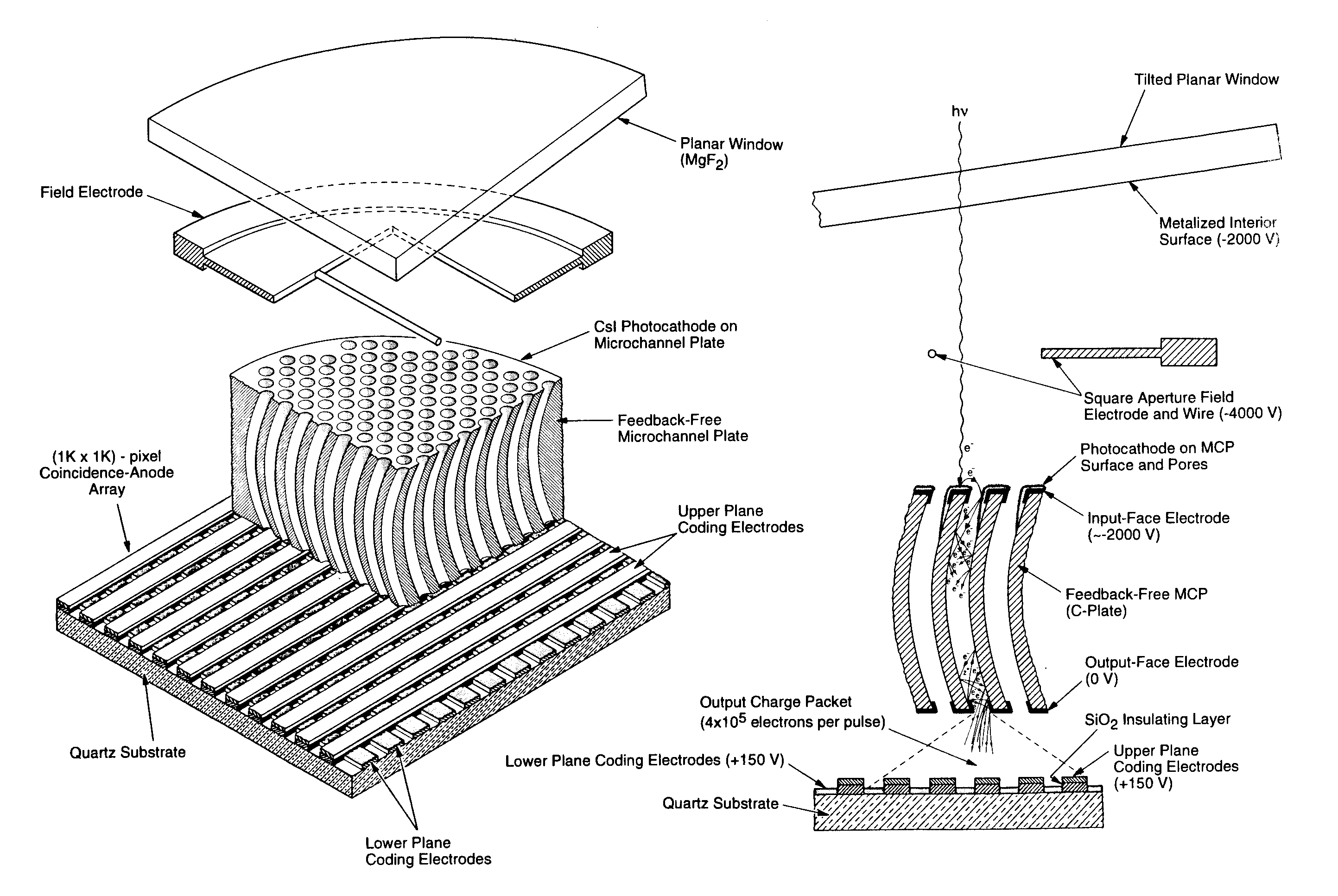
ACCUM) mode, in which a time-integrated image is produced. Unlike the STIS MAMAs, the ACS does not offer the high-resolution (2048 ¥ 2048) mode or time-tagged data acquisition. The primary benefits afforded by the STIS and ACS MAMAs, in comparison with previous HST UV spectroscopic detectors such as those in the GHRS and FOS, are high spatial resolution, two-dimensional imaging over a relatively large field of view, and low background for point sources.Figure 4.16: Design of the SBC MAMA.Figure 4.16 illustrates the design of the MAMA, which has an opaque CsI photocathode deposited directly on the face of the curved microchannel plate (MCP). Target photons strike the photocathode, liberating single photoelectrons which pass into the MCP. There they are multiplied to a pulse of ~4¥105 e–. The pulse is recorded by an anode array behind the photocathode, and detected by the MAMA electronics which rejects false pulses and determines the origin of the photon event on the detector.
The field electrode, or repeller wire, repels electrons emitted away from the microchannel plate back into the channels. This provides an increase in quantum efficiency of the detector at the price of an increase in the detector point spread function halo. The repeller wire voltage is always on for SBC observations.
Table 4.7: SBC detector performance characteristics.
1The dark count increases with the length of time the SBC is turned on, beginning at about 10-5 electrons/pixel/second and increasing by about a factor of five over two hours.
2Rate at which counting shows 10% deviation from linearity. These count rates are well above the bright-object screening limits.
4.4.2 SBC Spectral Response
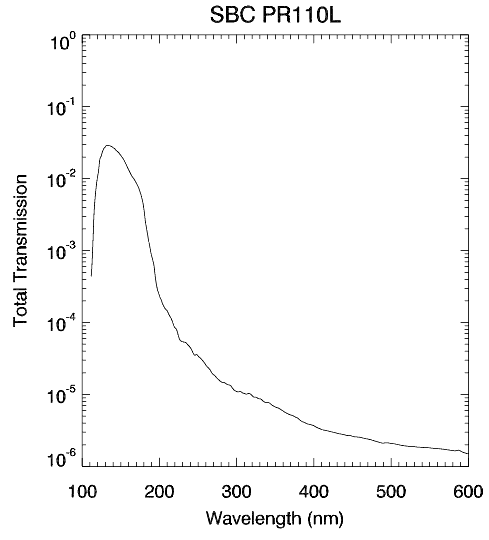
The total transmission curve for the SBC with the PR110L prism is shown in Figure 4.17. The peak photocathode response occurs at Lyman-a. Its spectral response is defined by the cutoff of the MgF2 window at 1150 Å at short wavelengths, and by the relatively steep decline of the CsI photocathode at long wavelengths.
Recent observations of flux calibration stars and a G-type star using the SBC PR110L prism have revealed that the sensitivity of the MAMA detector to optical and near-UV light is apparently much larger than previously thought.
Preliminary estimates of the real SBC throughput indicates that the detector efficiency is factors of approximately 50 and 1000 higher at wavelengths of 3000 and 4000 Å respectively compared to ground testing. For a solar type spectrum, this can mean that one-half or more of the counts detected are due to optical and near-UV photons, rather than from the expected FUV photons. There is also some evidence that this red leak changes as the SBC detector warms up, increasing by as much as 30% over the course of 5 orbits. It is not yet clear if this red leak has also been increasing secularly over time. STIS FUV MAMA data seem to show a similar, although perhaps somewhat smaller effect.
For dispersed PR110L and PR130L observations, it is straightforward to identify this extra red light; however, it clearly also affects SBC imaging observations done with the long pass filters. Until this effect is better understood and calibrated, extreme caution should be used when interpreting FUV imaging observations of red targets. Observers who need to measure FUV fluxes of red targets may wish to consider interleaving observations with two different SBC long pass filters (e.g., F140LP and F165LP), so that the difference in the count rates can be used to isolate the true FUV flux.
Figure 4.17: Total transmission curve for ACS SBC plus the PR110L prism4.4.3 Optical Performance
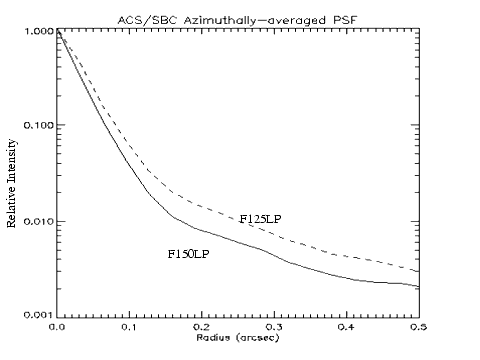
The SBC exhibits low-level extended wings in the detector point-spread function (PSF). Sample MAMA detector PSF profiles are shown in Figure 4.18.
Figure 4.18: MAMA point spread function.
|
Space telescope Science Institute http://www.stsci.edu |