Space Telescope Imaging Spectrograph Instrument Handbook for Cycle 14
 |
 |
 |
 |
 |
|
| Space Telescope Imaging Spectrograph Instrument Handbook for Cycle 14 | |||||
| ||||||
First-Order Grating G230LB
Description
The
G230LBgrating mode uses a low resolution grating originally designed for use with theSTIS/NUV-MAMAwhich has been re-directed for use with theSTIS/CCDto enable R~700 spectroscopy in the near-UV which takes advantage of the CCD's higher throughput and dynamic range longward of=2500 Å.
Recommended Uses
The
G230LBgrating mode is designed for programs needing the highest available sensitivity in the near-UV from ~2500 to 3100 Å or more generally to allow observation of sources too bright for the MAMA in the near UV.Special Considerations
In making the plots for the
G230LBgrating mode, we assumed that the CCD is subject to a change in the effective quantum yield resulting in the creation of multiple electron-hole pairs per photon forAlso be aware that because of the high sensitivity of the CCD to red light, observations of red stars with
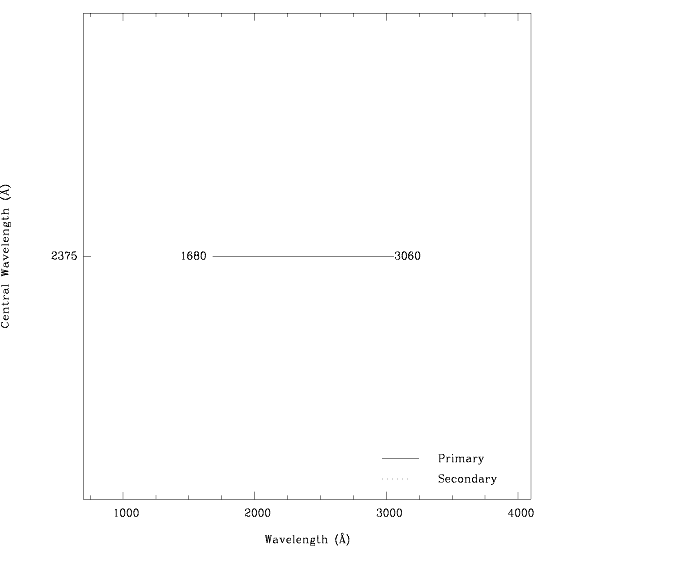
G230LBare more likely to be affected by scatter than observations of red stars using the MAMAG230Lmode.Figure 13.18: Wavelength Range for the G230LB Grating Setting
Grating Average Dispersion (Å per Pixel) Plate Scale (arcsec / pixel) Central Wavelengths Complete Per Tilt G230LB 1680-3060 Prime
G230LB Sensitivities
Table 13.7: G230LB Sensitivities & Throughputs for a Point Source
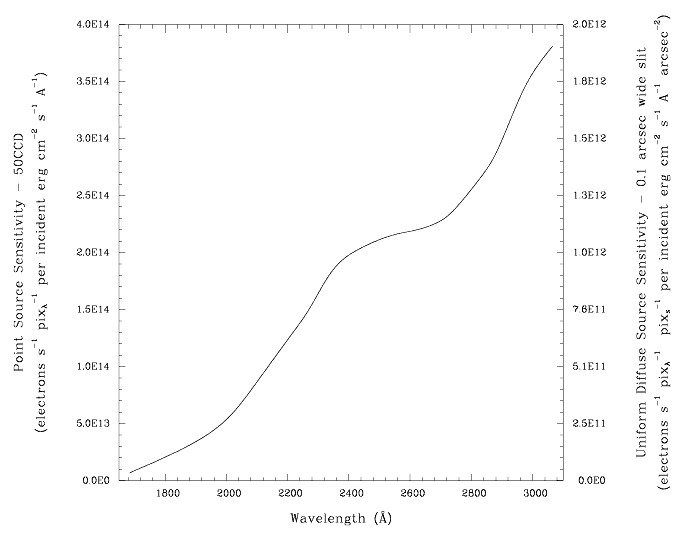
Figure 13.19: G230LB Point Source (left axis), and Diffuse Source (right axis) Sensitivities.
Note
Point source sensitivity assumes full transmission (zero slit losses). Diffuse source sensitivity assumes a 0.1" wide slit. To convert point source sensitivities to diffuse source sensitivities multiply the point source values by the grating spatial (cross dispersion) plate scale in units of arcseconds per pixel and by the width of the desired slit in units of arcseconds.
G230LB Signal-to-Noise
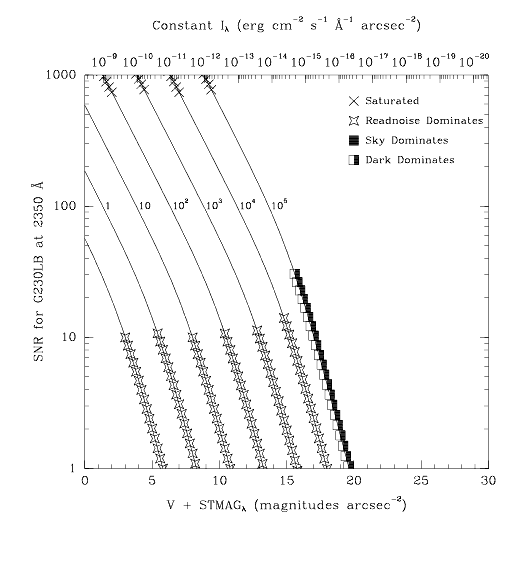
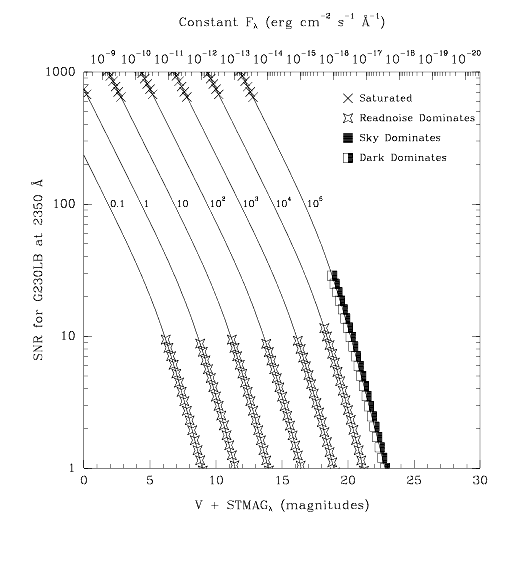
Note:
The top axis displays constant F
Figure 13.20: Diffuse Source Signal-to-Noise as a Function of STMAG for G230LB
Figure 13.21: Point Source Signal-to-Noise as a Function of STMAG for G230LB
|
|||||
|
Space Telescope Science Institute http://www.stsci.edu Voice: (410) 338-1082 help@stsci.edu |