Comparison of G230LB and G230L
The trade-off between using the G230LB or the G230L (which uses the NUV-MAMA), depends sensitively on the science goals and your source properties.
- The CCD has read noise, whereas the MAMA does not.
- The CCD suffers from charge transfer inefficiency (CTI), whereas the NUV-MAMA does not
- The CCD does not have bright object limits, whereas the MAMA does.
- The NUV-MAMA is solar insensitive, whereas the CCD is not.
- The spatial sampling of the MAMA is better than that of the CCD.
- The CCD does not enable high time resolution (Dt<10 seconds),. whereas the MAMA does.
- For red objects, CCD data can suffer from scattered light problems. The detector PSF of the CCD is much cleaner than that of the
NUV-MAMA.
Figure 13.22: Comparison of Limiting Magnitudes and Fluxes for G230LB and G230L. Plotted are the limiting source magnitudes and fluxes for G230LB and G230L to achieve a signal-to-noise ratio of 10 per 2-pixel spectral resolution element integrated across the PSF, in 1 hour. The prediction due to the Charge Transfer Inefficiency (CTI) effect, expected in the year 2005, is also shown.
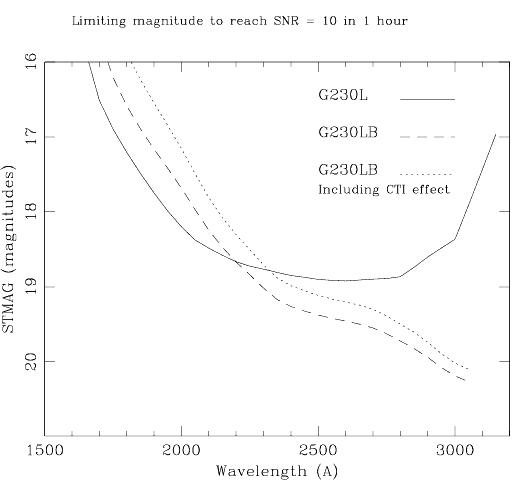
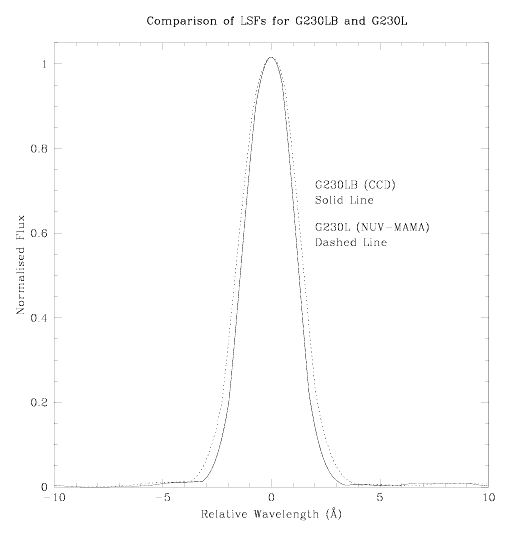
Figure 13.23: Comparison of LSFs for G230LB and G230L