Space Telescope Imaging Spectrograph Instrument Handbook for Cycle 14
 |
 |
 |
 |
 |
|
| Space Telescope Imaging Spectrograph Instrument Handbook for Cycle 14 | |||||
| ||||||
PRISM
Description
The
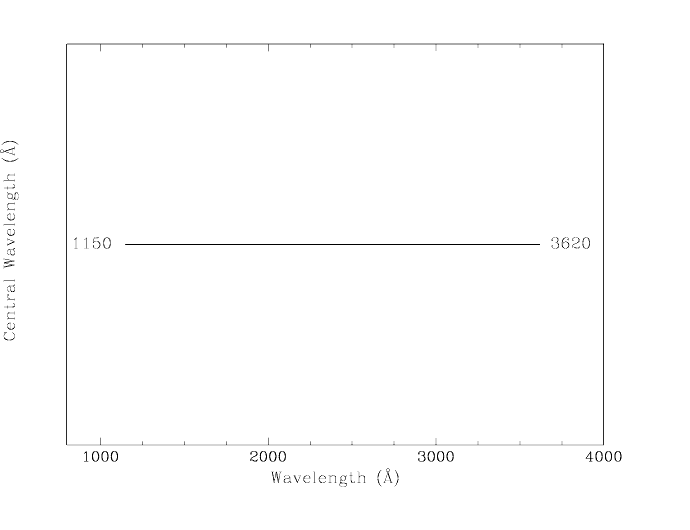
PRISMhas two central wavelength settings optimized to cover the optical through the far-UV tail down to 1150 Å. It is used with theNUV-MAMAdetector.Special Considerations
The full dispersion spreads over ~450 pixels with dispersion as shown in Figure 13.64; thus if you have sources covering the field of view in the dispersion direction, the red tail will be lost for some targets with this setting. For a plot of wavelength vs. pixel no., see Figure 4.13.
We note that the dispersion of the PRISM at wavelengths longer than ~2600 Å is very poorly known at this time.
Figure 13.62: Wavelength Range for the Prism Setting
Grating Average Dispersion (Å per Pixel) Plate Scale (arcsec / pixel) Central Wavelength Complete Per Tilt PRISM 1150-3620 Prime 1200/2125
PRISM Sensitivities
Table 13.17: PRISM Throughputs & Sensitivities for a Point Source
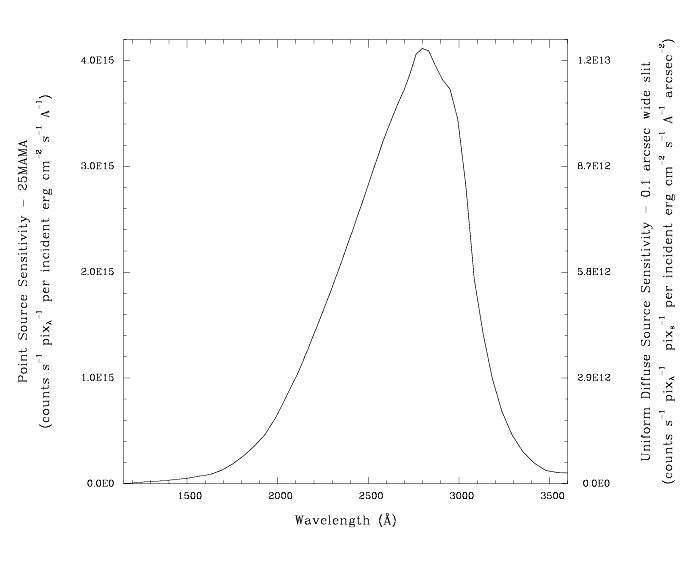
Figure 13.63: Prism Point Source (left axis), and Diffuse Source (right axis) Sensitivities.
Note
Point source sensitivity assumes full transmission (zero slit losses). Diffuse source sensitivity assumes a 0.1" wide slit. To convert point source sensitivities to diffuse source sensitivities multiply the point source values by the grating spatial (cross dispersion) plate scale in units of arcseconds per pixel and by the width of the desired slit in units of arcseconds.
|
|||||
|
Space Telescope Science Institute http://www.stsci.edu Voice: (410) 338-1082 help@stsci.edu |