Space Telescope Imaging Spectrograph Instrument Handbook for Cycle 14
 |
 |
 |
 |
 |
|
| Space Telescope Imaging Spectrograph Instrument Handbook for Cycle 14 | |||||
| ||||||
12.3 Time-Resolved Observations
There are two ways to obtain time-resolved spectroscopic and imaging observations with STIS:
- Use the MAMA
TIME-TAGoperating mode (described in Section 11.1.3) in the ultraviolet.- Take a series of multiple, short, identical repeated observations (described in Section 11.2.4) of your target in
ACCUMoperating mode with either the CCD or the MAMAs.Both the data products received (an event stream in the case of
TIME-TAGand a series of individual images from eachACCUM-mode exposure in a repeated sequence) and the basic parameters of the time-resolved observations (e.g., sample time, interval between samples, total number of samples or equivalently duration) differ dramatically in these modes. In Table 12.1 we summarize and contrast the ranges of parameter space covered by the different methods of obtaining time-resolved observations.The information presented in Table 12.1 can be summarized into the following set of guidelines for performing time-resolved observations with STIS:
- If you wish to observe variability on second or less timescales, observe in the ultraviolet using
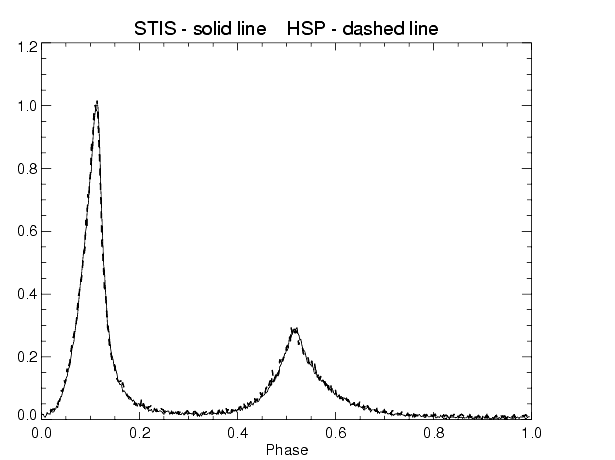
TIME-TAGmode. Figure 12.3 shows an example of a time profile of the Crab Pulsar obtained with STISG140LinTIME-TAGmode overlaid on prior HSP observations.- In the optical, variability can be observed on tens-of-seconds timescales using subarrays and multiple exposures with the CCD.
- In the ultraviolet, variability on the several-minute or more timescale can be observed by multiple
ACCUM-mode exposures with the MAMAs or usingTIME-TAG(subject to count rate limitations).- Remember that a series of identical exposures that are each less than three minutes in length incurs additional data management overheads when compared to longer exposures (see Table 9.2).
- Remember that single MAMA visits are limited to five orbits (see Chapter 2, so continuous variability can be tracked for only that duration with the MAMAs.
Figure 12.3: Crab Pulsar Observed Using the STIS FUV-MAMA with G140L in TIME-TAG Mode. The resulting integrated time profile is shown superimposed on the early results from the HSP. The full period of the Crab pulsar is 33 milliseconds. (Figure courtesy of Don Lindler and Ted Gull, see also Gull et al. 1998, ApJ, 495, L51).
Table 12.1: Summary of Time-Resolved Imaging and SpectroscopyObservation Type )
Interval Between Samples ( Total Duration of Uninterrupted Time Series1 Repeat ACCUM45 sec-full frame 20 sec-1060 x 32 subarray For Repeat ACCUM30 sec for
2 min forNo limit2 No limit TIME-TAG30 6.0x10⁷ / R seconds if R < 21,000 counts/sec or 4.0x10⁶ / R seconds if R > 21,000 counts/sec where R is rate in counts/sec,
1
2Note, withBINAXIS1=BINAXIS2=2, 7 images separated by 1 minute and each of duration
3Above 30,000 counts/sec timing accuracy suffers.
|
|||||
|
Space Telescope Science Institute http://www.stsci.edu Voice: (410) 338-1082 help@stsci.edu |