Space Telescope Imaging Spectrograph Instrument Handbook for Cycle 14
 |
 |
 |
 |
 |
|
| Space Telescope Imaging Spectrograph Instrument Handbook for Cycle 14 | |||||
| ||||||
6.7 Extinction Correction
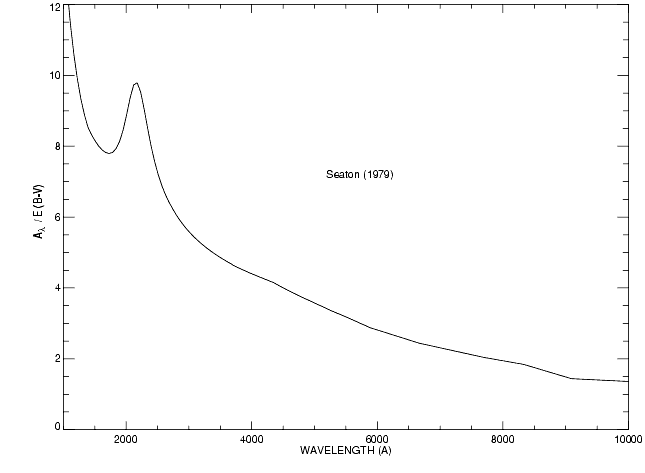
Extinction can dramatically alter the counts expected from your source, particularly in the ultraviolet. Figure 6.3 shows A
/E(B-V) values applicable to the Galaxy, taken from Seaton (MNRAS, 187, 73p, 1979).
Extinction curves, however, have a strong metallicity and environment dependence, particularly at the UV wavelengths. Sample extinction curves can be seen in Koornneef and Code, ApJ, 247, 860, 1981 (LMC); Bouchet et al., A&A, 149, 330, 1985 (SMC); and Calzetti, Kinney, and Storchi-Bergmann, ApJ, 429, 582, 1994, and references therein. At lower metallicities, the 2200 Å bump, which is so prominent in the galactic extinction curve, disappears and A
The easiest way to understand how to determine the extinction correction for your source is to work through an example; see Section 6.8.4. A choice of extinction laws is offered in the ETCs.
Figure 6.3: Extinction versus Wavelength
|
|||||
|
Space Telescope Science Institute http://www.stsci.edu Voice: (410) 338-1082 help@stsci.edu |