Space Telescope Imaging Spectrograph Instrument Handbook for Cycle 14
 |
 |
 |
 |
 |
|
| Space Telescope Imaging Spectrograph Instrument Handbook for Cycle 14 | |||||
| ||||||
1.1 Purpose
The STIS Instrument Handbook is the basic reference manual for the Space Telescope Imaging Spectrograph; it describes the instrument's properties, performance, operations, and calibration. The Handbook is maintained by the Spectrographs Group at STScI. Wherever possible, the most recent operational data have been incorporated into this revised edition.
We have designed the document to serve three purposes:
- To provide instrument-specific information for preparing Phase I STIS observing proposals.
- To provide instrument-specific information to support the design of Phase II proposals for accepted STIS programs.
- To provide technical information about the performance and operation of the instrument that can help in the understanding of problems and in the interpretation of data acquired with STIS.
This Handbook is not meant to serve as a manual for the reduction and analysis of data taken with STIS. The
HST Data Handbook(available from the STScIHelp Deskor theSTIS World Wide Web site) describes how to work with STIS data.1.1.1 Document Conventions
This document follows the usual STScI convention in which terms, words, and phrases which are to be entered by the user in a literal way on an HST proposal are shown in a typewriter font (e.g.,
STIS/CCD,SHADOW). Names of software packages or commands (e.g., calstis) are given in boldface.Wavelengths in this Handbook and in STIS data products are always measured in vacuum conditions. Wavelength units in this Handbook are in Angstroms (Å).
1.1.2 Examples Used in this Handbook
The Handbook uses six observational examples to illustrate various scenarios such as calculation of exposure times, estimation of overheads, etc. throughout the text. The examples are:
- Long-slit optical spectroscopy of the nearby galaxy NGC 4406 (M86).
- Long-slit optical and ultraviolet spectroscopy and optical imaging of NGC 6543, the Cat's Eye planetary nebula.
- First-order low-resolution spectroscopy covering STIS's full wavelength range from 1,150 Å in the UV to 10,300 Å in the near-IR of the continuous viewing zone (CVZ) solar analog star P041-C.
- Echelle spectroscopy of the O-type star Sk-69°215 in the Large Magellanic Cloud (LMC), a target in the CVZ.
- Deep optical imaging of a random field.
- Time-resolved ultraviolet spectroscopy of the flare star AU Mic.
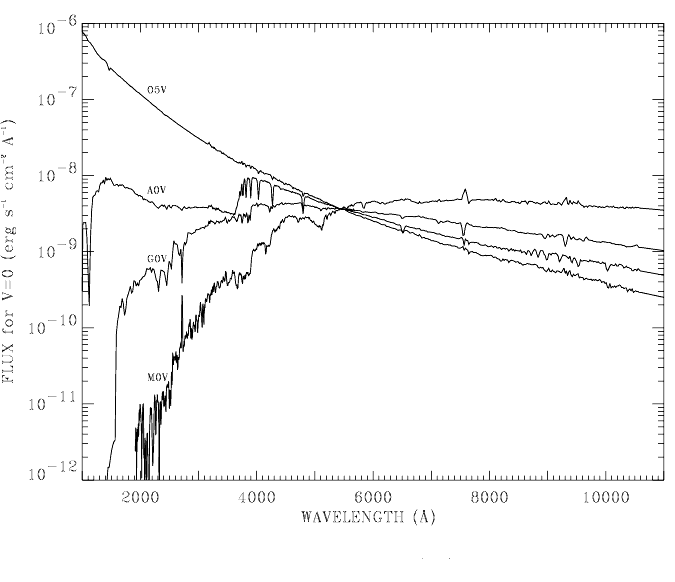
In addition, we use stellar spectra throughout the Handbook to illustrate signal-to-noise ratio calculations and derive limiting magnitudes. Figure 1.1 shows the normalized spectra of O, A, G, and M stars from an observed catalog of stars (for details, see Buser, 1978, A&A, 62, 411) which are used in the Handbook examples.
Figure 1.1: Spectra of O5V, A0V, G0V, and M0V stars normalized at 5550 Å used throughout the Handbook. Note the dramatic differences in the UV properties.
|
|||||
|
Space Telescope Science Institute http://www.stsci.edu Voice: (410) 338-1082 help@stsci.edu |