Space Telescope Imaging Spectrograph Instrument Handbook for Cycle 14
 |
 |
 |
 |
 |
|
| Space Telescope Imaging Spectrograph Instrument Handbook for Cycle 14 | |||||
| ||||||
A.2 Full Aperture Complement
The STIS aperture wheel has 65 positions, several of which correspond to multiple slits or masks. Only a small fraction of the full complement of spectroscopic apertures are currently supported. Table A.1 provides a complete list of STIS apertures for spectroscopy, together with comments regarding their characteristics or purposes. Schematics of three complex apertures are given in Figure A.1, Figure A.2, and Figure A.3.
Figure A.1: Schematic Showing the 52x 0.1" Long Slit with 3 Occulting Bars.
Table A.1: STIS Spectroscopic Apertures. Supported apertures are in boldface. For most apertures, the name gives the length by the width in arcseconds.Apertures Comments 52X0.05 52X0.1 52X0.2 52X0.5 52X2 Long slits; the names give the length in the spatial direction by the width in the dispersion direction in arcseconds. 52X0.05E1 52X0.1E1 52X0.2E1 52X0.5E1 52X2E1 Long slits centered at 19.7 arcsec in +Y position. (Places compact target at row ~900 on the CCD to reduce CTE losses.). Supported with all CCD gratings. Use with the MAMAs is not allowed. 52X0.2E2 52X0.5E2 52X2E2 These CTE aperture positions are also centered near row 900 on the STIS CCD detector. However, the positions are offset from the physical aperture centers to give better alignment with fringe flats done using the 52X0.1aperture. The E2 positions are supported for theG750LandG750Mgratings only.52X0.05D1 52X0.1D1 52X0.2D1 52X0.5D1 52X2D1 These aperture positions put a target near the bottom edge of the FUV-MAMAand are intended for observation of very faint targets where it is necessary to minimize the contribution of theFUV-MAMAdark current. They are all supported with theG140LandG140Mgratings.52X0.05D1and52X0.1D1are also supported for CCD peakups.52X0.05F1 52X0.05F2 52X0.1F1 52X0.1F252X0.2F152X0.2F2 52X0.5F1 52X0.5F2 52X2F1 52X2F2Fiducial bars on the long slits which can be used for coronagraphic spectroscopy. The 52X0.2F1is supported for all first-order gratings and is available-but-unsupported for thePRISM. The other fiducial bars are available-but-unsupported with all gratings and thePRISM. The F1 and F2 bars are 0.5" and 0.86" long, respectively (see Figure 13.1).52X0.1B0.5 52X0.1B1.0 52X0.1B3.0A long slit with 3 fiducial bars where the bar length in arcseconds is given by the third dimension. See Figure A.1. 31X0.05NDA 31X0.05NDB 31X0.05NDCNeutral-density-filtered long slits of the given dimensions in arcsec, which may be used for bright objects or flat-field calibration. The dex ND factors are 0.4, 0.8, and 1.2, respectively. 0.5x0.5 2X2 6X6Square apertures of the given dimensions in arcsec. 0.1X0.03 0.1X0.06 0.1X0.09 0.1X0.2 0.2X0.06 0.2X0.09 0.2X0.2 0.2X0.5 0.3X0.06 0.3X0.09 0.3X0.2 1X0.06 1X0.2 6X0.06 6X0.2 6X0.5 0.2X0.05ND 0.3X0.05ND As of Cycle 12, the 0.2X0.2aperture is supported for use with all first-order gratings; it is available-but-unsupported with the PRISM. While not supported for first-order observations, the other echelle apertures can be used in first order as available-but-unsupported apertures. This includes the echelle neutral-density slits0.2X0.05NDand0.3X0.05NDwith dex ND factors of 2.0 and 3.0, respectively.25MAMA 50CCD Supported full-field clear apertures. F25QTZ F25SRF2 F25QTZandF25SRF2are supported for all MAMA gratings andPRISM,but are unavailable with the CCD.25MAMAD1 F25SRF2D1 F25QTZD1 These aperture positions put a target near the bottom edge of the FUV-MAMAand are intended for observation of very faint targets where it is necessary to minimize the contribution of theFUV-MAMAdark current. They are all supported with theG140LandG140Mgratings.F25ND3 F25ND5 F25NDQ1 F25NDQ2 F25NDQ3 F25NDQ4 Supported neutral-density filters for MAMA detectors. Can be used as available-but-unsupported apertures with the CCD gratings. The numbers give the dex ND factors. F25MGII F25CN270 F25CIII F25CN182F25MGIIis supported and these other filters are available -but-unsupported with theNUV-MAMAgratings andPRISMonly.F25LYAThe F25LYAfilter is available-but-unsupported with theG140L,G140M,E140H, andE140Mgratings only.F28X50LP F28X50OII F28X50OIIIThese CCD imaging filters are available-but-unsupported with the CCD gratings, but are unavailable with the MAMA detectors. 36X0.05P45 36X0.05N45 36X0.6P45 36X0.6N45Long slits of the given dimensions in arcsec which are inclined at ±45° to facilitate observations of moving targets at off-nominal rolls. See Figure A.1. 0.1X0.03 0.1X0.060.1X0.09 0.1X0.2The latter two are supported with E230Honly. The0.1x0.03is supported with all echelle gratings.0.2X0.06 0.2X0.09 0.2X0.2 0.2X0.50.2X0.06and0.2X0.2are supported withE230MandE140M, while0.2X0.09and0.2X0.2are supported withE230HandE140H.0.2X0.06FP 0.2X0.2FP Masks with five apertures, suffixed A through E, for reduction of fixed-pattern noise; see Figure A.3. 0.2X0.05ND 0.3X0.05ND Neutral-density slits. Dex ND factors are 2.0 and 3.0, respectively. 0.3X0.06 0.3X0.09 0.3X0.2 0.5X0.5 1X0.06 1X0.2Miscellaneous available-but-unsupported echelle apertures. 2X2 6X0.06 6X0.2 6X0.5 6X6 The 6X0.2long slit is supported with the echelles.52X0.05 52X0.1 52X0.2 52x0.5 52X2Long slits for use with the echelles. 52X0.05is supported, and the others are available-but-unsupported with the echelle gratings.52X0.05F1 52X0.05F2 52X0.1F1 52X0.1F2 52X0.2F1 52X0.2F2 52X0.5F1 52X0.5F2 52X2F1 52X2F2 The fiducial bar slits are available-but-unsupported with the echelle gratings. 52X0.1B0.5 52x0.1B1.0 52x0.1B3.0 A long slit with 3 fiducial bars. The bar length in arcseconds is given by the third dimension. See Figure A.1. 31X0.05NDA 31X0.05NDB 31X0.05NDCNeutral-density-filtered long slits, which may be used for bright objects. The dex ND factors are 0.4, 0.8, and 1.2, respectively. 25MAMA Full-field clear aperture. F25QTZ F25SRF2 Supported long-pass filters, with all echelles. F25ND3 F25ND5 F25NDQ1 F25NDQ2 F25NDQ3 F25NDQ4 Supported neutral-density filters for MAMA detectors.The numbers give the dex ND factors. F25MGII F25CN270 F25CIII F25CN182Narrow-band filters. F25MGIIis supported forE230HandE230M. Others are available with theNUV-MAMAonly.F25LYA Available-but-unsupported with the FUV-MAMAonly.36X0.05P45 36X0.05N45 36X0.6P45 36X0.6N45Long slits which are inclined at ±45° to facilitate observations of moving targets at off-nominal rolls. See Figure A.2.
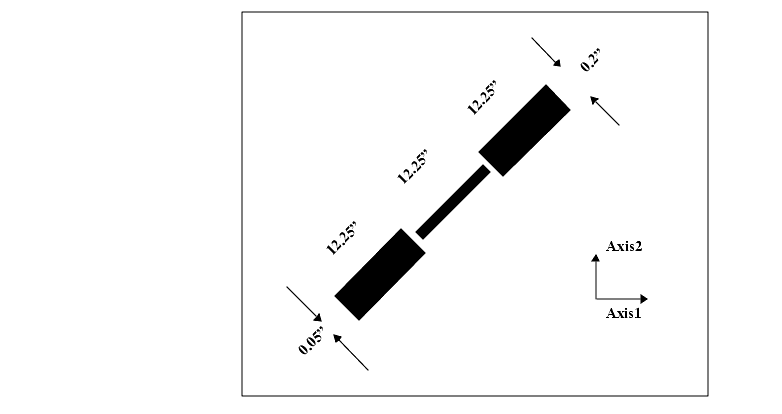
Figure A.2: Schematic Showing the STIS 45° Slits Design. A second pair has the same morphology but widths of 0.6" (central) and 2.0" (peripheral).
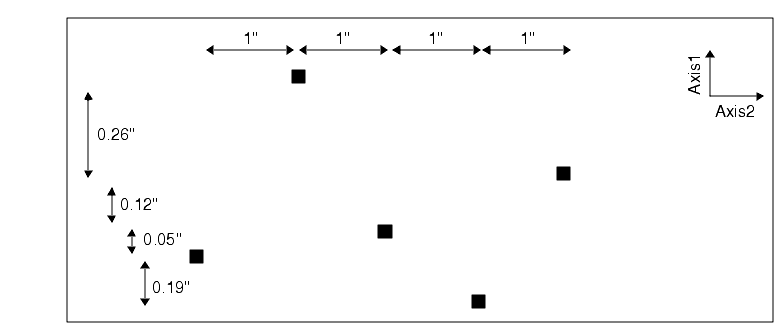
Figure A.3: Schematic Showing the Configuration of the Fixed-Pattern Slits. There are two sets with slit widths of 0.06" and 0.2", and lengths of 0.2" in both cases. Axis1 corresponds to the dispersion direction.
The 45° slits (Figure A.2) are nominally inclined at plus or minus that angle with respect to the dispersion and normal long slit, in order to increase the scheduling flexibility for moving-target observations with specified position angles. Otherwise, the HST roll angle constraints severely limit the windows for such observations. These slits have different widths in their central and outer segments, and there are two pairs with different dimensions.
The fixed-pattern slits (Figure A.3) comprise two masks with five apertures each, which are spaced to place the spectrum at different detector locations designed to optimize the reduction of fixed-pattern noise. The target is moved from one aperture to another, and the slit wheel is repositioned, with the intention that the spectrum shifts along the dispersion direction only. See Section 12.5.2 for further details.
It is not feasible to provide detailed transmission properties of all of the unsupported apertures at this time. They can in many cases be estimated from the data provided for similar supported apertures in Chapter 13, and from the imaging data in Table 14.38.
|
|||||
|
Space Telescope Science Institute http://www.stsci.edu Voice: (410) 338-1082 help@stsci.edu |