Cosmic Origins Spectrograph Instrument Handbook for Cycle 17
 |
 |
 |
 |
 |
|
| Cosmic Origins Spectrograph Instrument Handbook for Cycle 17 | ||||
|
7.3 How Accurate an Acquisition Do I Need?
7.3.1 Centering accuracy and photometric precision
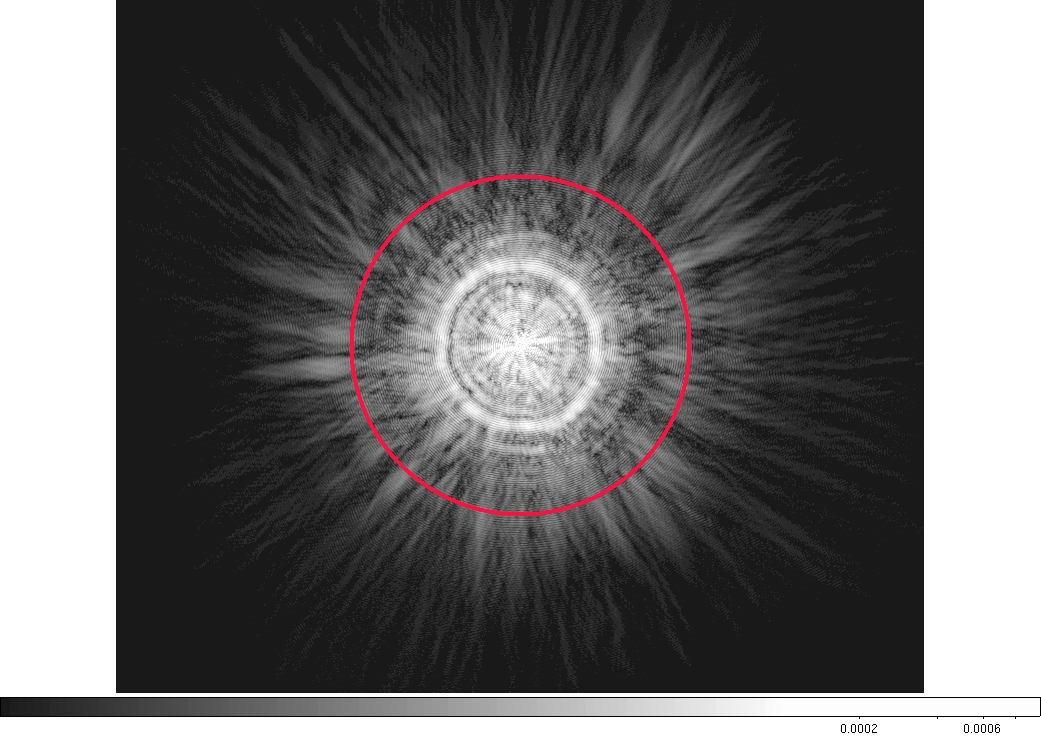
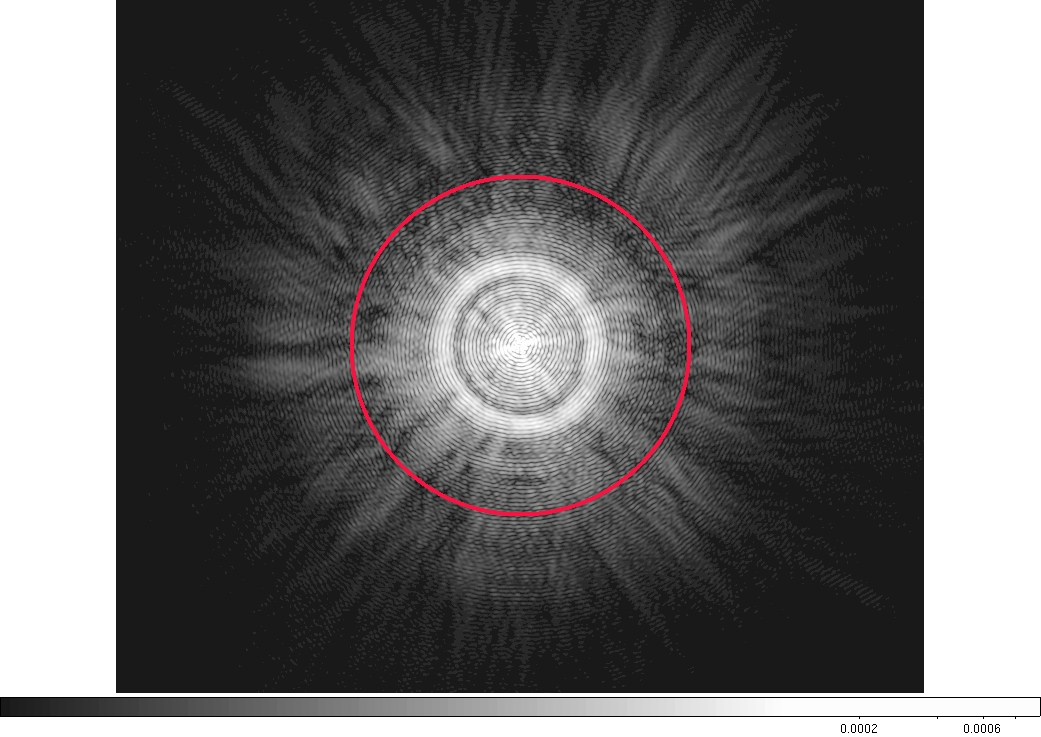
Figure 7.1 and Figure 7.2 show the HST point-spread function (PSF) at the nominal position of the COS aperture. Note that this is an aberrated PSF that includes spherical aberration. The COS Primary Science Aperture (PSA) is 2.5 arcsec in diameter, and it passes 95.4% of the total flux from a point source when that source is perfectly centered.
Figure 7.1: The HST Point Spread Function at the COS PSA for 1450 Å.
Note that the COS apertures lie near, but not in the HST focal plane, and their location was chosen to maximize throughput. These images were calculated with TinyTim and are for 1450 Å (left) and 2550 Å (right). Note that these images are stretched to show the light in the outer regions. The energy contained within the 2.5 arcsec PSA (red circle) is 95.4%.
Figure 7.2: The HST Point Spread Function at the COS PSA for 2550 Å.
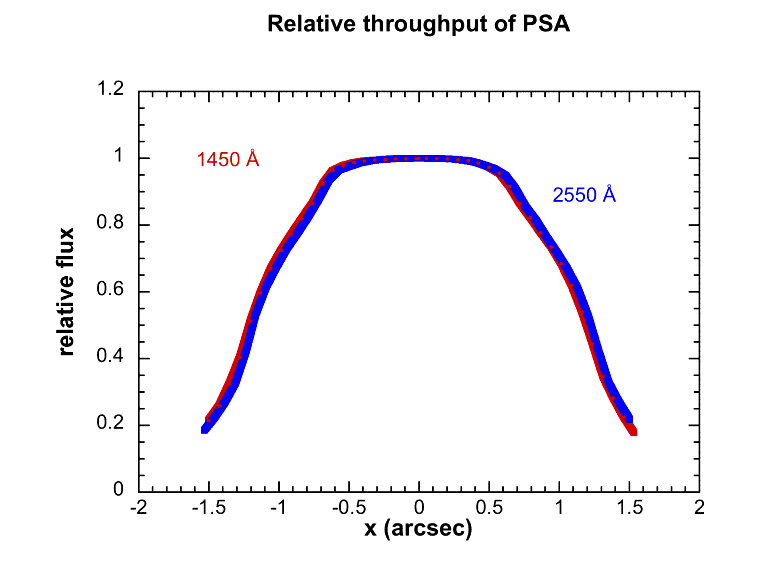
Figure 7.3: Relative transmission of the COS PSA at 1450 and 2550Å.
The transmission is shown as a function of displacement from aperture center. The calculation was done for a point source and for the HST PSF at 1450 and 2550 Å. Note that the absolute transmission with a point source centered is approximately 95.4%
.
Figure 7.3 and shows the relative transmission of the PSA as a function of displacement of a point source from the aperture center, computed using the PSFs in Figure 7.1 and Figure 7.2. Obviously any mis-centering of a source leads to some loss of throughput, but that loss is less than 1% if the source is within 0.4 arcsec of aperture center and is less than 5% if the displacement is less than 0.65 arcsec. In other words, the signal-to-noise achieved in an observation is little affected by centering errors.
7.3.2 Centering accuracy and the wavelength scale
If an accurately wavelength-calibrated spectrum is desired, one wants the error contribution from mis-centering to be low compared to other sources of uncertainty. For NUV
ACQ/IMAGEacquisitions, a resel (resolution element) is 3 × 3 pixels. If we then wish to center to within 1 pixel, that corresponds to about 1/40 arcsec (the actual plate scale is 42.3 NUV pixels per arcsec). Simulations of COS acquisitions have been calculated that show that a centering precision of about 0.02 arcsec is, in fact, feasible.Dispersed-light acquisitions, whether with the FUV or NUV detector, are unlikely to achieve such a high pointing precision without requiring a substantial amount of time. This is because dispersed-light acquisitions require movements of HST, and those need finite times. Simulations of dispersed-light acquisitions have used 0.1 arcsec as a centering tolerance and can achieve that in reasonable times, as discussed below.
As just noted, the throughput of COS is little affected by mis-centering of the source, and so a very high centering precision is not necessary if your science goals do not require a good wavelength zero point. For example, the spectra of some objects may include foreground interstellar absorption lines that can serve to establish relative velocities.
7.3.3 Centering accuracy and spectroscopic resolution
The plot below shows the effect on spectroscopic resolving power of displacing a point source in the PSA. The measurements were made during ground tests on grating G130M, and the results agree with calculations done from ray tracing. The net effect is that there is no loss of spectroscopic resolution with a displacement as large as 0.5 arcsec.
Figure 7.4: Spectroscopic resolving power versus source displacement in the aperture for grating G130M.
Space Telescope Science Institute
http://www.stsci.edu
Voice: (410) 338-1082
help@stsci.edu