Cosmic Origins Spectrograph Instrument Handbook for Cycle 17
 |
 |
 |
 |
 |
|
| Cosmic Origins Spectrograph Instrument Handbook for Cycle 17 | ||||
|
5.6 Internal Wavelength Calibration Exposures
Three types of internal wavelength calibration exposures may be inserted in the observation sequence by the scheduling system or by the observer:
FLASH=YES(so-called TAGFLASH) lamp flashes (TIME-TAGobserving only),- AUTO wavecals, and
- User-specified wavecals.
Note that all wavelength calibration exposures are taken in
TIME-TAGmode. Wavelength calibration exposure overheads are higher when the BOA is used for science observation as the aperture mechanism must be moved farther to place the WCA in the wavelength calibration beam.For
TIME-TAGobserving, we strongly recommend usage of the defaultFLASH=YESmode of wavelength calibration.5.6.1 What "TAGFLASH" does during TIME-TAG observations
Optional Parameter
FLASH(=YES(default),NO) indicates whether or not to "flash" the wavelength calibration lamp duringTIME-TAGexposures. These flashes are needed to provide information used by the calcos pipeline to compensate for the effect of post-move drift of the Optic Select Mechanisms. The default behavior will be that when the external shutter is open, the wavecal lamp is turned on briefly at the start of an externally targeted exposure, and at intervals later in the exposure. In this mode, photons from the external science target and the internal wavelength calibration source are recorded simultaneously on different portions of the detector. Other than the flash at the start of each exposure, the actual timing of flashes is determined by the elapsed time since the last OSM move has occurred. As a result, flashes may occur at different time-points in different exposures. The grating-dependent "flash" durations (discussed below) and the time-since-last-OSM-move-dependent flash intervals will be defined and updated as necessary by STScI. Observers may not specify either flash duration or flash interval.
FLASH=YESTIME-TAGsequences provide the highest amount of on-target exposure time per orbital visibility as no on-target time is lost due to required instrumental calibration exposures.When flashing is enabled, the exposure time must be at least as long as a single flash.
FLASHmay not be specified, and defaults toNO, when aperture BOA is selected.FLASHalso may not be specified forACCUMmode.The details of how TAGFLASH works
When an object is observed through the PSA, light from the Pt-Ne lamps can pass through the WCA and illuminate a portion of the detector separate from the science spectrum. When an external source is observed through the BOA, the Pt-Ne wavecal beam is blocked from reaching the active area of the detector, hence TAGFLASH is available only for PSA observations.
The lamp flash durations required to obtain a sufficient signal level to determine a usable wavelength calibration offset are grating dependent and are given in Table TBD.
Every COS TAGFLASH exposure begins with a lamp flash. Depending upon the length of the exposure and the time since the last major OSM movement, one or more lamp flashes may be inserted at intermediate times during an exposure. Also, depending upon the proximity of the most recent flash, a lamp flash may be inserted at the very end of an exposure.
The first step in the process of specifying the placement of lamp flashes within any particular science exposure involves the determination of length of time, tsince, that has elapsed since the last major OSM move and the start of the science exposure.
The first step is to determine tsince for the start of the exposure. Determine the interval (1,2,3,...,n) from Table 5.1 in which the start of the exposure occurs. For the first exposure after a major OSM move only, reset the value of tsince to be the time tint in Table 5.1 at the start of this interval, and also align the relative times so that tint corresponds to the beginning of the science exposure. For all subsequent exposures with the same optical element, again determine the time interval from Table 5.1 in which the start of the exposure occurs and reset the timeline to align the exposure start with the tint of that interval, but do not reset tsince. (In nearly all cases for COS, the initial tsince of the first exposure will fall in the first interval of Table x.1, such that the value of tsince will be reset to the start of interval 1 or to a value of 0.)
A complete list of times of TAGFLASH lamp flashes, in exposure elapsed time, is given in Table 5.2 below as a function of exposure duration for exposures starting in each tsince interval.
The following section provides important definitions and describes the detailed rules employed for placement of lamp flashes within a TAGFLASH exposure. The exposure times for the lamp flashes are provided in the COS chapter of the Phase II Proposal Instructions.
Detailed Definitions and Rules for Lamp Flash Sequences
Definitions:
texp = duration of science exposure
tsince = wall-clock time since last major (grating-grating) OSM move (tsince is not reset after central wavelength changes or FP-POS moves.)
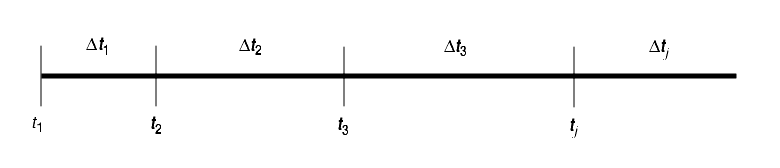
tj = time at beginning of time interval j; also time at beginning of scheduled flash j
fj = fraction of interval j to be used to check if flash at exposure end is needed; 0
fj
tj = time between scheduled flashes j and j + 1.
Rules:
Figure 5.1: Schematic of a TAGFLASH timeline.
- At the start of the first science exposure after a major OSM move, intercept the timeline shown in Figure 5.1 below such that ti
Each of the t values represents a flash of the calibration lamp.
- Flash the lamp at the beginning of each science exposure. The beginning of the lamp flash should coincide as closely as possible with the beginning of the science exposure. Due to latency in lamp discharges, some flashes may be delayed approximately one second.
- Insert intermediate lamp flashes as scheduled in the TAGFLASH Interval Table (Table 5.1 below) for flashes scheduled to occur before the end of the science exposure. A caveat to this rule concerns the case where an intermediate lamp flash might extend past the end of an exposure. In that case, the start of the lamp flash is moved earlier such that its end coincides as closely as possible to the end of the science exposure.
- Insert flash at the end of the science exposure only if (texp - ti)
fi
- The minimum allowable TAGFLASH exposure duration is 120 seconds.
- If the rules above produce two lamp flashes that overlap in time, only the later flash should be executed at its nominal time of execution.
tsince is reset only for the first exposure after a major OSM move (rule 1). Therefore, the internal flash patterns of identical exposures obtained in sequence may be different; more flashes potentially occurring in the earlier exposures in the sequence. This allows efficient tracking of the approximately exponential decay of the OSM drift while using a minimum number of flashes so as to preserve lamp lifetime.
Table 5.1: TAGFLASH intervals Interval times and relative interval times are in seconds.
Table 5.2: Times of TAGFLASH lamp exposures. Given are elapsed times (in seconds) as a function of exposure duration for exposures that begin in the specified tsince interval.
5.6.2 AUTO wavecals (when "Tagflash" is not used)
For
TIME-TAGexposures, specifyingFLASH=NOdisables automatic flashing for the current exposure. Also, flashes are not performed inACCUMexposures.In these cases, unless specifically requested in the Exposure Specification, a separate
TIME-TAGMode wavelength calibration exposure will be automatically performed (AUTOwavecal) for each set of external spectrographic science exposures using the same spectral element, central wavelength, and OSM offset (FP-POS), including each sub-exposure of an exposure specification with Optional ParameterFP-POS=AUTO. These AUTO wavecals are always obtained inTIME-TAGmode with the external shutter closed. This automatic wavelength calibration exposure will be added prior to the first such science exposure and after each subsequent science exposure if more than 40 minutes of visibility time has elapsed since the previous wavelength calibration exposure. The calibration exposure will often use some science target orbital visibility. The calibration lamp configuration and exposure time will be based on the grating and central wavelength of the science exposure. Utilization of a GO wavecal (see below) resets the 40 minute interval timer. Insertion of aFLASH=YESexposure in the time-line does not affect the 40-minute clock.For
TIME-TAGFLASH=NOand forACCUMobservations,AUTOwavecals may not be turned off by the observer. If there is a science requirement to turn offAUTOwavecals, specific permission must be sought from the STScI Contact Scientist.
ACCUMandTIME-TAG FLASH=NOobservations will be less efficient thanFLASH=YES TIME-TAGobservations in terms of on-target utilization of orbital visibility and in terms of resultant wavelength calibration due to possible OSM motions.5.6.3 User-specified wavelength calibration exposures (GO wavecals)
Observers may insert additional wavelength calibration observations in the visit by specifying target=
WAVE(so-called GO wavecal exposures). Exposure time must be set toDEFfor these exposures,TIME-TAGmust be used, andFLASH=NOshould be explicitly selected. Exposures specified with the WAVE internal target will use the same calibration lamp configuration and exposure time as the automatic wave calibrations discussed above. Note: the default isFLASH=YES, which will result in the calibration lamp being flashed rather than commanded continuously on for the exposure. Initially, lamp flash durations are identical to the required default wavelength calibration exposure times, however this identity may be changed.
|
Space Telescope Science Institute http://www.stsci.edu Voice: (410) 338-1082 help@stsci.edu |
| |
|
|
|
|