|
|

1. Overview
The Cosmic Origins Spectrograph (COS) is a fourth-generation instrument to be installed on the Hubble Space Telescope (HST) during Servicing Mission 41. COS is designed to perform high sensitivity, medium- and low-resolution spectroscopy of astronomical objects in the 1150-3200 Å wavelength range. COS will significantly enhance the spectroscopic capabilities of HST at ultraviolet wavelengths, and will provide observers with unparalleled opportunities for observing faint sources of ultraviolet light. COS is not meant to be a replacement for the Space Telescope Imaging Spectrograph (STIS), which will remain in HST after the servicing mission2. Both instruments have unique capabilities, which we briefly summarize and compare in this document.
1.1 Instrument Overview
COS has a simple optical design that minimizes the number of reflections required to disperse and detect ultraviolet light in its two optical channels. COS has especially high throughput in the far ultraviolet, below about 2050 Å. The instrument is designed for high-throughput spectroscopy of point sources. It may also be used to observe extended objects, but with limited spatial information and significantly degraded spectral resolution.
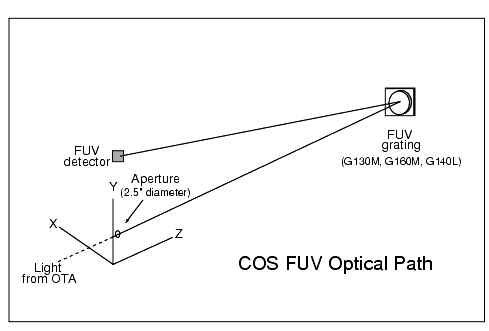
Light enters COS through one of two 2.5 arcsec diameter circular apertures and encounters an optical element that enables far-ultraviolet (FUV; 1150 <
Figure 1: The COS FUV optical path. Only one reflection is required to place the dispersed light onto the FUV microchannel plate detector. An optic selection mechanism configures one of the gratings for the observation. A mirror can also be inserted in place of the FUV grating to divert light into the COS NUV channel.< 2050 Å) or near-ultraviolet (NUV; 1700 <
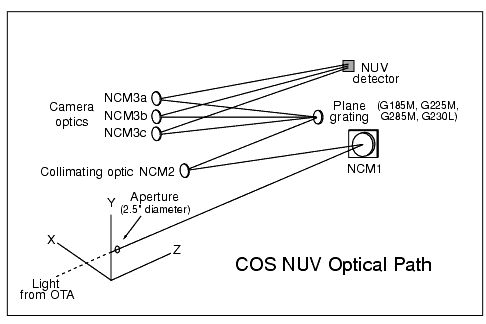
Figure 2: The COS NUV optical path. Four reflections are required to place the light onto the NUV MAMA detector. The NCM1 mirror is placed in the light path by the FUV optical element selection mechanism.Light entering the NUV channel encounters four optical elements (3 mirrors and a holographically-ruled plane diffraction grating) before reaching a multi-anode microchannel array (MAMA) detector. The larger number of reflections reduces the throughput of this channel compared to the FUV channel, but allows for a compact Czerny-Turner design. The COS NUV optical path is illustrated schematically in Figure 2. A second optic selection mechanism specific to this channel configures either a low-dispersion grating or one of three medium-dispersion plane gratings for spectroscopic observations. An additional optical element, a target acquisition mirror, can be placed in the light path in place of the grating to perform imaging target acquisitions or to obtain target confirmation images.
1.2 STScI Contact Information
Table 1 lists the COS contacts in the Instrument Division at STScI. Observers seeking more detailed information about the COS instrument performance or operations should contact one of the COS instrument scientists. Observers may also direct questions to the Help Desk at STScI. To contact the Help Desk,
Send E-mail to:
help@stsci.eduPhone: 410-338-1082
Table 1: COS Instrument Division Contacts at STScI1.3 The COS Instrument Definition Team
The COS Instrument Definition Team (IDT) is responsible for the development, management, and scientific oversight of COS prior to launch. The COS IDT has approximately 550 orbits of guaranteed observing time with the instrument. The IDT observing time will occur primarily in Cycle 17, with a portion of the time remaining for observations in Cycles 18 and 19. Key personnel on the COS IDT include:
- Principal Investigator: James Green (University of Colorado)
- Project Scientist: Cynthia Froning (University of Colorado)
- Co-Investigators: Dennis Ebbets (Ball Aerospace), Sara R. Heap (GSFC), Claus Leitherer (STScI), Jeffrey Linsky (University of Colorado), J. Morse (Arizona State University), Blair D. Savage (University of Wisconsin-Madison), J. Michael Shull (University of Colorado), Oswald Siegmund (University of California-Berkeley), Theodore P. Snow (University of Colorado), S. Alan Stern (Southwest Research Institute), and John T. Stocke (University of Colorado).
- Primary Contractor: Ball Aerospace, Boulder CO.
1.4 Handbook Information and Additional Resources
Resources used in the preparation of this document include COS OP-01 (Morse et al. 2002, Rev. 17 and references therein) and the STIS Instrument Handbook (Kim Ouijano et al. 2003, v7.0). We thank the COS IDT members for their assistance with the preparation of this document, particularly Erik Wilkinson, Jon Morse, and Steven Penton. Additional COS information and planning tools, including a link to a preliminary spectral simulator, can be found on the COS web page at:
1COS will be inserted into the HST bay currently housing COSTAR, the Corrective Optics Space Telescope Axial Replacement, which is no longer needed to correct for the spherical aberration in the HST primary mirror.http://www.stsci.edu/instruments/cos/.
2As this is written plans are also being made to repair STIS during SM4, restoring its unique capabilities to HST's repertoire.
|
Your Company Your Company's Web Site Voice: (555) 555-1234 Fax: (555) 555-5678 Your Company's E-mail Address |
|
|