HST Two-Gyro Handbook Update for Cycle 14 Phase II Proposals
 |
 |
 |
|
| HST Two-Gyro Handbook Update for Cycle 14 Phase II Proposals | |||
| ||||
1.4 Science Instrument Performance
Science instrument performance in two-gyro mode appears to be very similar to science instrument performance in three-gyro mode. Observers constructing their Cycle 14 Phase II programs should therefore use the three-gyro point spread function (PSF) properties specified in the individual Instrument Handbooks rather than the overly conservative two-gyro PSF properties adopted in Chapters 7-11 of the HST Two-Gyro Handbook. The Exposure Time Calculators for each instrument are being updated to reflect this change. Please note that there are still some two-gyro-specific issues related to NICMOS coronagraphy and FGS astrometry, as outlined in Chapters 9 and 11 of the HST Two-Gyro Handbook.
Advanced Camera for Surveys (ACS)
The two-gyro on-orbit tests included measurements of the ACS point spread function shape and stability, coronagraphic acquisition accuracy, and coronagraphic light rejection. The PSF tests included exposures with durations of 10, 100, and 500 seconds. Pointing stability within individual orbits was found to vary by less than a few milli-arcseconds from exposure to exposure. Instrument performance in two-gyro mode is indistinguishable from that in three-gyro mode. For information about the three-gyro performance, see the ACS Instrument Handbook.
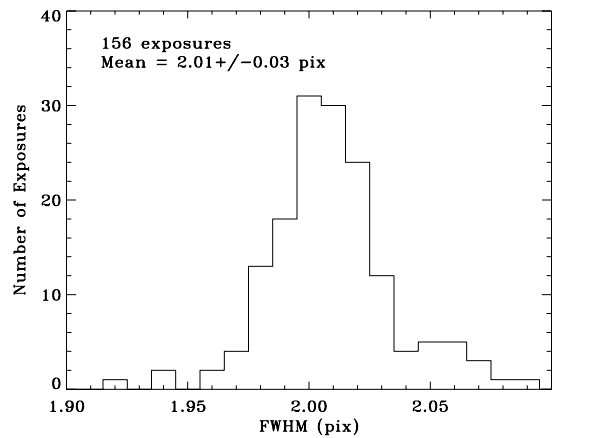
Figure 1.1: Two-Gyro ACS/HRC F555W Point Spread Function Widths.
The distribution of point spread function widths for 156 ACS/HRC F555W exposures of globular clusters NGC 6341 and Omega Cen is shown in Figure 1.1. The data for this plot were provided by the ACS Group as part of their early analysis of the two-gyro test observations. The PSF results do not depend strongly on FGS guide star magnitude or exposure duration. The average two-gyro ACS/HRC PSF width of 2.01±0.03 pixels is comparable to the three-gyro mean ACS/HRC PSF width of 1.99±0.02 pixels for a series of 18 F555W exposures of NGC 6341 several days before the two-gyro on-orbit test. The two-gyro PSF width is also well within the more extensive three-gyro historical average distribution of ACS/HRC PSF widths (2.04±0.03 pixels), which includes data taken at different focus positions and at different times over a period of several years. Note that the last HST focus update was performed in December 2004, so the two-gyro PSFs during the on-orbit test (and the preceding three-gyro comparison data for NGC 6341) tend to mimic the narrow end of the historical three-gyro PSF width distribution.
Near Infrared Camera and Multi-Object Spectrograph (NICMOS)
The two-gyro on-orbit tests for NICMOS included point spread function characterization, dither pattern functionality, coronagraphic acquisition accuracy, and coronagraphic light rejection. NICMOS instrument performance for all of these tests in two-gyro mode is indistinguishable from that in three-gyro mode. Observers filling out their Cycle 14 Phase II proposals should consult Chapter 9 of the HST Two-Gyro Handbook for restrictions on coronagraphic observations in two-gyro mode; in general, it will be possible to obtain NICMOS coronagraphic observations at only one field orientation within an orbit. For information about NICMOS performance in three-gyro mode, see the NICMOS Instrument Handbook.
Fine Guidance Sensors (FGS)
Several FGS science observations were performed as part of the two-gyro on-orbit test. These observations were used to check the pointing stability as measured by FGS tracking of guide stars. The FGS POS-mode data analyzed to date indicates that RMS pointing errors within an orbit are typically 3.0-3.5 milli-arcseconds for a range of guide star magnitudes. This performance is similar to that observed in three-gyro mode and is in good agreement with the jitter estimates from the gyro data. Observers filling out their Cycle 14 Phase II proposals should consult Chapter 11 of the HST Two-Gyro Handbook for restrictions on astrometric observations in two-gyro mode. For information about FGS performance in three-gyro mode, see the FGS Instrument Handbook.
|
Space Telescope Science Institute http://www.stsci.edu Voice: (410) 338-1082 help@stsci.edu |