


The F25QTZ filter with the NUV-MAMA provides high-throughput broad-band near-UV imaging with better rejection of geocoronal emission than the F25MAMA or F25SRF2 modes, the same field of view, and the same high spatial resolution.
Recommended for broad-band near-UV imaging of faint targets.
Sky background on the day side of the orbit contains a significant contribution from O II air glow emission at 2470 Å. In high-background conditions, the sky background can dominate the detector background. In average day-side observing conditions about half the background will be from the sky and half from detector dark current. Observers can limit the background (with some cost to the total amount of observing time per orbit) by using the DARKTIME special requirement.
Users should also consider whether the ACS HRC with the F220W or the F250W filter might be a better choice for their science goals.
| Pivot  (Å) (Å) |
FWHM (Å) |
AB mag zeropoint |
Speak |
B |
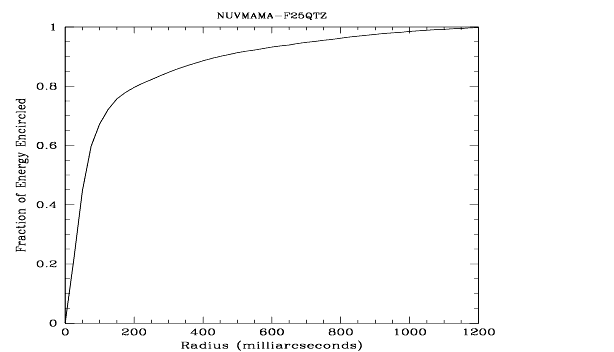
R80 (arcsec) |
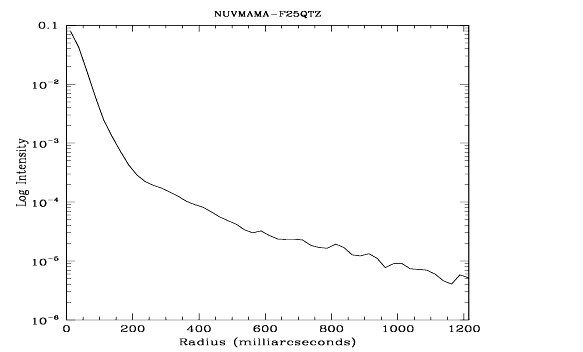
Flux in central pixel |
|---|---|---|---|---|---|---|
| 2364.8 |
995.1 |
23.781 |
1.54e+14 |
1089.1 |
0.32 |
8% |
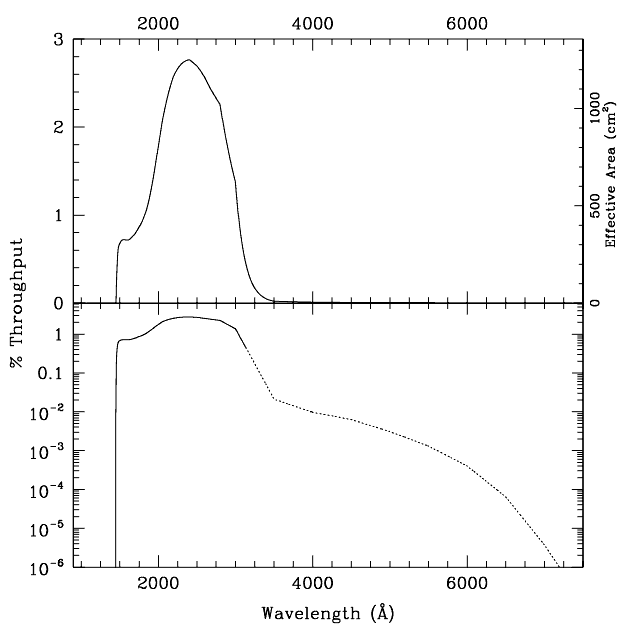
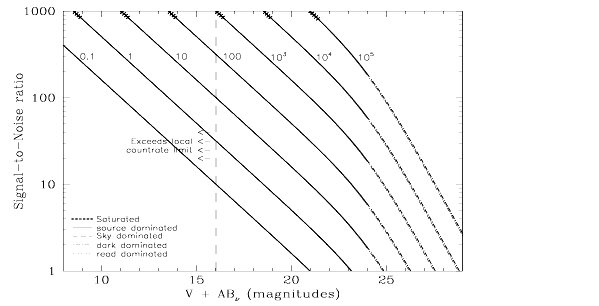
 for the F25QTZ NUV-MAMA mode. Top curves are for DARKTIME. Bottom curves are for average sky. Curves are labeled by required exposure time (sec).
 for the F25QTZ NUV-MAMA mode. Top curves are for an area of 0.2 arcsec2; bottom curves are for 1 arcsec2. Average sky assumed. Curves are labeled by required exposure time (sec).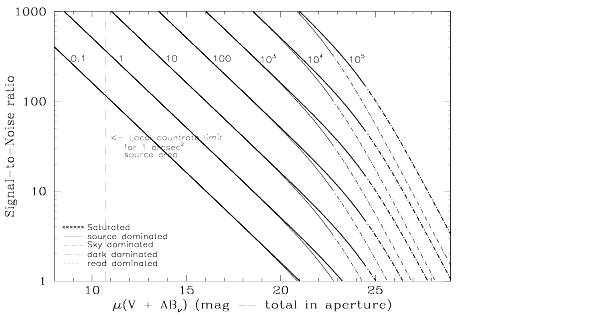
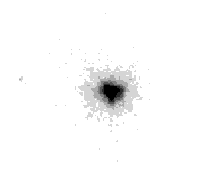
|
Space Telescope Science Institute http://www.stsci.edu Voice: (410) 338-1082 help@stsci.edu |