

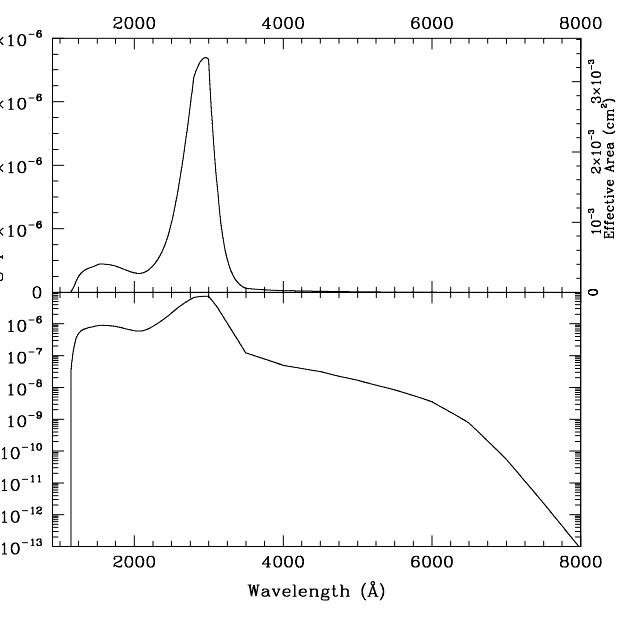
The F25ND5 mode with the NUV-MAMA provides broad band imaging with an attenuation of 5 x 10⁻⁶. The field of view is 25 x 25 arcsec. The value of R80 and the central pixel flux are unmeasured but assumed to be approximately the same as produced by the F25QTZ filter.
Recommended for broad-band near-UV imaging of objects too bright by 2 x 10⁵ for clear mode.
The throughput of the ND5 filter and NUV-MAMA combination relative to the unfiltered NUV-MAMA varies strongly as a function of wavelength. At wavelengths between 3000 and 5000 Å the attenuation factor is close to 5 x 10⁶. At shorter wavelengths the relative throughput can be a factor of ten or more smaller, while at longer wavelengths it is considerably larger, so special care should be taken for red sources. To make an accurate prediction of the expected count rate, observers should use a good approximation of the source spectrum as input for the STIS ETC.
| Pivot  (Å) (Å) |
FWHM (Å) |
AB mag zeropoint |
Speak |
B |
R80 (arcsec) |
Flux in central pixel |
|---|---|---|---|---|---|---|
| 2620.6 |
1514.7 |
9.185 |
5.01e+8 |
594.3 |
0.32 |
8% |
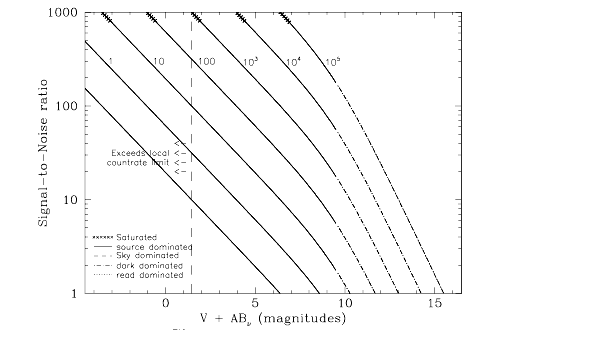
 for the F25ND5 NUV-MAMA mode. Top curves are for DARKTIME. Bottom curves are for average sky. Top curves are for DARKTIME. Bottom curves are for average sky. Curves are labeled by required exposure time (sec).
 for the F25ND5 NUV-MAMA mode. Top curves are for an area of 0.2 arcsec2; bottom curves are for 1 arcsec2. Average sky assumed. Curves are labeled by required exposure time (sec).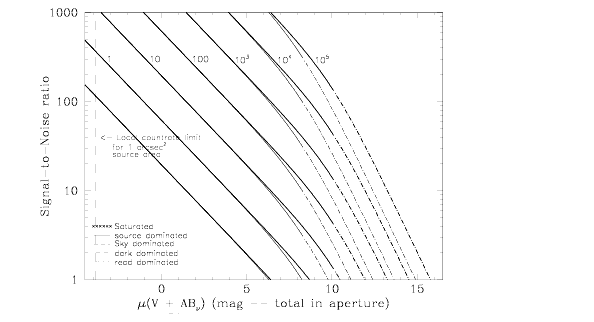
|
Space Telescope Science Institute http://www.stsci.edu Voice: (410) 338-1082 help@stsci.edu |