Space Telescope Imaging Spectrograph Instrument Handbook for Cycle 14
 |
 |
 |
 |
 |
|
| Space Telescope Imaging Spectrograph Instrument Handbook for Cycle 14 | |||||
| ||||||
First-Order Grating G140L
Description
The
G140Lgrating mode is used with theFUV-MAMA, has a resolving power R~1000, and covers a spectral range from 1150 to 1700 Å in a single exposure.Notice, that with two observations, one with
G140Land one withG230L, the full spectral region, from 1150 to 3100 Å can be efficiently observed at an R~1000.Recommended Uses
The
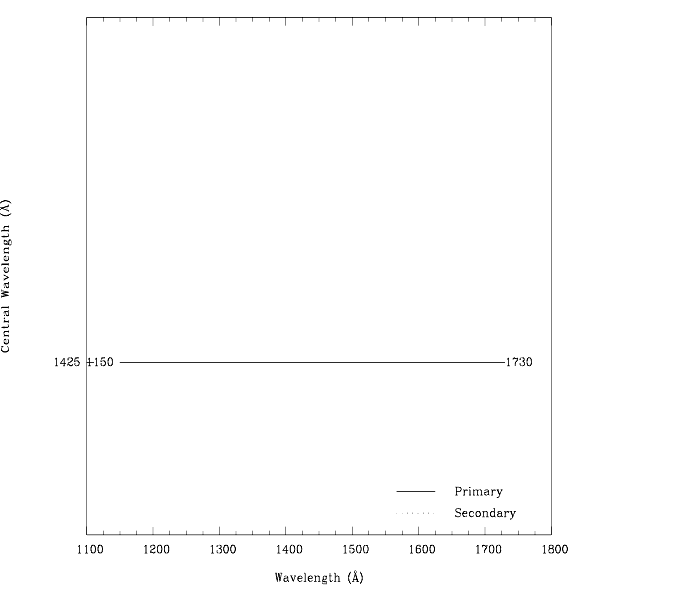
G140Lgrating mode is designed for observations where high spectral resolution is not required, but efficient, spatially resolved spectroscopy providing wide spectral coverage in the ultraviolet is desired.Figure 13.38: Wavelength Range for the G140L Grating Setting
Grating Average Dispersion (Å per Pixel) Plate Scale (arcsec / pixel) Central Wavelengths Complete Per Tilt G140L 1150-1730 Prime
G140L Sensitivity
Table 13.11: G140L Throughputs & Sensitivities for a Point Source
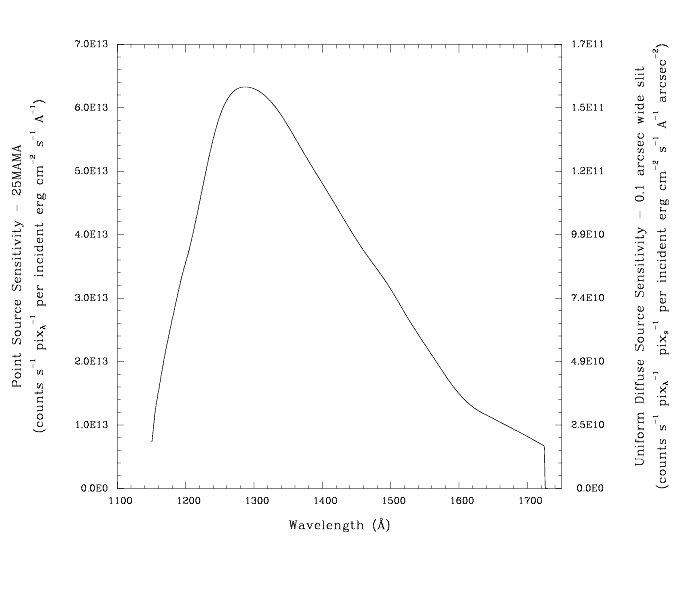
Figure 13.39: G140L Point Source (left axis) and Diffuse Source (right axis) Sensitivities.
Note
Point source sensitivity assumes full transmission (zero slit losses). Diffuse source sensitivity assumes a 0.1" wide slit. To convert point source sensitivities to diffuse source sensitivities multiply the point source values by the grating spatial plate scale in units of arcseconds per pixel and by the width of the desired slit in units of arcseconds.
G140L Signal-to-Noise
Note:
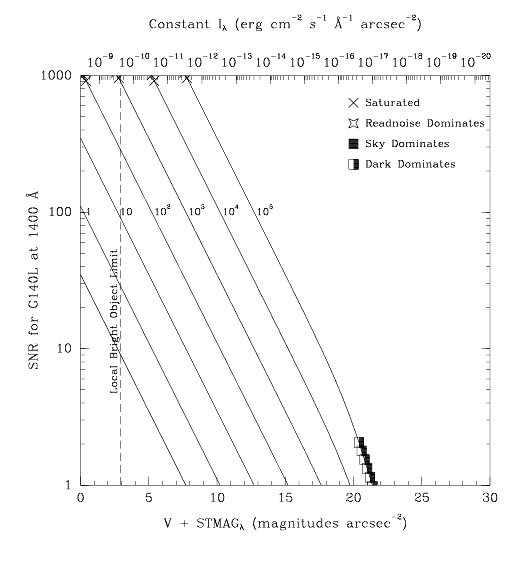
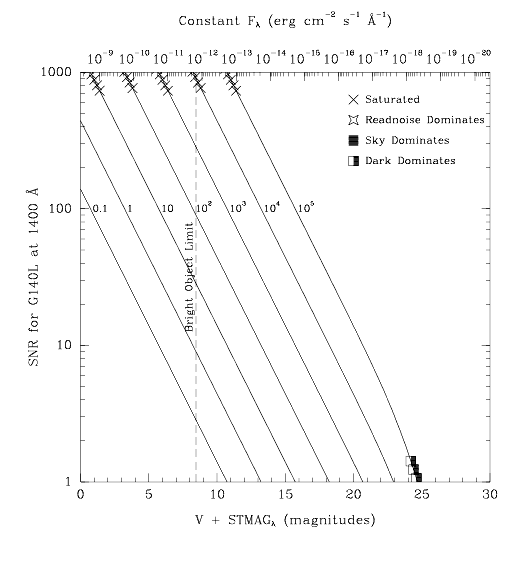
The top axis displays constant F
Figure 13.40: Diffuse Source Signal-to-Noise as a Function of STMAG for G140Lvalues corresponding to the STMAG units (V+STMAG
Figure 13.41: Point Source Signal-to-Noise as a Function of STMAG for G140L
|
|||||
|
Space Telescope Science Institute http://www.stsci.edu Voice: (410) 338-1082 help@stsci.edu |